Garage helps towns sell their old fire trucks and is valued at $225M. A great niche, or much bigger?
Why a used fire truck marketplace caught my eye
A startup that helps towns sell their old fire trucks just raised $41M at a $225M valuation.
I'm drawn to unglamorous markets like this, and to marketplaces in general. Back in 2020 I wrote that I've always been drawn to platforms, especially marketplaces, and to ones that help the little guys compete with bigger players. Garage is both.
Few people chase markets like this, so a company can build exactly what its customers need and charge a fair price without spending investor money on discounts. That also makes early traction easier to trust. When a town pays a 10% fee to sell its old truck, that's real demand, not demand bought with subsidies.
Garage is doing more than putting fire trucks online. It's turning a local market into a national one, where a truck worth $30,000 to one department can be worth $125,000 to another.
I like Garage a lot as a business but I'm less sure its growth rate tells us how big it can get, or that $225M is a bargain.
The short version
Garage is a three-year-old online marketplace where towns and businesses buy and sell used specialized trucks. It started with fire trucks and now also lists ambulances, garbage trucks, sewer trucks and dump trucks.
| Garage at a glance | |
|---|---|
| Founded | 2023, marketplace launched early 2024 |
| Sales through the site | Over $100M a year at today's pace, up more than 400% |
| Revenue | About $7M to $10M a year (my estimate) |
| Valuation | $225M (Series B, November 2026) |
| Raised | About $60M |
| Customers | 1,000+ communities in all 50 states and Canada |
| Team | 51 to 200 people, per its job listings |
| Average delivery | 1,400 miles, with over 90% of sales crossing state lines |
- It makes a local market national. A town replacing a fire truck used to sell the old one by phone or at a local auction, where few of the right buyers saw it. Garage shows it to departments across the country and handles the payment, paperwork and freight. It never owns the truck.
- A shortage made that matter. Three makers build most US fire trucks. A new engine now costs over $1M, about double 2020, and can take years to arrive. Used trucks got more valuable, and more towns shop for them.
- The scarce side is the seller. Thousands of departments want an affordable truck, but each town sells only now and then, usually after a council vote. Garage wins by becoming the place a town calls when it retires a truck.
- It keeps about 10% of each sale. That points to roughly $7M to $10M of revenue (my estimate, since Garage doesn't disclose it), so its valuation is about 22-32 times revenue. Whether that's a great business depends on their costs.
- Fire trucks alone have a ceiling. Garage may already rival the biggest used fire truck dealers. The next order of magnitude has to come from ambulances, garbage trucks, sewer trucks and categories it doesn't list yet, where GovDeals and RB Global are stronger.
- Its edge has to be habit. Agreements with towns aren't exclusive. The durable position is to become the software a town uses to manage and retire its equipment, the source it trusts on value and condition, and the place it sells.
I'm more bullish on Garage as a company than as a $225M investment. Growing to GovDeals' size, about $1B of sales a year, would build a valuable company but only a modest return for today's investors. My base case is a $500M-$1B company in about seven years. That's 2x-4x today's price, before further dilution, which is fine but not very exciting for the risk. Getting to $10B+ probably requires winning several equipment categories, and possibly using its resale data to finance and lease trucks.
Garage lets a town in Vermont sell its old truck to a buyer in Kansas
Fire trucks often live more than one life.
A well-funded city may replace an engine after 10-15 years while it still runs well. A smaller town buys it, and later a rural volunteer department might buy it again. Those lives have limits. The National Fire Protection Association, which writes the fire service's safety standards, recommends moving trucks older than 15 years to reserve duty and replacing them after 25, so an old truck that still runs isn't right for every department.
Those resales used to happen through phone calls, Facebook groups and local auctions. The right buyer for a Vermont tanker might be in Kansas, and nobody in Kansas would ever see it.
Garage puts the truck in front of buyers everywhere and handles the hard parts.
- Get a price. The seller lists for free, on its own or with Garage's team managing the listing. Garage's free appraisal tool gives an instant price, drawing on what it says are over 100,000 data points.
- Find the buyer. Buyers browse by type and state, read seller-provided details and book video walkarounds. They can buy now, make an offer or bid in an auction.
- Move the money and the title. Garage handles the payment and title transfer. Its buyer protection is aimed at transaction problems, like a truck that never ships or arrives significantly different from its listing. It isn't a mechanical warranty, and checking condition before buying is the buyer's job.
- Move the truck. A buyer enters a ZIP code and gets an instant delivery quote. Garage books a carrier from its network, insures every shipment for the truck's full value, and has zero logistics employees.
- Add the extras. Financing through a partner lender, with 1 to 15 year terms that can match a town's fiscal year. An optional extended warranty from Vital Trends. Third-party inspections, with a report in 5 to 7 business days.
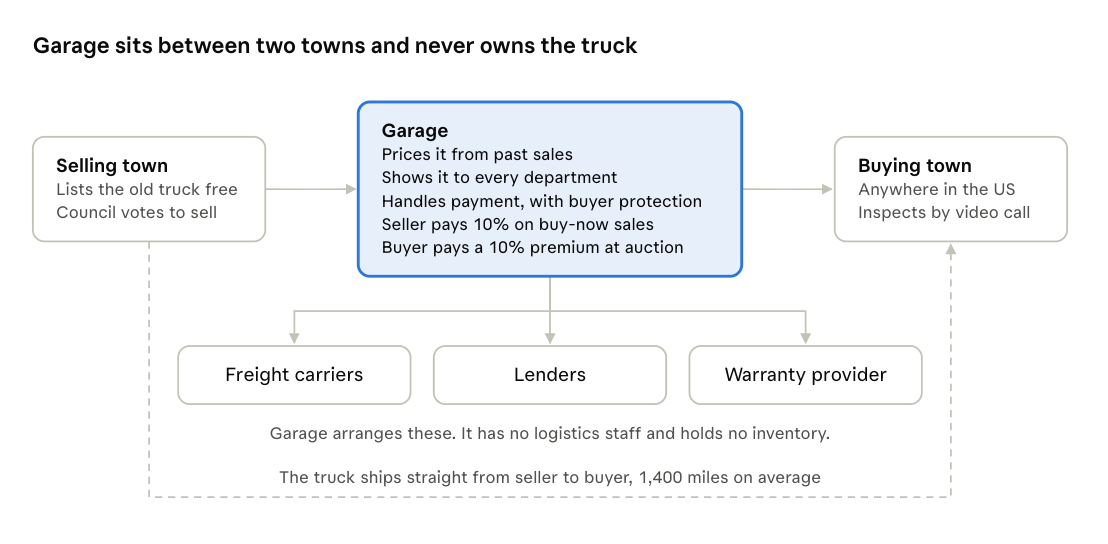
Why reach changes the price. Economists call this a thin market, meaning few buyers who each want something specific. Picture a 2005 tanker for sale in Vermont. Within driving distance there might be two departments that need one this year, and maybe neither has the budget. Across the country there might be twenty. The price is set by the most eager buyer who sees the listing, so going from two bidders to twenty can multiply the price, not just nudge it. In a market with plenty of buyers, like used pickup trucks, a national audience adds little, because a good buyer is already nearby.
Here is what sellers say they got.
| Seller | Expected, or got before | Sold on Garage |
|---|---|---|
| Small Texas town | Budgeted $100,000 | $1.3M |
| South Charleston, West Virginia (three trucks) | Budgeted a few hundred thousand | Over $1.2M |
| Hinesburg, Vermont (tanker) | $50,000 to $80,000 | $135,000 |
| Hunt's hometown department, Delaware | Hoped for $30,000 | $125,000 |
| Auburn, Massachusetts | About $10,000 through other channels | $120,000 |
Caveat: these are prices, and Garage takes a fee. A seller paying 10% needs a price about 11% higher than a free alternative just to come out even. These outcomes suggest Garage can create a lot of value, but they aren't controlled comparisons, so they don't show how much more a typical seller nets after fees. But the number I'd most want from Garage is what the typical seller takes home compared with their best realistic alternative.
The founders know the problem well. Martin Hunt joined his volunteer fire company in northern Delaware at 15 and later took on the unglamorous job of selling its old trucks. He went on to Columbia and private equity at Goldman Sachs. In 2023 a fellow firefighter called asking for a better way to buy equipment, and Hunt couldn't find one. He and CTO Alaz Sengul, a former Twitter and Mem engineer, quit with no product and no funding, joined YC in and launched in early 2024. In 2025, the engine Hunt rode to his first fire came up for sale. His hometown department hoped to get $30,000 for it. It sold through Garage within days for $125,000.
New fire trucks got expensive and slow to arrive, so old ones are worth more
The shortage. A private equity firm began rolling up fire truck makers in 2015. Today REV Group, Oshkosh's Pierce and Rosenbauer control an estimated 70% to 80% of the market. A new engine went from about $589,000 in 2020 to over $1M, and ladder trucks top $2M. Phoenix waits three years for a new engine and four for a ladder truck. More than 60 cities and counties have sued the makers, who deny wrongdoing and blame the pandemic and supply chains.
Used trucks rode the same wave. Used engine prices in Pennsylvania rose 62% in a single year. Medina, New York, put a never-used 2025 Pierce ladder truck on Garage at $2.4M, about $700,000 more than it agreed to pay in 2023, because a comparable new one now costs about $2.5M and takes three to four years. That's an asking price, not a confirmed sale, but it shows what long waits do to used prices.
Will it last? Shipments are recovering. The fire apparatus makers' trade group reported 2024 shipments up 13% from 2022, and REV Group says it raised output about 40% in three years and cut average delivery to about two years. Prices are less likely to fall back. Three makers still dominate, new emissions standards start with model-year 2027 engines (an EPA proposal from July 2026 would trim some compliance costs but isn't final), and electric garbage trucks cost $750,000 to $850,000 against $450,000 to $540,000 for diesel. It seems like waits will shrink over the next few years while prices stay high.
The volume of new trucks barely grows. Towns replace fire trucks. They rarely add them. About 5,000 new ones are sold a year. Garbage truck sales across North America and Europe were about 15,000 in 2024 and are projected at about 16,500 by 2030.
That sounds bad for Garage, but new truck sales aren't what drive its business. What matters is how many used trucks change hands, how many of those sales move online, and what each truck sells for. Garage can push the online share. It can't control prices. Higher prices may have contributed to its 400% growth, though Garage doesn't disclose how much came from price versus volume.
Garage keeps about 10% of each sale
Three numbers explain any marketplace.
- Sales, or GMV (gross merchandise value), is the value of everything sold
- Take rate is the share the marketplace keeps
- Revenue is the two multiplied
Take a $150,000 engine sold at a fixed "buy now" price. The seller pays Garage a 10% success fee, $15,000. At auction it flips, and the buyer pays a 10% premium on top of the winning bid. Big managed deals can go lower. Medina's truck was listed through a Garage broker at 5%. At a blended 7% to 10%, $100M of sales means roughly $7M to $10M of revenue (my estimate).
| Who | How it works | Who pays | Cut |
|---|---|---|---|
| Garage | Specialist marketplace that handles pricing, payment and freight, and never owns trucks | Seller on buy-now, buyer at auction | 10%, about 5% on some large managed deals |
| GovDeals (Liquidity Services) | General government surplus auctions | Set per agency | 9.8% of sales in fiscal 2026 |
| Municibid | General government surplus auctions, free for agencies | Buyer only | 7% up to $100,000, 5% from $100,000 to $500,000 (New Jersey state contract) |
| Brindlee Mountain | Dealer that buys, fixes and resells, and also brokers | Built into the resale price | Not disclosed |
| RB Global (Ritchie Bros., IAA) | Full-service equipment and vehicle auctions with yards | Both sides | About 20% of sales as service revenue in Q3 2026 (21.6% in 2025), a company-wide average |
The pattern is that the cut follows the work. The marketplaces here mostly charge 5% to 10%. RB Global, which inspects, stores and markets equipment, earns about twice that.
Owning no trucks doesn't make it cheap to run. Having no inventory and no truckers on payroll is a real advantage. But winning towns one council at a time, managing listings, coordinating freight and handling problems all take people. Its job listings put it at 51 to 200 employees, too broad a range to pin down costs. As a rough scenario, 75 people at about $200,000 each with benefits would cost about $15M a year, against my $7M to $10M revenue estimate. So it's plausibly still losing money (which is common at a Series B and is what the $41M is for).
Mature versions of this model can be very profitable. GovDeals earned $88.6M of segment direct profit on $93.4M of revenue in fiscal 2026. That's roughly revenue minus direct costs, before shared technology, sales and corporate spending. So it shows attractive gross economics, not what Garage's fully loaded costs will be.
If I could see Garage's numbers, I'd want five things.
- Contribution margin per sale, meaning what's left of the fee after the staff time and other costs that deal took.
- Sales and gross profit per employee.
- The share of listings that sell, and how fast.
- How many sellers come back, and how many deals close without staff help.
- What sellers take home compared with their best alternative.
Small extras won't change the picture. Freight is a $6,000 to $8,000 trip at typical heavy-haul rates, so even a 10% to 15% margin adds only $500 to $1,000 a truck. Warranty and financing referrals add a little more. The bigger lever is pricing Garage's managed help as a premium service instead of a discount.
Towns can sell anywhere, so Garage's edge has to be habit
In this market the sellers are the scarce side. In most consumer marketplaces sellers are plentiful and buyers are the prize. Here it runs the other way. Thousands of departments might want an affordable truck, but each town sells maybe once every few years, after a council vote. Buyers follow the inventory, so the job is to be the first call when a town retires a truck.
Copart, the company insurers use to auction totaled cars, is a close model, with two notable differences. Insurers produce wrecks every day, while a town sells occasionally. And Copart's position also rests on physical yards, title processing and a deep pool of buyers, not just seller contracts.
Garage's agreements make it easy to use, not mandatory. Its cooperative purchasing contracts (NPPGov since January 2026, BuyBoard since September 2026) let over 60,000 member agencies use Garage without running their own bid process, where state rules allow. Councils have approved agreements too. Ladue, Missouri, approved one unanimously in July 2026, and North Riverside, Illinois, approved selling a ladder truck through it. None of this locks in a town's next truck. Garage's terms bar going around a deal it introduced for 24 months, but they also let sellers list elsewhere.
So the real prize is habit. If a fleet manager or purchasing officer calls Garage first whenever something is retired, Garage gets first look at supply without needing exclusive contracts.
The customer mix could change this strategy. Private sanitation companies are Garage's fastest-growing customers, and they behave differently from a town selling one truck every decade. A large hauler runs a big fleet, replaces trucks often, decides centrally and has far less paperwork. Winning one of those relationships could be worth dozens of town agreements. So the open question for Garage's next phase is whether it becomes a platform for government surplus, or a remarketing network for commercial fleets. The two can work together, but they need different products and different sales teams.
Condition is the gap in the model. Garage's protection covers transaction problems, not mechanical condition, and its auction terms warn that used items may have defects that aren't obvious. That's reasonable for a marketplace. It's also a big ask when a town spends $150,000 on a truck it will rely on in an emergency and has only seen on video. Whoever offers condition reports buyers can trust, and stands behind them, will have a real edge.
AI isn't the moat either. Garage calls itself an AI-powered marketplace, and it uses AI to price trucks and quote freight. But anyone can build an appraisal model, and dealers, manufacturers and GovDeals all have pricing data of their own. What's harder to copy is a large set of completed sales in these specific categories, plus the buyers and relationships that make those prices real. AI will make the marketplace more efficient but it likely won't be why it wins.
Sales grew 5x in a year, but there are only so many used fire trucks
- Sales passed $100M a year at today's pace, up more than 400%. That implies roughly $20M a year earlier.
- It serves more than 1,000 communities in all 50 states and Canada, including 36 West Virginia departments that partnered with it.
- Private sanitation companies are its fastest-growing customers.
- Its seller page says a listing draws five interested buyers on average, and its fastest sale took under two days.
| Round | Date | Amount | Lead |
|---|---|---|---|
| Series B | November 2026 | $41M at a $225M valuation | Invus Opportunities |
| Series A | August 2025 | $13.5M | Infinity Ventures |
| Seed | 2024 | $4.5M | Initialized Capital |
Total raised is about $60M. YC, FJ Labs and Benchstrength are also investors, and eBay Ventures joined the Series B.
Garage may already rival the biggest specialist dealers. Brindlee Mountain Fire Apparatus, which calls itself the largest buyer and seller of used fire apparatus, sells 500 to 600 trucks a year. Garage calls itself the largest source of used fire trucks in the country, but it doesn't publish unit sales, so the two can't be compared directly.
How much of the market is left? Hunt told Fortune that Garage works with about 1% of the market, even in its largest categories. About 5,000 new fire trucks are sold a year, but a truck can be resold more than once, used prices range from about $50,000 to $1M, and Garage doesn't share how its sales split by category. My suspicion is that Garage already has a meaningful share of used fire trucks sold online, and that fire trucks alone can't carry the next order of magnitude.
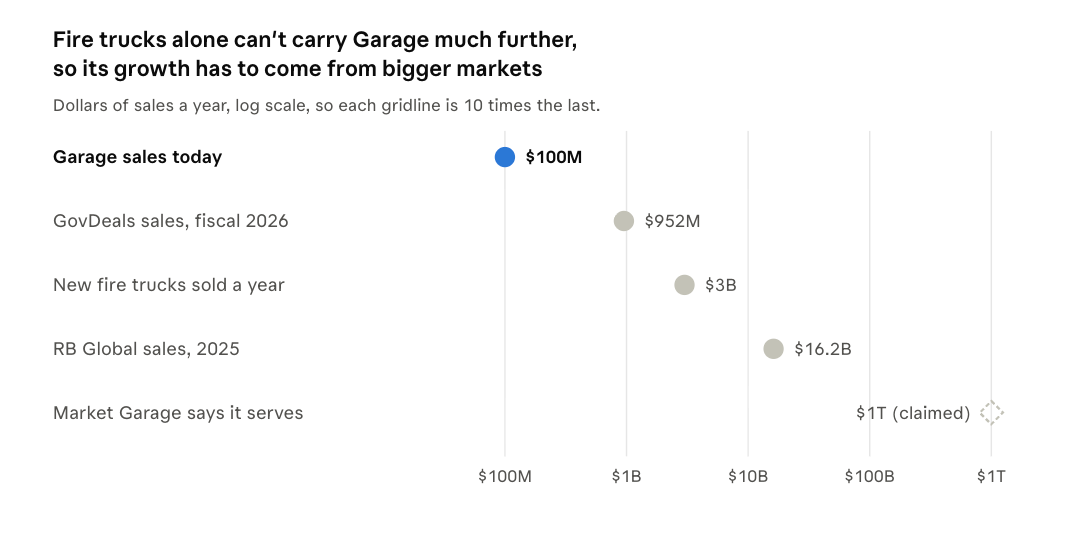
That's why the expansion matters so much. The bigger markets, from GovDeals' general government surplus to RB Global's equipment and vehicle auctions, are where the next billion has to come from.
Garage competes with an Alabama dealer today, and with GovDeals and RB Global as it grows
Brindlee Mountain Fire Apparatus is the incumbent specialist. A volunteer firefighter started it in 2001 after a bad used-truck purchase, and it has sold over 10,000 trucks since. It buys, repairs and resells on a 43-acre campus in Alabama, brokers trucks for departments, and has held a Sourcewell cooperative contract for used apparatus since 2022. Its strength is a truck that's inspected, fixed and ready now. Its weakness is that it has to buy and hold that truck, so it can't grow as fast or as cheaply as a marketplace.
GovDeals, owned by Liquidity Services, is the default for town surplus of every kind. It sold $952M in fiscal 2026. For fire trucks, its weakness is that its buyers are mostly the general public. Safety Harbor, Florida's staff made that point when they recommended selling the city's aerial truck through Garage instead. Municibid, Purple Wave and Public Surplus play a similar role.
RB Global, the parent of Ritchie Bros. and IAA, is the giant of used equipment and vehicles, with $16.2B of sales in 2025 and full service from inspection to storage to financing.
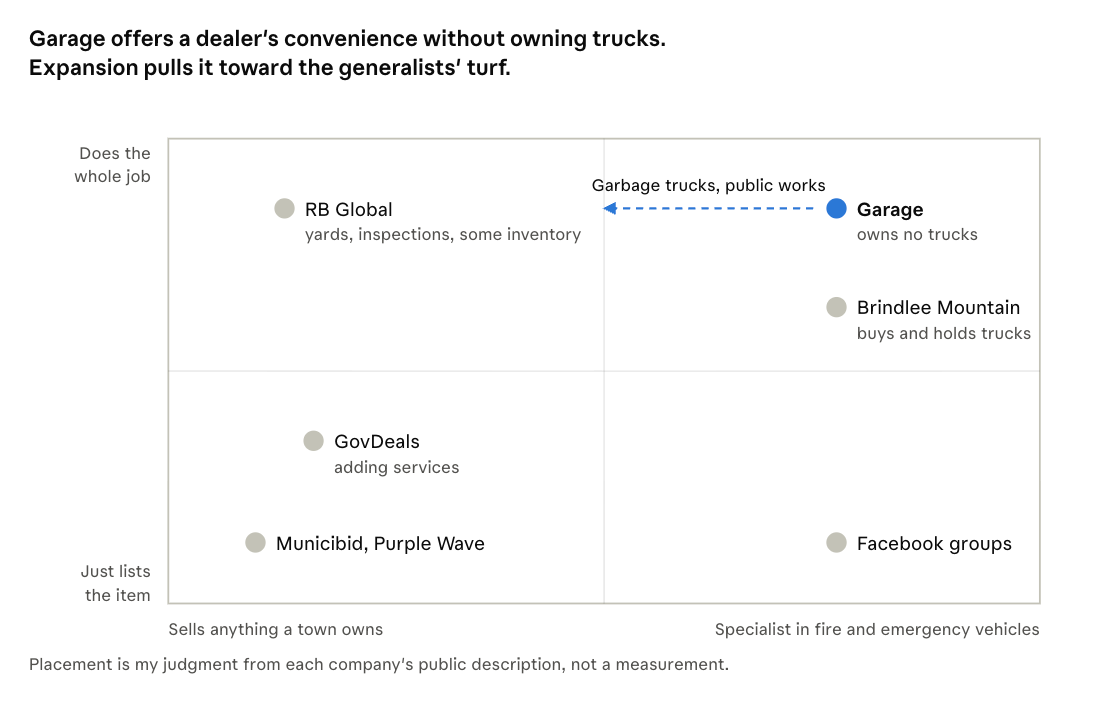
Garage's unusual spot is the top right. It offers much of a dealer's convenience without owning inventory, though it doesn't repair trucks the way a dealer does. The arrow is the risk. In fire trucks, the buyers are a closed club of departments that generalists can't reach. Garbage trucks, dump trucks and plows are different. Their buyers include contractors, haulers and dealers who already shop RB Global and GovDeals, so Garage's edge there has to come from pricing data, freight, financing and procurement paperwork, not from a buyer pool only it can reach.
Garage already lists ambulances, garbage trucks and sewer trucks. The best bets are the specialized ones.
Garage is broader than its fire truck headlines. Its site has five sections. There's fire, and EMS for ambulances. Refuse covers rear, side and front loaders and roll-off trucks. Sewer and vac covers combination sewer, hydrovac, jetter and septic trucks. Heavy duty covers dump trucks and machinery. Dealers list there too. So the question isn't which categories to open. It's which ones Garage can win the way it won fire trucks.
Fire trucks worked for four reasons. The categories that share these traits deserve the most effort.
- They're expensive.
- They're specialized, so few buyers are nearby.
- Public bodies sell them through slow approvals.
- The buyers are people Garage already reaches.
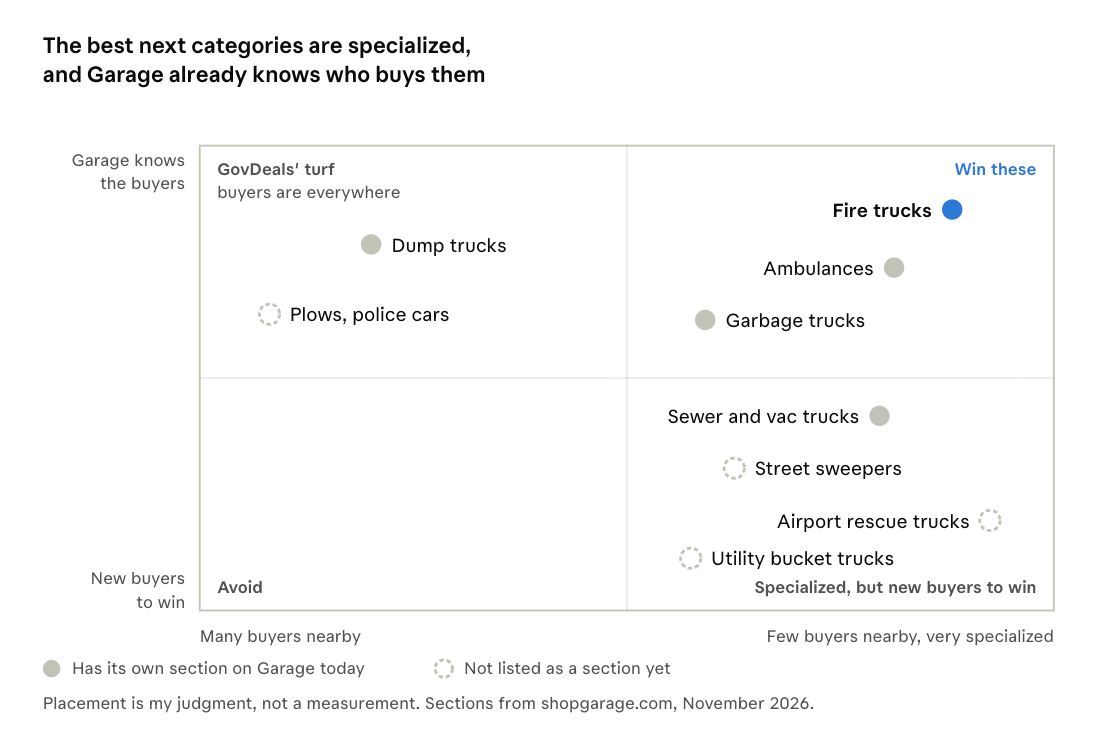
- Ambulances, already listed, are the closest fit. Fire departments run many of them, so Garage already knows the buyers, and private ambulance companies add more buyers and sellers.
- Sewer and vac trucks, already listed, are the hidden gem. Public works and utility departments own them, they're specialized and expensive, and few nearby buyers want a used one.
- Garbage trucks, already listed, are the growth engine. Private haulers are Garage's fastest-growing customers, and there are over 10,000 organizations that own garbage trucks in the US.
- Airport rescue trucks and street sweepers are worth adding. Neither has its own section yet. Both are expensive and specialized, and towns or airport authorities own them.
- Dump trucks are listed, but I wouldn't lean in, and the same goes for plows and police cars. Buyers are everywhere, so a national reach adds little and GovDeals already does the job cheaply.
What I'd do if I ran Garage
1. Own the town's disposal routine. Give towns free software for retiring any asset, from declaring it surplus to the council resolution and the title transfer. Garage would list what fits and refer the rest. That gets Garage to sellers earlier and more often, without carrying any trucks. The hard part is that selling software to towns is slow, and GovDeals will fight for its home turf.
2. Be the trusted source on value and condition. Garage already gives free instant appraisals. It could publish a price guide that insurers, auditors and lenders pay for, and add condition reports it stands behind, so a buyer 1,400 miles away can trust what they're getting. That fills the biggest gap in the model today. With enough data, it could even offer towns a guaranteed resale value when they buy a truck. The hard part is staying trusted while also being the one who sells.
3. Use its resale data to finance, and maybe one day lease. This is a long shot but the path to $10B+.
Leasing fire trucks isn't new. Pierce, through PNC Bank, offers lease-purchase plans and turn-in leases. In a turn-in lease, the payments are set around the truck's expected resale value, and at the end the department can hand it back and lease a new Pierce. Garage itself already arranges loans through a partner lender.
The opening is in that expected resale value. A lessor makes or loses money on what a truck is really worth in 10 years, and on how quickly it can find the next user. That's exactly what Garage is learning to do. It's also how aircraft lessors work. AerCap buys planes, leases them to one airline, then places them with another, and reported $2.7B of adjusted net income in 2025. Its edge is knowing what a used plane is worth and who needs it next.
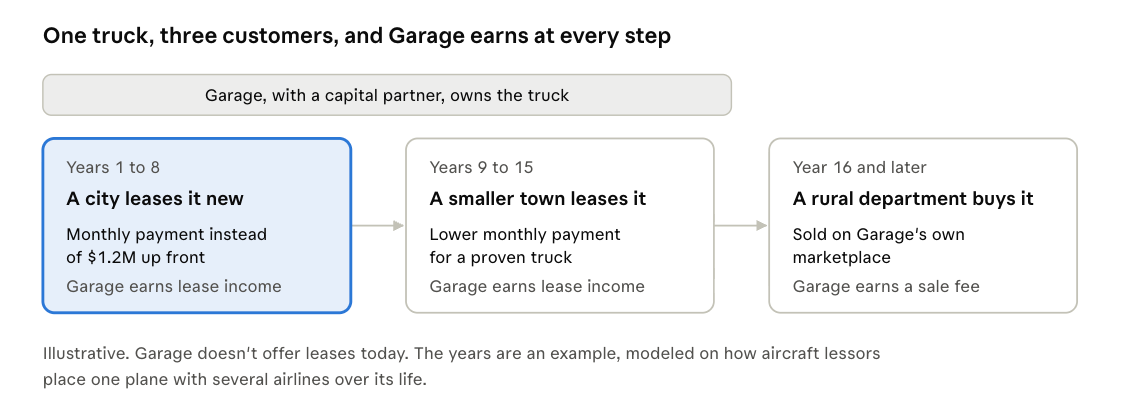
It's a long shot for good reasons. Garage would have to own trucks and borrow billions, which brings interest rate risk and lower valuation multiples. It would compete with manufacturers and banks that already lease. And it would have to stay a neutral marketplace while also placing its own trucks. Leasing also doesn't make budgets disappear. Depending on state law, a municipal lease can often avoid a voter referendum, but towns still have to fund the payments each year. I'd treat this as an option the first two bets create, not the plan.
There are smaller ideas too, like selling parts from trucks too old to sell whole, or shipping the oldest trucks to departments overseas. They're worth testing, but they won't materialy change the outcome.
Garage looks like a good company. At $225M, it's a less obvious investment.
| Company | Sales (GMV) | Revenue | Growth | Equity value, fall 2026 | Value ÷ revenue |
|---|---|---|---|---|---|
| Garage | $100M+ annualized | ~$7M to $10M (estimate) | Over 400% | $225M (private round) | ~22x to 32x (estimate) |
| Liquidity Services (owns GovDeals) | $952M at GovDeals (fiscal 2026) | $93M GovDeals, $478M company | 5% at GovDeals | ~$1.4B | ~2.9x |
| RB Global | $16.2B (2025) | $5.05B (last 12 months) | 14% to 15% (2026 outlook) | ~$17.7B | ~3.5x |
| Copart | Not disclosed | ~$4.7B (last 12 months) | ~2% (latest quarter) | ~$29.5B | ~6.3x |
These comparisons are rough. Garage's number is a private funding round, the others are public market values, and debt and cash differ a lot. RB Global carries debt and Copart holds cash, so multiples that account for debt and cash would look different. Copart's premium comes from steady supply from insurers, its yards and its deep buyer base, and about $0.32 of profit on every $1 of revenue.
Suppose Garage grows to $1B of sales a year, about GovDeals' size. At an 8% average cut, that's $80M of revenue. At 4x-6x revenue, a range for mature marketplaces, it would be worth $320M-$480M. That's 1.4x-2.1x today's price, years from now and before further dilution. A good business, and a modest return.
A 10x return, about $2.25B, needs roughly $375M-$560M of revenue, or $4.7B-$7B of sales (my estimate). That's 5-7 times GovDeals' size today, and only reachable by winning several categories.
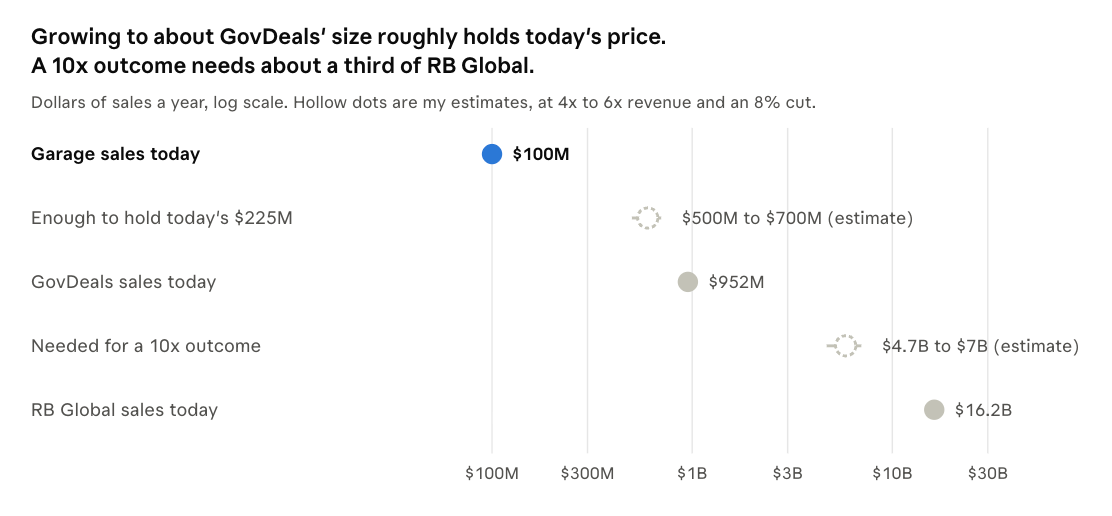
How I see the outcomes over the next seven years or so. These are judgment calls, not a model.
| Outcome | What happens | Value | How likely I think it is |
|---|---|---|---|
| A great niche | Fire trucks saturate, prices cool and new categories grow slowly. A surplus or auction company buys it. | $150M to $300M | Quite possible |
| The marketplace for municipal equipment | Fire, EMS, sanitation and public works reach $1B to $2B of sales and $80M to $150M of revenue | $500M to $1B | My base case |
| The default for local fleets | Garage owns the disposal routine across most of what towns and service fleets own, plus value data and financing | $3B to $6B | Possible, if the first two bets work |
| A lessor for public equipment | Garage leases and re-leases trucks at scale using its resale data | $10B+ | A long shot |
Where I land. I think Garage has a good shot at becoming a $500M to $1B company. At $225M, that alone isn't a super exciting Series B return, and the real upside needs several expansions that public evidence can't yet support. It has shown how much value comes from bringing national reach and clear prices to an obscure market. But fire trucks are finite, agreements with towns aren't exclusive, and the next categories have stronger incumbents. If Garage becomes the software a town uses to manage its equipment, the source it trusts to value it, and the place it sells it, $225M will look cheap. If not, it could be a terrific niche marketplace that pays today's investors only modestly.
Garage has proved that an obscure market can support a real business. It hasn't yet proved that winning one obscure market earns it the right to win the next five.
What I'd be watching
- Repeat sellers. A town that sells through Garage twice, without being chased, is a town Garage owns.
- The mix outside fire. If garbage trucks, ambulances and sewer trucks become half of sales within two years, the expansion is working.
- Seller take-home. Whether sellers net more after fees than their best alternative, not just whether prices are higher.
- Contribution margin per sale. Whether a deal still makes money after the staff time it takes.
- The average cut. Big managed deals and contract discounts pull it down. Premium services could pull it up.
- Used truck prices. If backlogs clear, prices and sales per truck soften.
- The first bad deal at scale. A truck that arrives broken after 1,400 miles will test the protection, the inspections and the word of mouth between fire chiefs that Garage’s reputation depends on.
Garage found a market where both sides are often governments, and the scarce thing is a council's decision to let go of an asset. I think that's the real insight, and it travels further than fire trucks.
If you were running Garage, would you spend the new $41M becoming the default marketplace for more kinds of equipment, or building the software and relationships that make Garage the first call whenever a town or fleet has something to sell?
Sources
- Garage's funding, sales and founders: Fortune, AlleyWatch, AI Journal, Initialized Capital, Y Combinator, Venture Capital Tracker on terms, UpNorthLive
- Garage's own pages: homepage and categories, seller page, appraisals, financing, freight, inspections, buyer protection, auction terms, warranty, cooperative purchasing, press
- Town decisions and examples: Medina, Orleans Hub, Medina broker fee, Orleans Hub, Ladue council, North Riverside trustees, South Charleston, WCHS, Smart Firefighting podcast, Safety Harbor City Commission agenda, May 18, 2026
- Prices, shortage and lifespans: Stateline, Governing, AZFamily, WAFB, East Valley Tribune on REV output, Altoona Mirror on used prices, FireRescue1 on FAMA shipments, NFPA age guidance via Rigspot
- Market size and emissions: refuse truck forecast, EPA 2027 rule, CCJ, EPA July 2026 proposal, Fresno refuse truck order, Long Beach electric refuse trucks, waste fleet owners, Recycling Today, heavy-haul freight rates
- Competitors and leasing: Brindlee Mountain history, Brindlee volume, Sourcewell contract, Municibid fees, Pierce leasing program, Pierce turn-in lease terms, Pierce on municipal leases
- Public company figures: Liquidity Services fiscal 2026 results, RB Global Q3 2026 results, RB Global value, Liquidity Services value, Copart figures, AerCap 2025 results