Bread is 30 years old and worth $4B. Imprint is 6 and worth $1.9B. Just a lender, a better lender, or even more?
Imprint raised $130M last week at a $1.88B valuation. It's six years old, expects about $400M of revenue this year, and runs the credit cards for H-E-B, Kroger, Albertsons, Shell, Booking.com and, as of last week, Fanatics.
Bread Financial, the company Alliance Data became, is 30. It holds $18.9B of card loans, earned $518M last year, and the stock market values it at about $3.9B.
So investors value Imprint at about half of Bread, with roughly a tenth of the loans. I'm a fan of what Imprint is building because I spent years working with the incumbents and a few inside of them, but I wanted to understand that bet a little better.
| Bread Financial | Imprint | |
|---|---|---|
| Born | 1996, as Alliance Data | 2020 |
| Value | About $3.9B, public stock | $1.88B, private round (Nov 2026) |
| Revenue | $3.85B (2025) | About $400M (2026, company expectation) |
| Profit | $518M (2025) | Not disclosed. It burned about $35M of cash in 2024 and expects to be profitable in 2026, per Sacra |
| Card loans | $18.9B | Not disclosed, my guess is about $2B |
| Growth | Revenue flat in 2025, low to mid single digits expected in 2026 | Revenue up about 150% in 2026 |
| Customers | About 34M open accounts, about 100 brand partners | 2M+ members, up from about 15,000 three years ago |
| Main products | Store cards that work at one retailer, co-brand Mastercards, its own Bread Cashback cards, financing for big purchases | Co-brand cards on Visa, Mastercard and Amex that work anywhere, plus a secured card |
| Typical cardholder | A wide range of credit. About 59% of revolving loans go to people scoring 660 or higher | Mostly prime shoppers who spend a lot and pay fast |
| Employees | About 6,000 | A few hundred, by outside counts |
| Operating costs | About $2.0B in 2025, $880M of it on people | Not disclosed |
A few cautions before digging in:
- Bread reports revenue after paying for its funding and paying brands their share. Imprint hasn't said how it counts revenue, and many fintech lenders count it before those costs.
- Imprint does co-brand cards, which run on Visa, Mastercard or Amex and work anywhere. Bread is best known for store cards, also called private label, which only work at one retailer. Co-brand is now about half of Bread's card spending. That half is where it competes with Imprint, and it's why Bread is a good public company to compare with.
- I worked at Bill Me Later before PayPal bought it, worked on PayPal Credit, and helped start Blispay, where we built a credit card product on TSYS. Alliance Data bought Blispay and I spent two long years there.
The short version
- Some big brands are moving their cards to Imprint. Kroger left U.S. Bank for it, Shell left Citi, and Albertsons and Fanatics launched with it this year.
- Sacra suggests Imprint makes most of its money by lending. About 60% of its revenue was interest in 2024. It holds the loans and eats the losses, just like Synchrony and Bread.
- Investors are paying for growth. Imprint's $1.9B valuation is about 4.7 times expected 2026 revenue, versus roughly 1 to 2 times for mature card lenders. It's not a perfect comparison because they count revenue differently. The bigger question is whether Imprint can sustain faster growth and better returns on capital.
- It's taking business from big banks, not Bread. Bread's core, store cards and promo financing across a wider range of credit, isn't what Imprint does.
- Bread isn't dead. It's very profitable but growing slowly.
- Imprint doesn't need to become a software company to justify $1.9B. It needs to become a much bigger lender, a much more profitable one, or both. At a normal card lender's multiple, my math says it needs about $8.4B of loans just to support today's valuation. But lenders with fast growth and exceptional returns, like Nubank, can earn much higher multiples.
- The biggest question is who keeps the value Imprint creates. Better tech can lower costs, win brands and make cardholders more profitable. But powerful retailers can demand a bigger share of those gains when contracts renew.
- If I had to invest in one for ten years, I'd pick Imprint. Bread has proven scale and profitability, but Imprint has a shot at fundamentally improving the economics of branded credit cards. Its technology could help it win bigger programs, acquire better customers, and generate superior returns on capital. If it pulls that off, $1.9B would look relatively cheap. The risk isn't that it's "just a lender." It's that brands capture most of the value it creates, or credit losses erase the advantage.
Retail card spending is moving from store cards to co-brand cards, which is Imprint’s market
There are three kinds of credit cards worth knowing here.
| Store card (private label) | Co-brand card | Regular bank card | |
|---|---|---|---|
| What it is | Only works at that store | Has a brand's name, works anywhere Visa, Mastercard or Amex works | The bank's own card |
| Examples | Victoria's Secret or Ulta store card | Costco Citi Visa, Delta Amex, Kroger Mastercard | Chase Sapphire, Capital One Venture |
| How the lender makes money | Mostly interest | Interest plus swipe fees on every purchase | Same as co-brand |
| Average interest rate (2024) | 31.3% | Usually like a regular card | 25.2% |
| Biggest lenders | Synchrony, Bread | Chase, Amex, Citi, Barclays, U.S. Bank, Synchrony, Bread, now Imprint and Cardless | Chase, Capital One, Citi, Bank of America |
A swipe fee, called interchange, is what a store pays every time you use a Visa, Mastercard or Amex, usually around 2% of the purchase. Most of it goes to the bank behind the card, which hands a lot of it back to you as rewards. Store cards don't run on those networks, so they don't get swipe fees. They make up for it with higher interest rates, and they lose more money to bad loans, nearly twice as much as regular cards, according to the CFPB.
The money is leaving store cards.
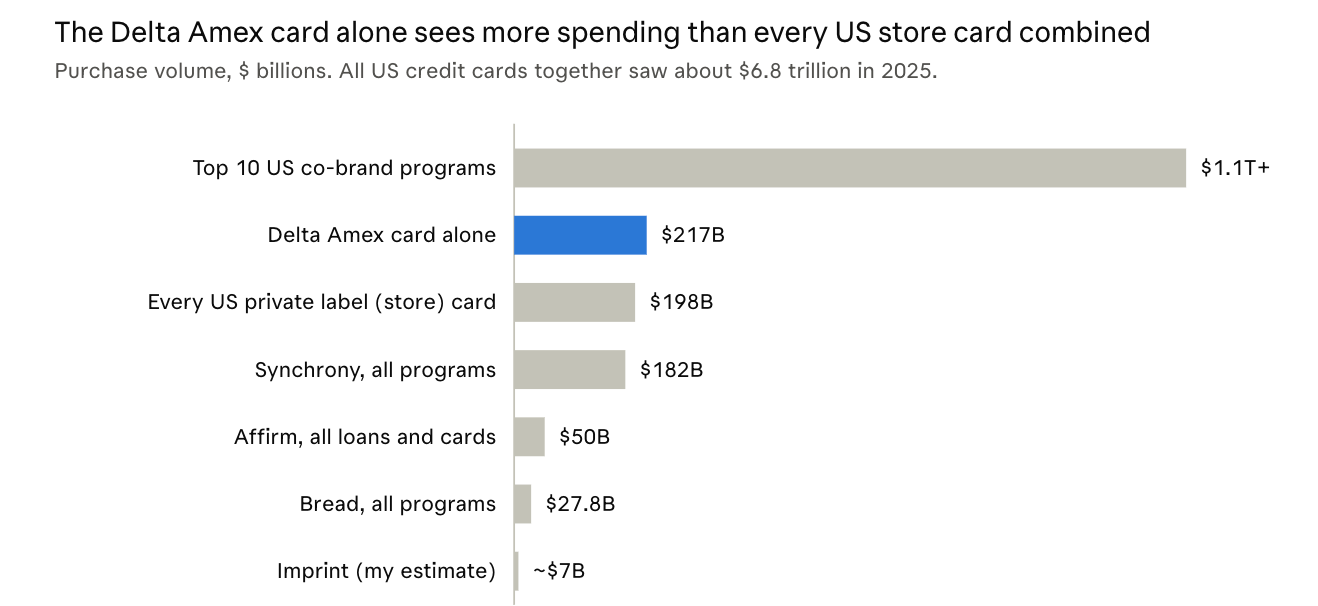
Store card spending fell to $198B in 2024, and the number of store cards fell 8%. Meanwhile the ten biggest co-brand programs alone did more than $1.1T. One airline card does more business than every store card in the country put together.
Even the store card specialists are following the money. Co-brand cards were half of Synchrony's purchase volume in late 2025, and 52% of Bread's. In the second quarter of 2026, Synchrony's co-brand spending grew 23% while its total grew 8%. That's the lane Imprint lives in.
To be precise, this is a shift inside retail cards. Store cards are only about 3% of the roughly $6.8T Americans put on credit cards, and most spending is on regular bank cards like Chase Sapphire. I haven't seen a reliable figure for co-brand's share of the total.
Brands know what these cards are worth. Amex paid Delta $8.2B in 2025, about 10% of the airline's revenue.
Every card program has five players around the lender
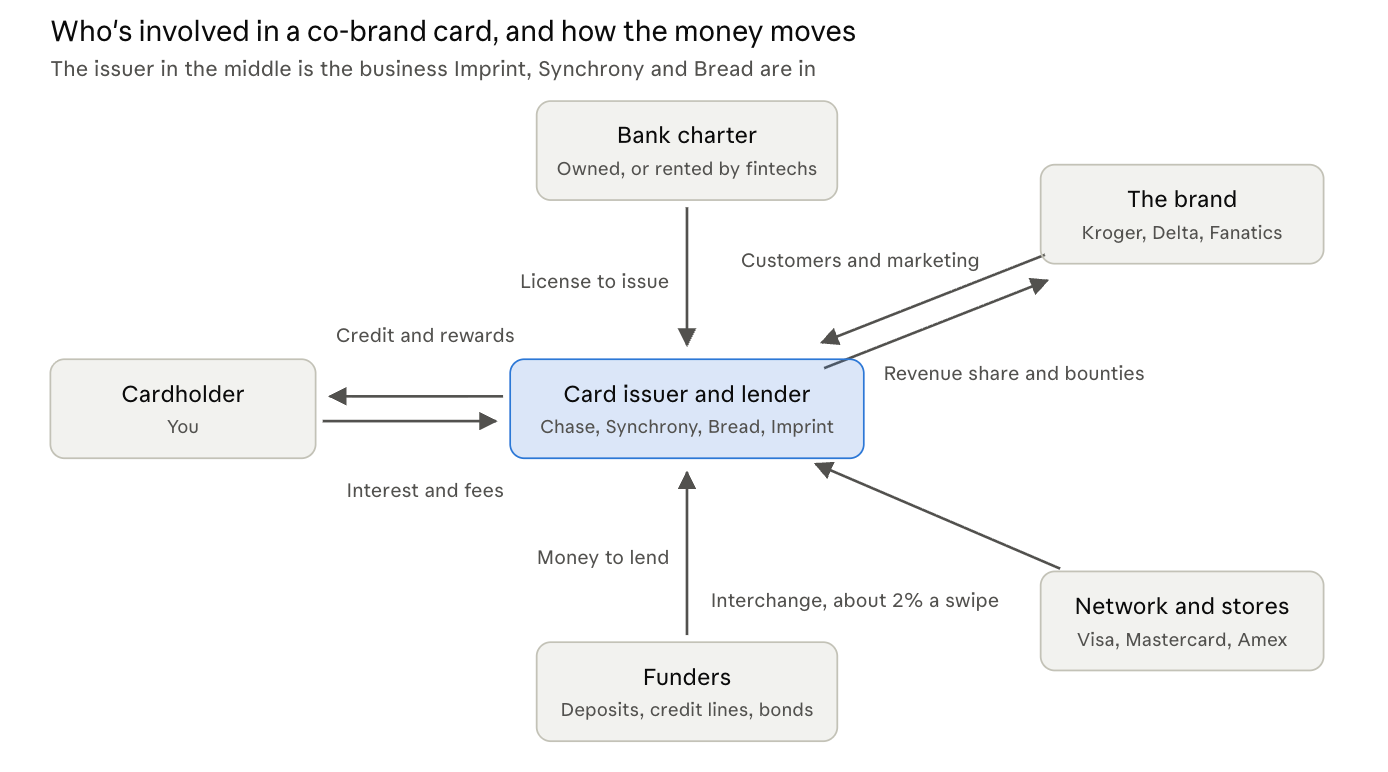
The lender, called the issuer, is the business this post is about. It approves you, lends you money, pays your rewards, collects interest and swipe fees, pays the brand its share, and borrows from someone else to fund it all. A licensed bank has to be the legal issuer, which is why fintechs rent one.
Imprint competes with big banks and with card specialists that own banks
| Company | What it is | Started | Value | Card loans | Brands it works with |
|---|---|---|---|---|---|
| JPMorgan Chase | Biggest US bank and card lender | 1799 | Over $700B | Not broken out | Amazon, United, Southwest, Marriott, Disney, soon Apple |
| American Express | Runs its own network and lends | 1850 | About $230B | Delta is 21% of its loans | Delta, Hilton, Marriott |
| Citi | Big bank | 1812 | About $200B | Not broken out | Costco, American Airlines |
| Synchrony | Card specialist that owns a bank | 1932 roots in GE, public since 2014 | About $25B | $103B | Amazon, Lowe's, PayPal, Sam's Club, Walmart |
| Bread Financial | Card specialist that owns a bank | 1996 | About $4B | $19B | Victoria's Secret, Ulta, AAA, Caesars, the NFL |
| Imprint | Fintech lender that rents a bank | 2020 | $1.9B, private | Not disclosed | H-E-B, Kroger, Albertsons, Shell, Booking.com, Fanatics |
| Cardless | Fintech card platform | 2019 | Not disclosed | Not disclosed | Bilt, Coinbase, LATAM, Avianca |
Synchrony bought PayPal's $7.6B credit portfolio in 2018 and issues PayPal Credit today, the product I worked on to start my career.
Is Bread a bank? Alliance Data used to call itself a loyalty and marketing company, but its cards always ran through its own banks, Comenity Bank and Comenity Capital Bank, which it merged into one this fall. Synchrony and Bread own banks so they can take deposits and lend cheaply. Chase and Citi are giant banks where co-brand is a side business.
Imprint is neither. It rents a bank and lends with borrowed money, so far.
Bread's co-brand business is the closest match to what Imprint does day to day. Synchrony is the best public view of the economics at scale. But Imprint's biggest wins came from Citi and U.S. Bank.
A card lender keeps about $0.046 a year on every $1 it lends, about three times what a typical bank keeps
Think of a card lender as a store that sells money. It borrows money cheaply, lends it to you at 20% or more, and keeps what's left after the costs. Synchrony is the cleanest public example, so here's what $1 of its loans earned and cost in 2025.
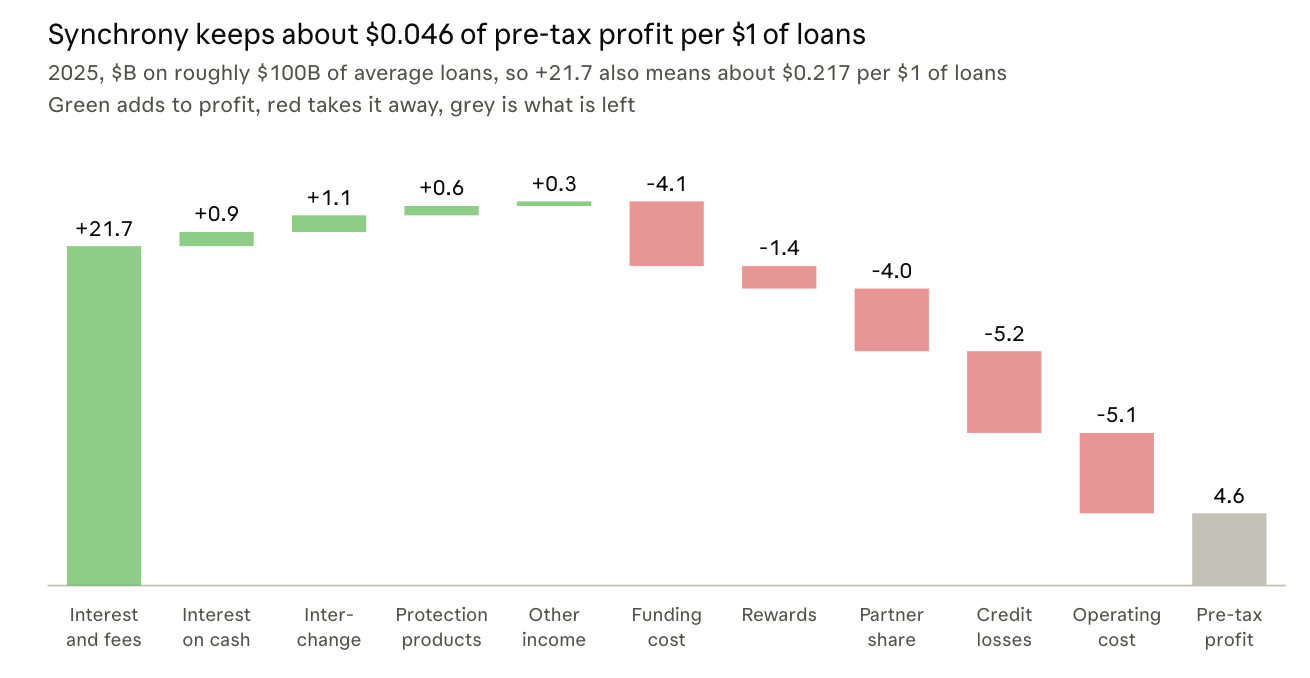
The green bars are money coming in. Interest is by far the biggest, about $0.22 a year for every $1 lent. Swipe fees and add-on products bring in a little more.
The red bars are money going out. Synchrony pays for the money it borrows, pays rewards, pays the brand its share, writes off loans that never get repaid, and pays to run the business. What's left is about $0.046 before taxes, and about $0.035 after.
That sounds small, but it's a great business. It's every year, on every $1 lent, and a typical US bank keeps closer to $0.01 to $0.015 before taxes. A lender also only puts in about $0.16 of its own money per $1 lent and borrows the rest, so $0.035 after tax on that small slice of its own money works out to about a 21% return for Synchrony's shareholders in 2025.
Every red bar is a place to win or lose. A lender with cheaper money, smarter approvals, cheaper servicing or a better deal with the brand keeps more. That's the whole game. Brand contracts also carry signing bonuses, payments for each new account, marketing promises and minimum volumes. They're rarely disclosed, and they're already inside these totals.
One difference matters for Imprint. Swipe fees are small for Synchrony because so much of its lending is on store cards. For a co-brand lender like Imprint, they were about a third of revenue in 2024.
Store cards and co-brand cards make money in opposite ways
| Store card | Co-brand card | |
|---|---|---|
| Where it works | One retailer | Anywhere Visa, Mastercard or Amex works |
| Main income | Interest, at about 31% on average | Interest plus swipe fees |
| Rewards | Modest, mostly store discounts | Generous, because rewards are the selling point |
| Losses | Nearly twice those of regular cards | Closer to regular cards |
| How people use it | Bigger purchases, often carrying a balance | Everyday spending, and many pay in full |
Per $1 of loans, a store card earns more and loses more. A co-brand card needs far more spending to build the same loan balance, because so many people pay in full each month. That's why Imprint's focus on groceries and gas matters so much.
It also means Bread's and Synchrony's numbers, which mix both kinds of card, aren't a perfect template for Imprint. I use them anyway in the math later, because Imprint's own figures land in a similar place.
Imprint pays more for the money it lends than banks that take deposits
The cheaper a lender borrows, the more it keeps. There are three main ways to get the money.
| Source | How it works in plain English | Who uses it | The catch |
|---|---|---|---|
| Deposits | People keep savings at an insured bank, and the bank lends that money out | Banks only, including Synchrony and Bread | Cheapest and steadiest, but you need a bank license and regulators |
| Warehouse lines | A big bank lends you money, using your card loans as collateral, like a mortgage on your loan book | Fintech lenders like Imprint | Costs more, and the bank can shrink the line when markets get nervous |
| Securitization (bonds backed by card loans) | You bundle card loans and sell bonds to investors. Safest slices get paid first and pay the lowest rate. You keep the riskiest slice | Almost everyone at scale, including Synchrony, Bread and Imprint | Cheap for the safest slice, but buyers can disappear in a panic |
Banks have a real edge here. In November, Synchrony sold its safest card bonds at 0.57 percentage points over the benchmark rate. Imprint's first bonds of the same rating, in October 2025, cost about 1.6 points over. Imprint's warehouse lines cost more than that, and Synchrony and Bread fund most of their loans with deposits, which are cheaper still.
But Imprint is closing the gap. Its second bond sale in August drew $2.35B of orders for $500M of bonds, and it says new financing cut its funding costs by 23%. My rough guess is it still pays $0.01 to $0.02 more per $1 of loans than a bank funded by deposits. Against a $0.046 margin, that's a big deal.
Owning a bank could cut Imprint's costs
Buying a small bank isn't like buying a license off the shelf. Regulators review the new owner, its capital and its business plan as if it were starting fresh. The old bank mostly saves time and comes with deposit insurance already in place. There are three realistic paths.
| Path | Who has done it | The catch |
|---|---|---|
| Buy a small bank | SoFi paid $22M for Golden Pacific, a three-branch bank with $150M of assets, then committed $750M of capital. LendingClub paid $185M for Radius, a $1.4B online bank. | Still needs approval from bank regulators and the Fed. SoFi took about a year and a half from its first application to closing. |
| Apply for a new national bank | Nubank, Mercury and Upstart all won conditional approval this year | Conditional approval isn't a working bank. Nubank got the nod in January and was still waiting on deposit insurance in September. |
| Apply for a credit-card-only bank | Mission Lane this year, the first such approval in about 20 years | Lighter oversight, but it can't take everyday savings. Only deposits of $100,000 or more, so it doesn't solve cheap funding by itself. |
Whichever path it takes, five things come with it.
- A lot of capital. New banks usually have to keep equity of at least 8% of assets for their first three years. On $3B of loans, that's about $240M locked in the bank (my math).
- The Fed as a supervisor. With a full bank, Imprint's parent becomes a bank holding company. The Fed examines it and limits what else it can own.
- A plan it has to stick to. For three years, a new bank needs permission to stray far from its approved plan. Regulators don't love a lender that wants to double every year.
- Deposits it has to go win. A new online bank pays top rates to attract savings. Synchrony, with $82B of deposits, still paid 3.93% for its money last quarter. Deposits are steadier and somewhat cheaper than borrowed money, not free.
- Running a bank. Imprint would stop paying its partner banks, but take on the compliance, audits and exams they handle today.
The prize can be big. LendingClub said its warehouse lines cost the Fed's benchmark rate plus 3.3 points, while Radius paid 0.28% for deposits, and it cut that funding cost by 90%. That was when rates were near zero, so it overstates today's gain. My guess is a charter would close half to most of Imprint's $0.01 to $0.02 gap, after paying for deposit marketing and running the bank.
The timing has never been better. Regulators approved 29 bank charter applications this year through mid-September, more than double all of 2025, with fintechs leading. I haven't seen Imprint say publicly that it's pursuing one. I'd expect it to within three years, through a full bank rather than a card-only one, because it already offers deposit accounts to its brands. That could become its deposit engine. Kroger shoppers saving in a Kroger-branded account would be cheap, sticky money.
One catch for the valuation story. A charter makes Imprint more profitable and also makes it look even more like a lender. As the Nubank example later shows, that's fine as long as returns are high.
Brands pick card partners on money, approvals, speed and control
The brand is the real customer here. Brands launch cards to make money (the lender pays them), to get customers to come back and spend more, to see what their best customers buy everywhere else, and to help people afford big purchases. Imprint says its partners see about twice the share of their customers' spending and 20% more spend than with their old programs. That's a company claim, but it matches what I saw at Alliance Data.
The first choice is which kind of card. A retailer whose shoppers have thinner credit or buy big-ticket items often wants a store card, and only Bread and Synchrony offer those at scale. A brand whose customers are prime and shop often wants a co-brand, and that's where Imprint competes. Then comes the choice of partner.
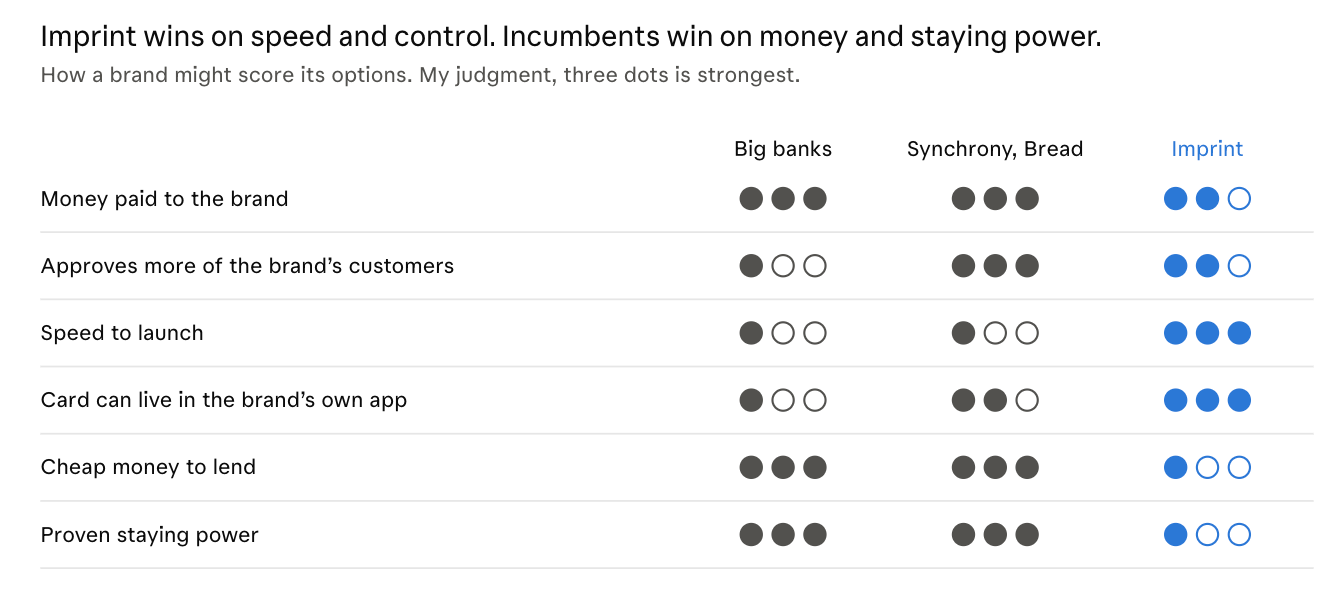
Imprint wins with brands that think of themselves as tech or loyalty companies. The incumbents win with CFOs who care most about the check and the safety of the partner. That's why Imprint's first big wins came from banks where co-brand was a side business, and why the biggest programs will take longer.
Staying power isn't abstract. Deserve was an earlier startup that ran cards for brands like M1, AMC, Sallie Mae and BlockFi. It mostly served smaller fintech and affinity brands and students with thin credit. In 2025 it sold its core technology and part of its team to Intuit, and partner programs ended. M1 shut down its card, and AMC told cardholders its card was ending because the issuer had been acquired. Brand CFO's have probably heard that story, and it's why Imprint's bond deals, big-name partners and prime borrowers matter as much as its speed.
Imprint rents a bank, holds the loans and runs the card, often inside the brand's app
Two small banks, First Electronic Bank and First Bank & Trust, are the legal issuers. Imprint decides who gets approved, holds the loans with borrowed money, runs its own customer service and rewards, and can build the card into the brand's app. It sounds like Kroger and Harris Teeter shoppers apply for and manage the card inside the grocer's app, and the points land in its loyalty program. Not every brand goes that far. Shell and Rakuten cardholders log in to the Imprint app or Imprint's website, and Crate & Barrel offers both. Either way, Imprint services the account. Who owns the cardholder data is set in each contract, and those aren't public.
According to their LLMs.txt, Imprint also apparently offers deposit accounts and installment loans to its brands.
Its customers look like potentially good borrowers, so far. The best public data comes from its loan-backed bonds, because the rating agency Fitch publishes the numbers.
| Imprint (bond trust, June 2026) | Synchrony (Q3 2026) | Bread (Q3 2026) | |
|---|---|---|---|
| Loans written off in a year | 4.9% before recoveries. My estimate after recoveries is 4.0% to 4.4% | 4.8% | 6.4% |
| Behind on payments | 1.8% are 60+ days late | 2.1% are 90+ days late | 5.8% are 30+ days late (Q4 2025) |
The late-payment row is the cleaner comparison. Imprint's 60-day number is lower than Synchrony's 90-day number, and anyone 90 days late is also 60 days late.
Caveats:
- Bond trusts hold a selected slice of loans, and Imprint's loans are young, which makes every credit number look better than it will later.
- Bread's and Synchrony's numbers include store cards, which lose more by design, so this isn't a pure test of who underwrites better.
The number I'd show any fintech person is how fast Imprint's cardholders pay. They pay off more than a third of what they owe every month. Fast payers mean more of the money comes from swipe fees, fewer losses, and bonds investors like. It also means Imprint needs a lot of spending to grow its loans.
Imprint grew by winning big programs away from other lenders
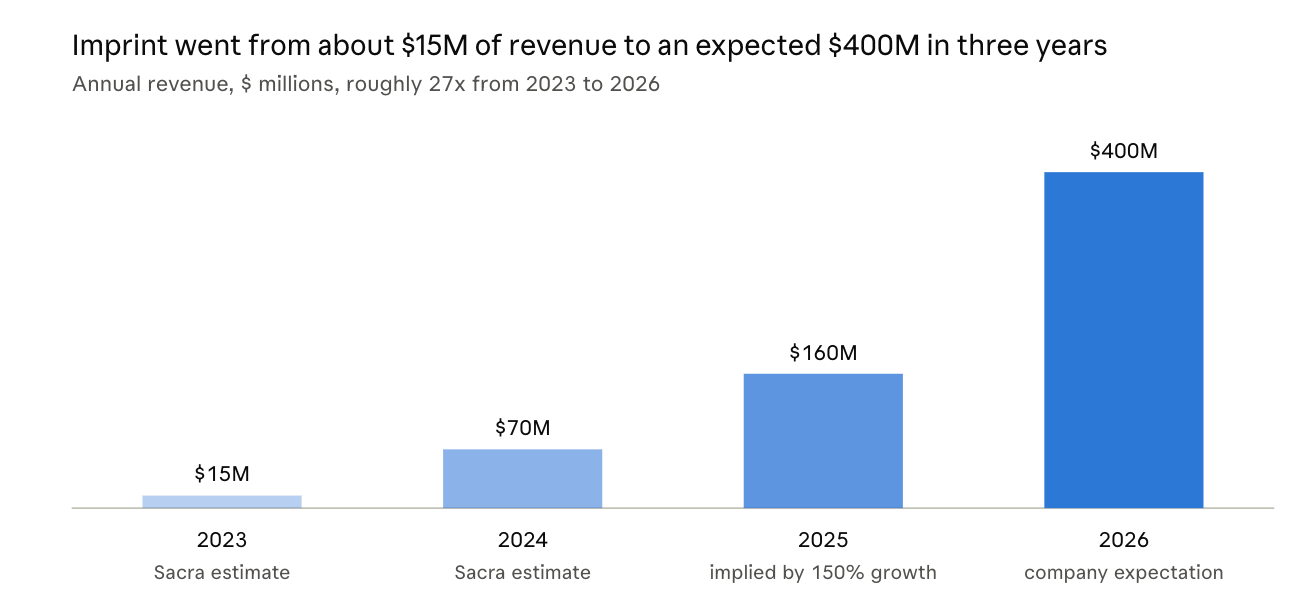
Starting from a small base, revenue is on track to grow about 27x in three years, and members went from about 15,000 to more than 2 million. Spending on its cards more than doubled this year. And the logos got bigger. A few years ago Imprint pitched brands with $50 to $200M of sales that big banks ignored. Now it has Kroger and Albertsons, two of the ten biggest retailers in the country.
Those wins came from other lenders, which is normal in this business.
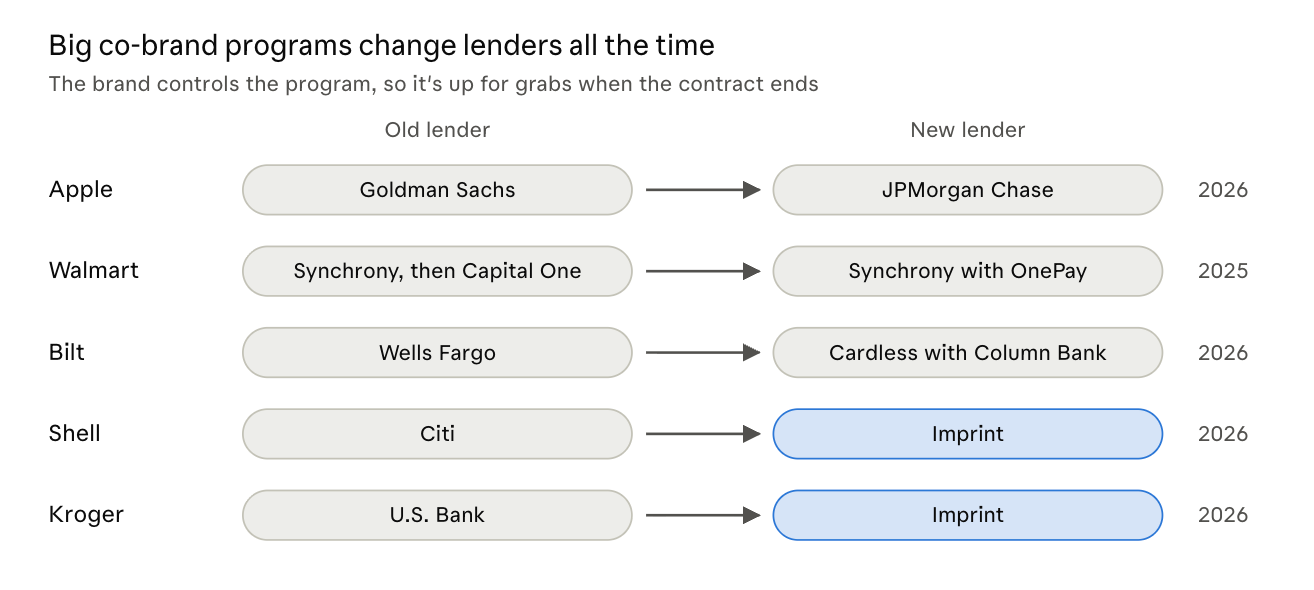
Apple is the cautionary tale. Apple pushed for approvals, Goldman said yes, and by late 2023 more than a quarter of Goldman's Apple Card loans were to people with credit scores under 660. Goldman lost money and is handing the roughly $20B portfolio to Chase at a discount of more than $1B. Walmart fought with Synchrony over approvals too, then with Capital One, then went back to Synchrony. Brands wanting more approvals than a lender can safely give is the oldest fight in cards.
One caution in Imprint's numbers. H-E-B was about 35% of its revenue in 2024. The new wins help, but any partner that big is a risk at renewal.
Imprint is tiny next to the incumbents, but each member already earns about as much as a Synchrony account
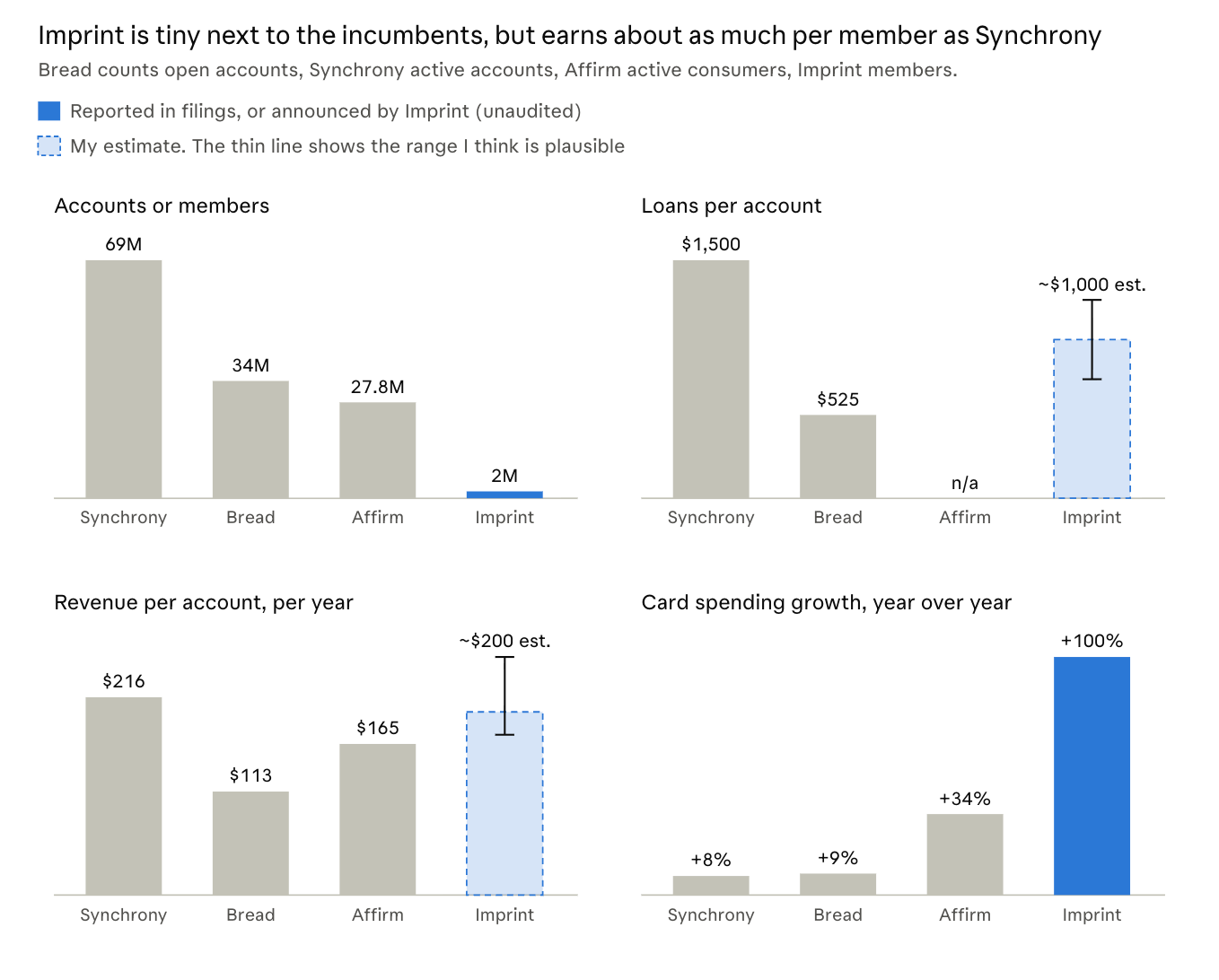
How good are my estimates? Treat Imprint's dashed bars as the right size and direction, not exact numbers. Imprint doesn't publish its loans, so I back into $1.5-$2.5B from its bond trusts and funding announcements. Revenue per member divides its own $400M forecast by its "2 million plus" members. Many joined during the year, which makes that number too low, while counting revenue before costs may make it too high. As a check, Sacra's 2024 figures, about $70M of revenue and 400,000 cardholders, work out to about $175 each. And members aren't the same as active accounts.
Synchrony has about 35 times as many accounts as Imprint has members, so it's no surprise Imprint grows faster. Doubling is a lot easier from a small base. The more telling number is revenue per member. By my estimate, Imprint's revenue per member is already close to Synchrony's.
Imprint is taking business from big banks today and will meet Bread in mid-size co-brand
The market splits by type of program, not by company.
| Program type | Typical brands | Who's strongest | Why |
|---|---|---|---|
| Store cards for a wider range of credit | Specialty retail, jewelry, beauty, furniture | Bread, Synchrony | Needs deeper approvals and decades of retail know-how. Imprint doesn't do this |
| Promo financing for big purchases | Home, health, electronics | Synchrony, Bread | Deferred interest and installment products built over decades |
| Everyday co-brand | Grocers, gas | Imprint, taking share from big banks | Prime spending, in-app card, loyalty tie-ins |
| Fan and affinity cards | Sports, travel, crypto | Imprint, Cardless, Amex, Chase | Brands want control and a fast launch |
| Mid-size retail co-brand | AAA, Caesars, the NFL | Contested | Bread is moving here fast, and so is Imprint |
| The biggest co-brands | Airlines, Amazon, Costco, Apple | Chase, Amex, Citi | Needs a huge balance sheet and paying the brand billions a year for its customers, like Amex's $8.2B to Delta |
What Bread keeps for now. Store cards, promo financing and customers with weaker credit. About 59% of Bread's revolving loans are to people with VantageScores of 660 or higher, so it serves prime customers too, but the other 41% is a market Imprint isn't built for. Bread also renewed its ten biggest programs into at least 2028.
Where they meet. Mid-size co-brand programs, about half of Bread's card spending. Every renewal there becomes a bake-off.
Who's losing to Imprint today. Big banks that treat co-brand as a side business. Citi lost Shell. U.S. Bank lost Kroger.
Cardless is the closest startup, but it's built differently. Both started around 2020, both launch cards in about three months instead of a year or more, and both put the card inside the brand's app. They even share a partner bank, First Electronic Bank, on most programs. The difference is how much of the card each one owns.
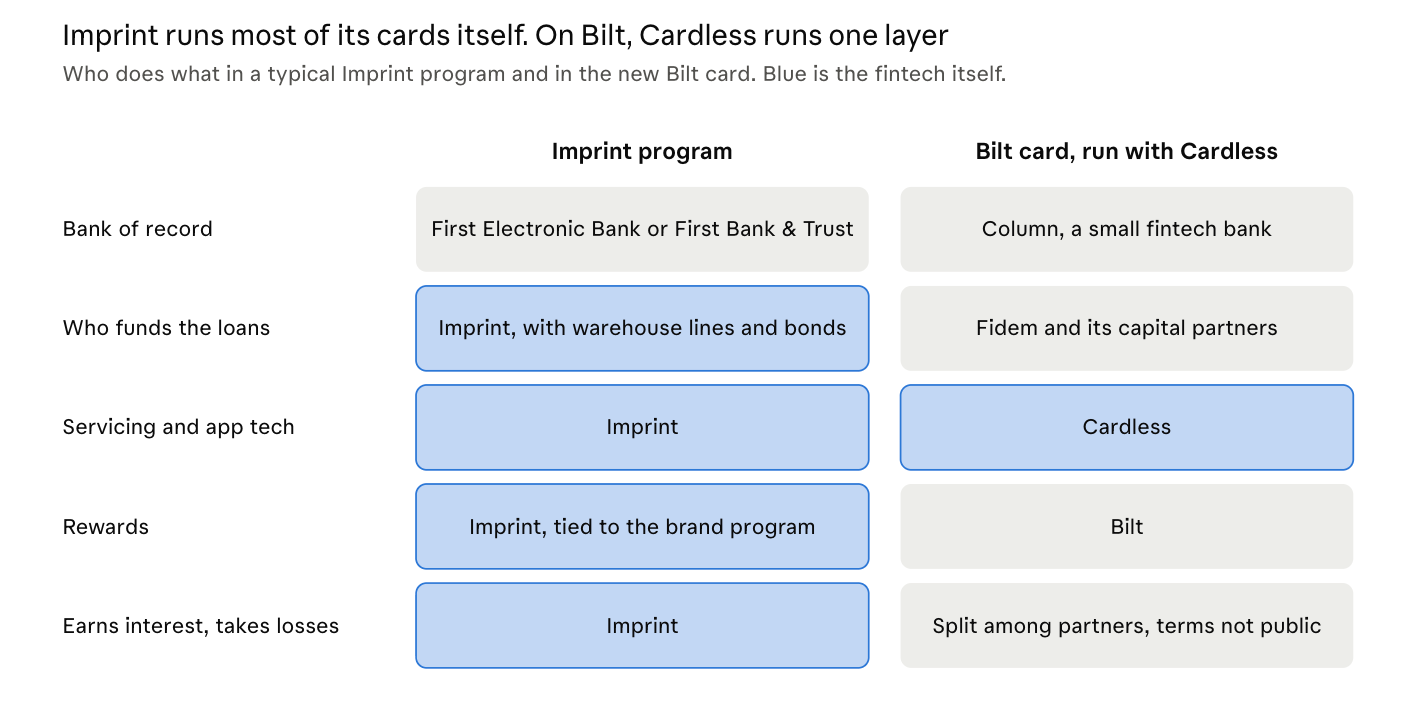
Imprint owns most of the stack. It funds the loans with its own warehouse lines and bonds, services the account and runs the rewards. So it keeps the interest and most of the swipe fees, and it eats the losses.
Cardless is more modular. On the new Bilt card, Column is the bank, a firm called Fidem funds the loans, Bilt runs the rewards, and Cardless gets paid to run servicing and the tech.
That shows up in the size gap. Imprint expects about $400M of revenue this year. Cardless had about $15M in 2025 and was targeting $150M annualized by mid-2026, per Bloomberg.
Why a brand would pick one or the other.
- Imprint if it wants one partner that brings the money, takes the credit risk and pays the brand a share, and its customers are prime shoppers who visit every week. It's the closest thing to a bank deal at startup speed.
- Cardless if it wants more say over which bank and funders it uses, or it's a newer or niche brand with a passionate audience. Coinbase, Bilt, Qatar Airways, Avianca and Avelo fit that.
Their brand mix differs too, though it's a tendency, not a rule. Imprint's biggest programs are places people shop every week, so the card gets used constantly at the brand itself. Cardless's are mostly brands people care about but buy from less often, like a crypto exchange, a rent app or an airline, so the card has to win spending everywhere else.
I like Imprint's mix better. Wells Fargo reportedly lost about $10M a month on the old Bilt card because people mostly used it for rent and rarely carried a balance. Bilt's new card added annual fees and cut back rewards to fix that, and its switch-over brought complaints about late notices and slow support.
For investors, the trade-off cuts both ways. Imprint earns far more per card, but gets valued like a lender. Cardless's lighter model is closer to the platform label Imprint wants, but it earns much less per card and depends on partners for the money.
Affirm is the other competitor. Splitting a purchase into installments is easy for any card lender to add, and Imprint already offers installment loans according to its LLMs.txt. The harder question is the reverse. Affirm's card has 6 million active cardholders and its spending nearly doubled last quarter. A shopper who carries an Affirm Card may not need a grocery co-brand.
Fanatics is where Imprint and Cardless start to overlap
Both sell brands the same thing, a card that lives in the brand's app. Fanatics is the clearest case of Imprint going after the kind of brand Cardless has focused on, one people identify with but don't buy from every week.
Fanatics just launched its first credit card. (Fanatics Financial Services is run by Greg Lisiewski, who founded Blispay and is a friend.)
It runs on Amex, is managed by Imprint, has no annual fee, earns FanCash across Fanatics' stores, sportsbook and collectibles, and comes in more than 500 Topps trading card designs.
This is an affinity card, a card for something you love rather than somewhere you shop. MBNA invented the idea in 1983 with Georgetown's alumni association, built one of the biggest card companies in the world on it, and sold to Bank of America for about $35B in 2006.
A problem with affinity cards can be that people love the logo more than the card. They sign up for their team and may stick it in a drawer. FanCash is different because fans can actually spend it on things they already buy. That gives the card a reason to come out of the wallet.
If Fanatics works, Imprint can credibly pitch both kinds of brand. That would make it and Cardless head-to-head rivals for the next wave of passion brands, from sports teams to creators.
Bread is very profitable but growing in the low single digits
To be honest, I left Alliance Data in 2021 thinking of it as a dinosaur.
And growth has been slow. Revenue was $3.85B in 2025, up $7M from 2024. Card spending grew 3%. Bread expects low to mid single-digit growth in 2026, though the third quarter was better, with loans up 7% and spending up 9%. It outsourced card processing to Fiserv years ago and doesn't ship at Imprint's speed.
But it's one of those companies, like eBay, that won't die quickly.
- It earned $518M in 2025, about a 20% return on its shareholders' money
- It signed seven major new brands in 2025, including Bed Bath & Beyond and Crypto.com
- It now expects to lose less than 7% of its loans to bad debt in 2026, better than last year
- Its own deposits are 53% of its funding, which makes its money cheaper every year
- It bought back enough stock to shrink its share count from about 50 million to under 40 million
Bread is a slow, very profitable bank that keeps shrinking its share count, and the stock nearly doubled over the past year. That can be a great investment while it loses the flashy bake-offs. Where it's vulnerable is the next generation of programs. A brand launching a card in 2030 will expect a three-month launch, a card in its own app and real-time rewards.
Do store cards make Bread more unique? Yes, but not really more valuable. Few lenders want to run high-rate cards for shoppers with thinner credit, offer no-interest-if-paid-in-full financing on a couch or a ring, and live through the losses that come with it. Bread is good at that, and Imprint isn't coming for it, yet. Retailers like store cards too, because the card works nowhere else and keeps shoppers coming back.
But being unique in a shrinking market doesn't earn a higher price. Store card spending and the number of store cards are falling, regulators are focused on their rates, and their losses swing harder in a recession. That's a big part of why investors pay Bread about 7.5 times earnings. Store cards make Bread durable, not more valuable per $1 of profit.
Imprint can only add a few hundred good programs, not thousands
My bull case says Imprint grows the whole market. Fewer than 200 major US brands offer a co-brand card, per Sacra, partly because big banks want a brand doing $500M or more in sales before they'll bother. Imprint can serve smaller brands, and Sacra counts about 4,000 possible candidates.
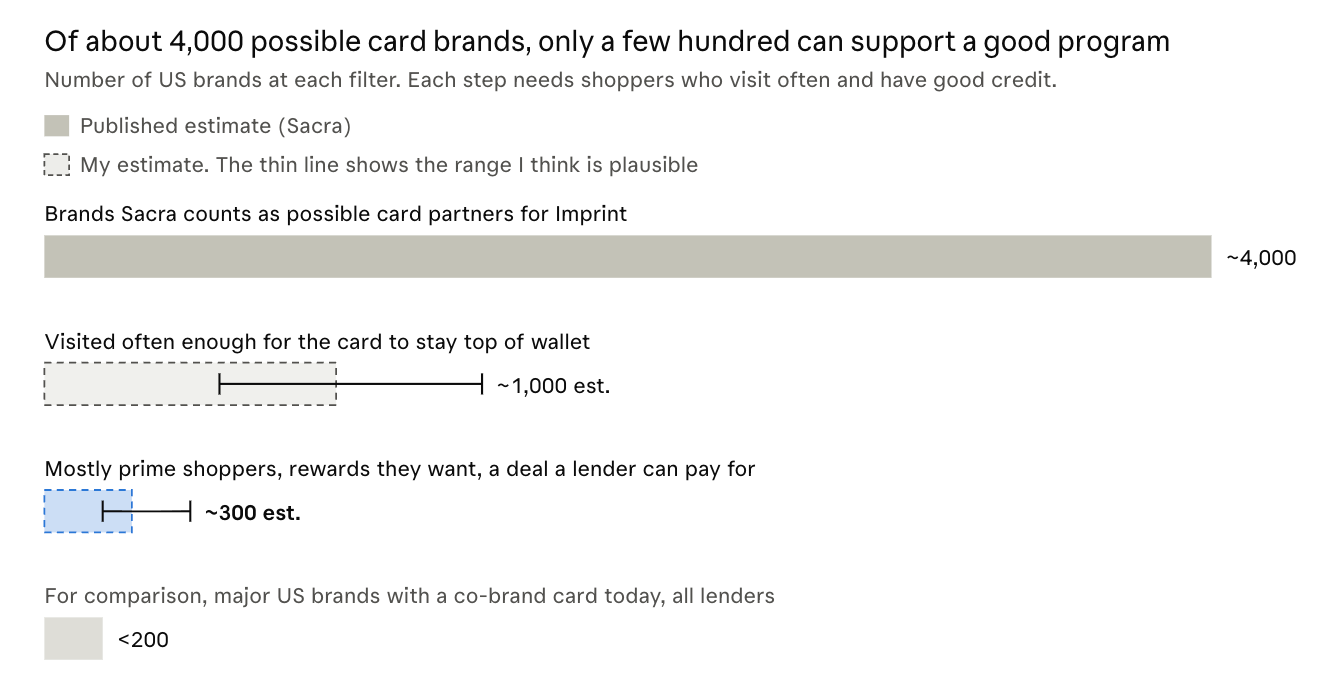
Each filter cuts deep. A card only works if it stays in the wallet, which takes a brand people visit every week or care about a lot. Then the shoppers need good credit, and the rewards have to be worth more than a 2% cash back card. Most of the 4,000 fail one of those.
I'm curious how far this goes. The limit was never just the lenders. It's the customers. There are only so many people with good credit, and each one has a card or two they actually use. About 24% of US adults have a co-brand card. A new card from a mid-size brand doesn't create new good borrowers. It fights Chase Sapphire and Costco for the same people.
It gets hard when a brand's customers don't qualify,. At Alliance Data, when we declined someone, the brand often wanted a second-look lender lined up to catch them, usually a subprime lender of sorts like a BNPL company. Imprint's answer is Imprint Access, a secured card with the same rewards, for the roughly 32 million Americans with little or no credit history. Smart, but those customers take years to become profitable.
Investors pay far less for $1 of lending revenue than for $1 of network revenue
A revenue multiple is simple. It's how many dollars investors pay for each $1 of a company's yearly sales. It's the quickest way to compare companies, and it's the only one that works for Imprint, which doesn't disclose profits.
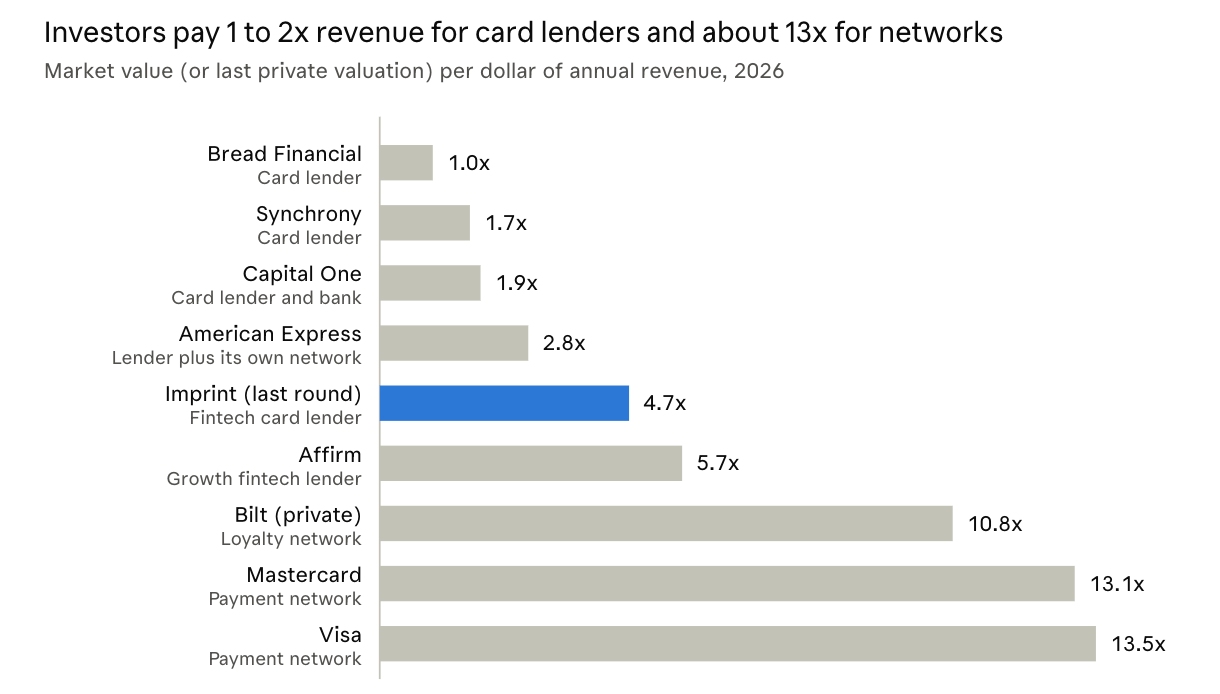
Lending revenue comes with strings attached.
- Some loans go bad
- the lender has to pay for its money
- a recession can wipe out years of profit.
So investors pay 1 to 2 times revenue for card lenders. Visa and Mastercard take a tiny fee on trillions of dollars of spending without lending a cent, keep about half their revenue as profit, and get about 13 times. Affirm sits in between because it grows fast and merchants pay it fees.
The more of Imprint's revenue that looks like the bottom of this chart, the more it's worth.
Revenue isn't counted the same way everywhere. Bread's revenue is after funding costs and brand payments. Affirm's is before. On Affirm's preferred measure, revenue after funding, losses and processing (about $2B for its last fiscal year), it trades at more like 12 times. Also, investors in lenders mostly look at two other numbers.
- Price to earnings is how many years of today's profit you pay. Bread is about 7.5. Synchrony about 8.
- Price to book is how much you pay for each $1 of the company's net worth. Bread and Synchrony trade around 1.6 to 1.8 times. Imprint's round is about 3.9 times the equity it has raised, a rough stand-in.
The best counterexample is Nubank, the Brazilian digital bank. It's a lender, but it trades around 20 times earnings and 5 to 6 times book, because it grows about 40% a year and earns around 30% on its shareholders' money. So lenders can earn rich multiples. They just have to earn very high returns while growing fast.
With each round, investors have paid a little less per $1 of Imprint's revenue.
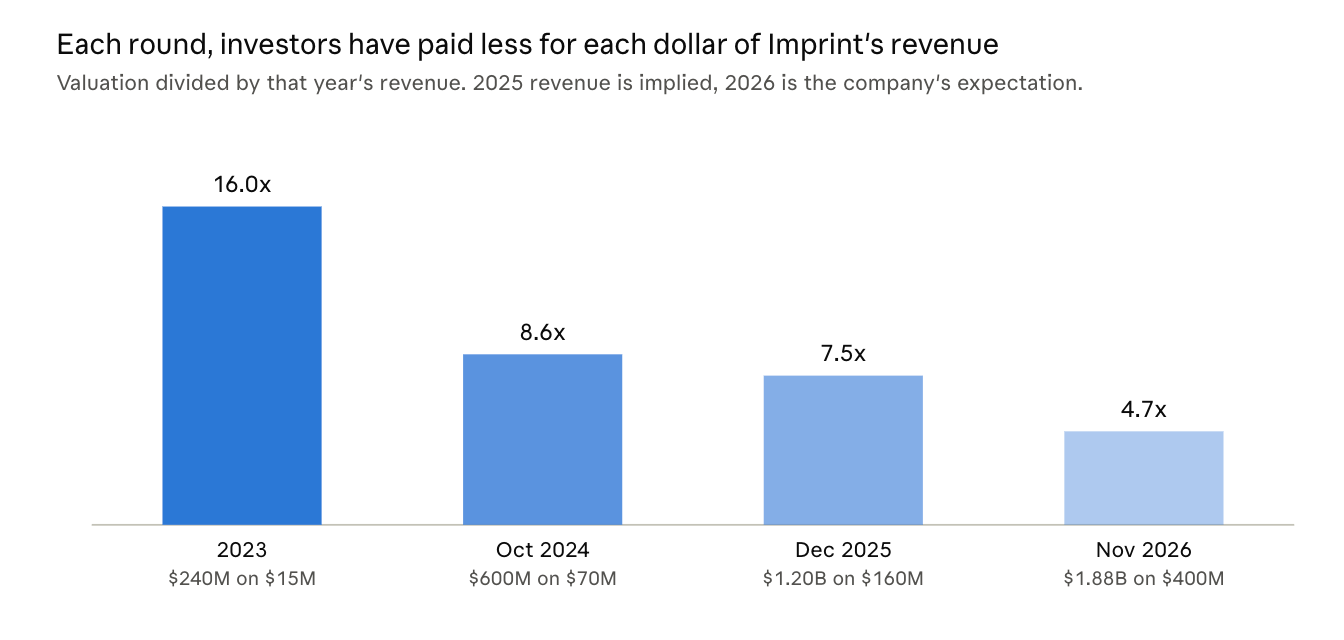
That isn't a knock. Paying 4.7 times this year's revenue for a company growing 150% is reasonable on its own terms, and next year's multiple will be lower if growth holds. It does show investors pricing Imprint more like a lender with each round. I made a version of this point in 2023, in a post on fintech revenue mix. A fintech rarely earns a pure software multiple. The ones that get close add revenue that doesn't depend on lending.
Imprint's price depends on how big and how profitable a lender it becomes
Here's the simplest way to judge $1.9B. Work backwards. Under each way investors might value Imprint, how big would it need to be for that price to be fair? I use the same assumptions for the rest of the post.
- Today. About $400M of revenue in 2026 and, by my estimate, about $2B of loans.
- Growth. Three paths. Slow starts at 50% in 2027 and fades to 5% by 2032. Steady starts at 75% and fades to 15%. Fast starts at 100% and fades to 25%. 2027 gets a lift on every path, because Kroger, Albertsons and Fanatics launched this fall and will count for a full year.
- Loans. About $4.50 of loans for every $1 of revenue. That's Bread's ratio, from a book heavy in store cards, but Imprint's own numbers land close to it.
- Profit. $0.025 after tax per $1 of loans, a bit below Synchrony.
- Labels. Investors value it one of four ways. Like a mature lender at 9 times earnings (Bread is about 7.5, Synchrony 8). Like Nubank at 20 times earnings. Like a lender with a real platform at 3.5 times revenue. Or like Affirm at 6 times revenue.
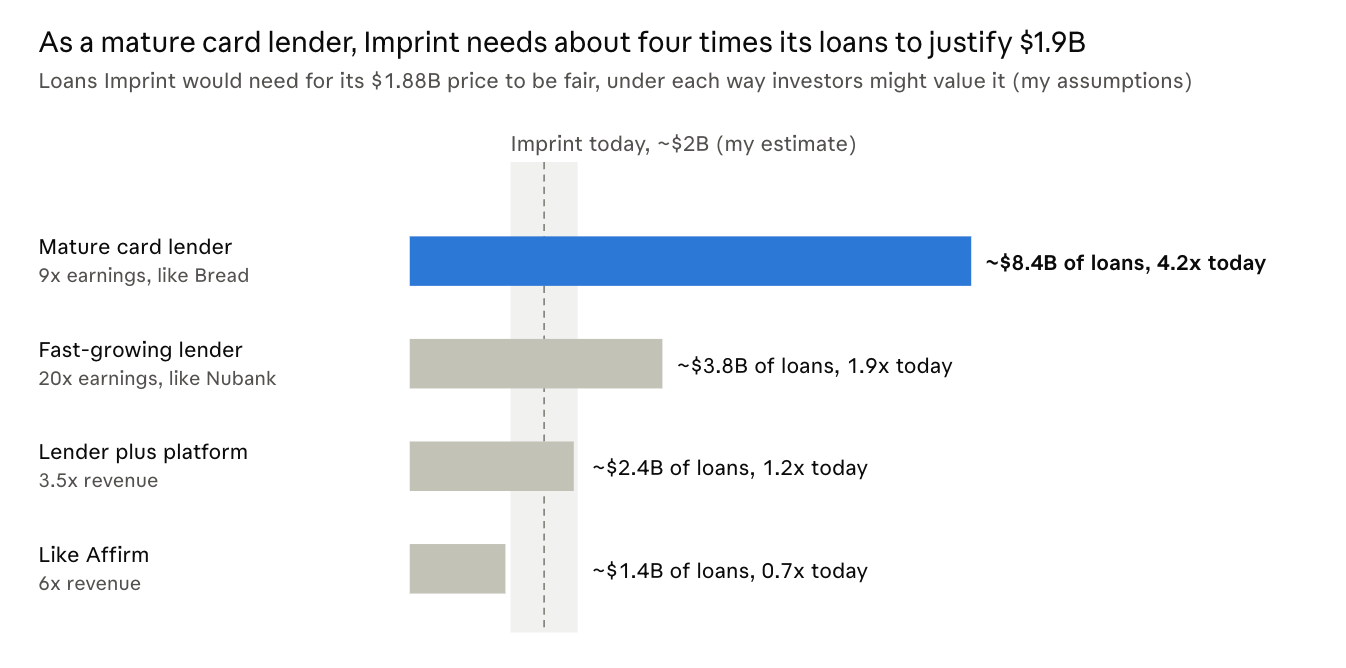
The economics set the bar. Valued like a mature card lender, Imprint needs about $8.4B of loans, roughly four times what I think it holds today. But lenders aren't all valued alike. Nubank earns a much higher multiple because it combines fast growth with exceptional returns on equity. Imprint could do the same without ever selling software separately.
So two questions decide what Imprint is worth.
- How fast can it grow?
- Can it eventually earn better returns on capital than a typical card lender?
Fast growth clears the toughest bar around 2030
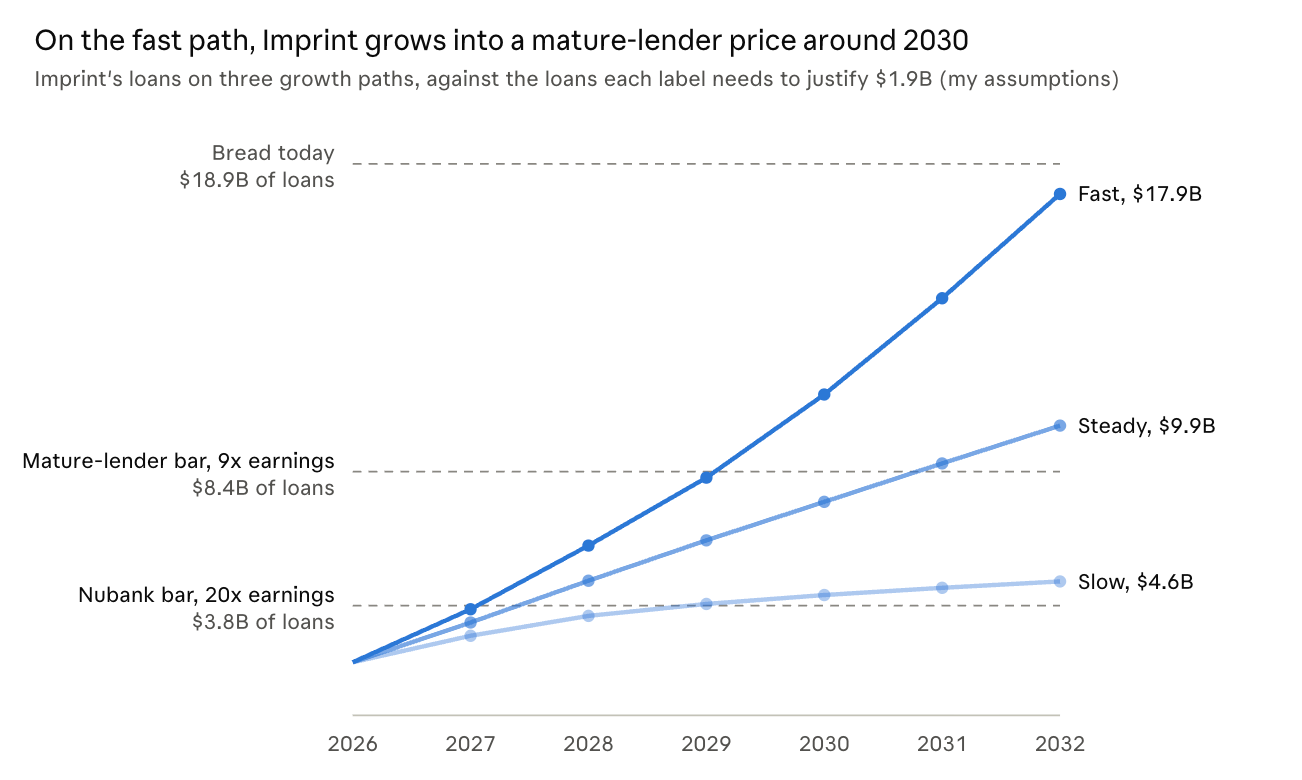
On the fast path, Imprint grows into a mature-lender price around 2030. On the steady path, it clears the Nubank bar by 2029 but not the mature-lender bar by 2032. Bread's $18.9B of loans stays out of reach on every path.
That's why one giant program matters so much. Walmart's program had $8.5B of loans when it left Capital One, and Apple's has about $20B. One win like that would roughly do the job by itself. Getting big comes down to four things.
- Win one or two giant programs without giving away the economics.
- Get cheaper money, which almost certainly means owning a bank.
- Get through a recession with today's loans holding up.
- Prove its technology and loyalty advantages produce better lending economics, or create valuable revenue beyond lending.
If Imprint were public in 2029, the label would matter more than the growth
Recent fintechs went public 8 to 13 years after they started, so a real IPO is more likely around 2030 to 2032, but, what if?
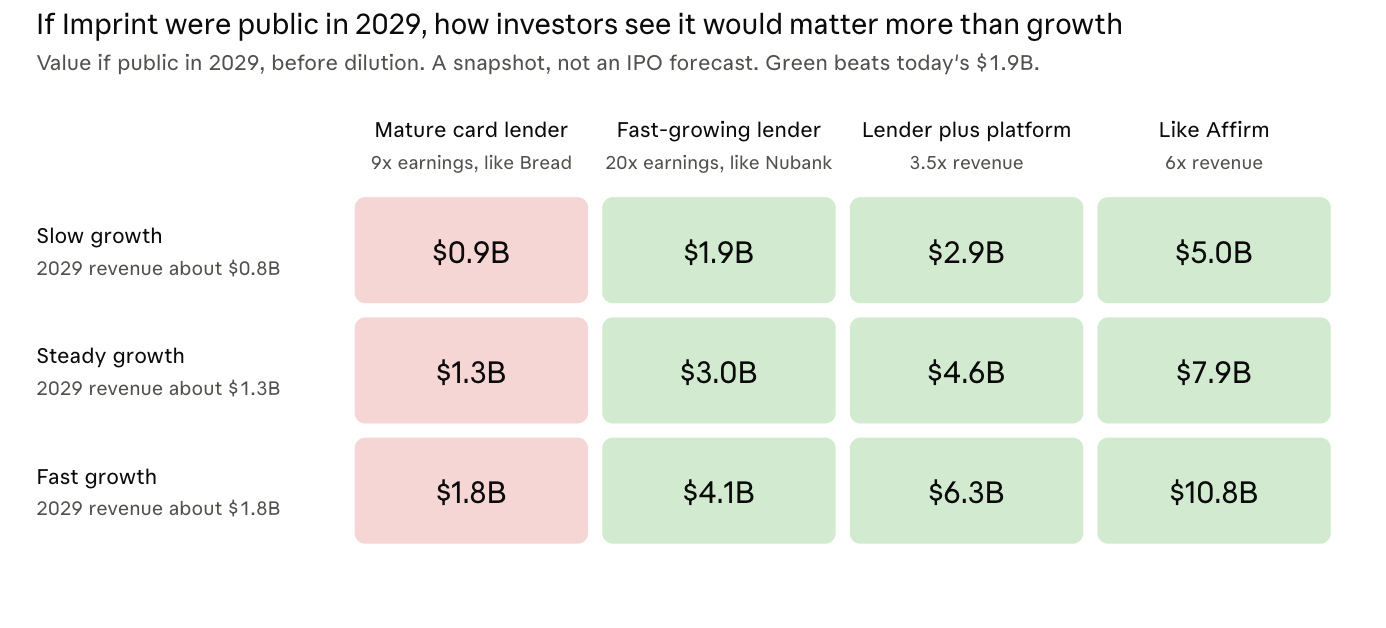
Read down a column and the value moves about six times. Read across a row and it moves about two times. If public investors see a mature card lender, Imprint is worth less in 2029 than its last round, even on the fast path. If they see a Nubank-style lender or anything with a platform, most paths beat today's price.
Tech, loyalty and AI matter if Imprint keeps more of the value they create
Imprint has three potential advantages beyond simply lending money:
- its technology
- loyalty product
- AI shopping tools.
None needs to generate standalone revenue to be valuable. They can help Imprint win programs, acquire better customers, lower costs and earn higher returns. The harder question is how much of that value Imprint gets to keep, rather than passing it back to brands through better contract terms.
The tech counts if it lowers costs, wins programs or earns fees
Imprint built the whole stack itself, from approvals to servicing to rewards. Bread outsourced card processing to Fiserv, and most banks run programs on TSYS, Fiserv or FIS. So what's Imprint's tech worth?
On its own, less than you'd think. The code that runs a card program is something incumbents can buy from vendors. Tech becomes valuable when it shows up in one of three places.
- Lower costs. Synchrony spends about $0.05 per $1 of loans running the business. Nubank runs at about a 20% efficiency ratio, meaning it spends about $0.20 to earn each $1 of revenue, against about $0.36 at Synchrony. If Imprint's stack lets it run far cheaper, that shows up as higher returns, and investors pay a Nubank-style multiple for that. There's an early hint. Bread brings in about $640K of revenue per employee. Imprint, with a few hundred people and about $400M of revenue, is likely well above $1M, though it may lean more on outside vendors for things like call centers.
- Faster growth. Launching in three months instead of 18, with a card inside the brand's app, wins programs. That's already working.
- Selling it to others. If a brand, or even another bank, paid Imprint to run a program on its stack without Imprint lending the money, the tech would earn software revenue and a software multiple. I haven't seen that yet. It would be a big deal if it came.
Affirm is the useful comparison. Its tech connects a huge network of merchants with nearly 28 million shoppers, and merchants pay Affirm to close sales. That network is what earns the higher multiple, not the code. Imprint's tech today goes deep with one brand at a time. It doesn't connect brands to each other.
My take. Imprint's stack is an advantage, but investors will value it through the returns it produces, not as a separate software business, unless Imprint starts selling it.
Loyalty counts if it improves card economics, even when bundled
Imprint now calls itself a payments, loyalty and intelligence platform. Alliance Data used to call itself a loyalty and marketing company. Here's how that played out.
Alliance Data owned Epsilon, a data marketing business, and Air Miles in Canada, next to its card bank. It sold Epsilon for $4.4B in 2019. It spun off Air Miles as Loyalty Ventures in 2021, which went bankrupt in 2023. What was left was the card bank, which is Bread, valued like a lender.
The lesson isn't that loyalty is fake. Epsilon was worth billions. Selling loyalty separately can create a valuable business, but it isn't the only way loyalty creates value. If Imprint's rewards make cardholders spend more, stay longer or cost less to acquire, the lending business becomes more profitable. The catch is that brands know what their loyalty is worth, too, and can demand more of those economics at renewal.
Imprint's loyalty product is real. It runs the rewards and connects them to each brand's program. But it comes bundled with the card. Does a brand ever pay Imprint for loyalty when Imprint isn't the lender?
AI shopping agents are upside
Imprint launched a server that lets AI agents use a member's rewards, virtual cards and purchase history, with the member approving each purchase. It also says AI has tripled how fast its engineers ship.
If an AI agent builds your weekly grocery order, it'll pay with whatever card is saved and follow the points. The grocer that owns the card and the rewards has a real shot at being the agent's default. Here's the catch. Agents will also compare prices across stores without any loyalty at all. And Synchrony is chasing the same thing with OpenAI and Stripe.
My take. AI shopping could make Imprint's cards more valuable even if brands never pay a separate fee for it. But it's early, and the value may go to the retailer, the shopper or the AI platform rather than Imprint.
All three come back to one question: can Imprint use technology, loyalty and AI to build a more profitable lending business than the incumbents, and keep enough of that advantage as brands negotiate harder? If it can, investors could value it like Nubank, a lender earning a premium because it grows fast and produces exceptional returns. Selling software or loyalty separately would be additional upside, not a requirement.
Five shifts will reshape co-brand over the next five years
This isn't a winner-take-all market. Chase, Amex, Synchrony, Bread and Imprint can all do well. But these shifts will move share.
- Co-brand keeps taking share from store cards. Javelin's 2026 report on the category is titled "Co-Branded Credit Cards Smoke, Private Labels Choke." That squeezes Bread's store card core and plays to Imprint.
- Brands keep gaining leverage. Morgan Stanley says airlines and hotels are gaining bargaining power at renewal. Brands will keep taking a bigger cut from every lender.
- The card moves into the brand's app. Walmart with OnePay, Bilt with Cardless, Kroger with Imprint. Bank-branded apps will look dated.
- AI agents start shopping. Stripe, Shopify, Synchrony and Imprint are all building for it.
- Regulators stay focused on store cards. The CFPB found 90% of retail cards had a maximum interest rate above 30%. That pressure lands hardest on the high-rate store card model.
Eight risks could cap Imprint's outcome
- Its loans are young. New accounts haven't had time to go bad, so fast growth makes losses look low. In my experience it takes a year or two to see real losses. Write-offs in its bond trust already ticked up from 4.73% to 4.86%.
- It has never seen a recession. Imprint was founded in 2020.
- Its funding can dry up. Warehouse lenders can cut lines and bond buyers can vanish in a panic, as happened in 2008 and March 2020. Deposits leave much more slowly.
- It depends on two small partner banks. Regulators have looked much harder at banks that rent out their charters to fintechs over the past few years.
- Giving the brand the customer makes you easier to replace. This is the one I think about most. Banks kept cardholders in their own apps partly because it made switching painful. When the card lives in the brand's app and the points live in the brand's loyalty program, the brand can run a cleaner bake-off at renewal. Imprint keeps more stickiness where cardholders use its own app, as Shell's do.
- One partner is big. H-E-B was about a third of revenue in 2024.
- Rate caps. President Trump called for a 10% cap on card interest rates in January, and Senators Sanders and Hawley have a bill. It looks stalled, but most of Imprint's revenue is interest.
- Incumbents aren't asleep. Chase just won Apple. Synchrony put Walmart's cards in OnePay's app. Affirm is competent.
Over ten years, Bread and Imprint have similar expected returns with very different risk
Not investment advice. Just how I'd think about it.
Buying Bread at about 7.5 times earnings, with slow growth plus buybacks and dividends, something like 10% to 13% a year is reasonable. That's roughly 2.5 to 3.5 times your money in ten years. It will probably still exist, either on its own or inside a bigger bank that bought it.
Buying Imprint at $1.9B means a wide range of outcomes, and future fundraising will dilute you along the way.
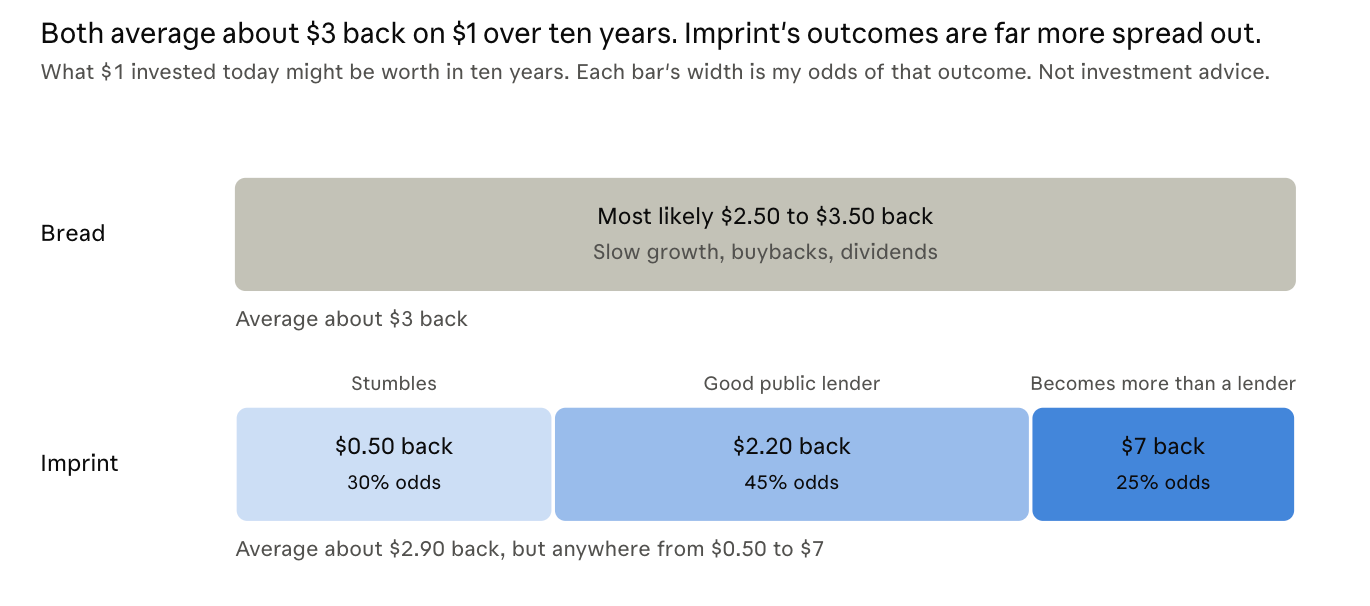
Both land around 3 times your money. Bread gets there with a narrow range of outcomes. Imprint gets there with a wide one.
My bet is Imprint. Not because the math is clearly better. Because the direction of travel is on its side. Brands want the card close to their own app and tied to their own rewards, launched in months. And ten-year returns come from the big outcomes, not the average ones.
Imprint is a strong business, priced for the big outcome it's working toward
Is Imprint worth half of Bread? On today's numbers, not really. But investors aren't paying for today's loan book. They're betting Imprint can become a much bigger lender, with better technology, lower costs and higher returns on capital than the incumbents. It doesn't need to become a software company to justify a premium valuation. It needs to prove those advantages translate into durable profits that brands can't negotiate away.
Is it just a hot private round? No. Bonds that drew nearly five times the demand, Kroger and Albertsons switching to a startup, and customers who pay like prime borrowers are hard to fake.
Is it coming for Bread? Not exactly. It's taking share from big banks today. Over time it will make Bread's co-brand pitch look slow. Bread's store card business is safe from Imprint.
Can Imprint become a big public company? My bear to base case is a good public lender worth roughly up to $10b ten years. The bull outcome is $15B to $20B, closing in on Affirm's $20B and Synchrony's $25B. That may take a bank of its own, a giant program, a clean recession and revenue brands pay for beyond the loans. I put the odds at about one in four. That's a lot going right, but it's not too unreasonable.
What I'd be watching.
- Whether Imprint buys or becomes a bank
- Write-offs in its bond trust as this year's accounts age
- Whether a big partner pushes for approvals Imprint shouldn't give
- What happens with H-E-B and other meaningful programs at renewal
- Whether Imprint's better technology translates into higher profits per account, or whether brands capture most of the benefits when contracts renew
- Any revenue from brands that isn't tied to lending. Perhaps:
- Running a card without lending on it. A brand, or even a bank, pays Imprint a fee to run its card program on Imprint’s technology, while someone else funds the loans. That’s software revenue, closer to what Cardless does on Bilt.
- Loyalty software on its own. A brand pays Imprint to run its rewards program for all its customers, not just cardholders. Imprint already builds rewards that can target specific products, so selling that separately is a natural step.
- Paid offers to cardholders. Brands pay to put deals in front of Imprint’s cardholders, like Amex Offers, where a merchant pays when a cardholder shops.
- Merchant-paid financing. A retailer pays Imprint to offer installment plans at checkout, the way merchants pay Affirm. This is still lending, but the merchant fee is a revenue stream investors value more than interest.
- AI agent shopping. Brands pay for Imprint’s tools that let AI agents shop with a member’s card and rewards.
I've written before how customer selection is critical across fintech. It's still the lesson I'd bet on here. Imprint picked groceries and gas, prime borrowers and everyday spending. Smart start. What happens when a big partner wants more account approvals and a bigger cut at the same time?
I'll end with a question for you. Is Imprint just a lender, or something more? And what would it take to convince you either way?
Sources and notes
- Upstarts Media, How fintech Imprint doubled revenue to $400M and hit a $1.9B valuation
- Beinsure, Imprint raises $130M, AI tools and Imprint Access
- Sacra, Imprint research
- Contrary Research, Imprint
- Imprint, products and deposit accounts
- Imprint, $2 billion in new debt funding (Aug 2026)
- Imprint, inaugural AAA bonds (Oct 2025)
- Fitch ratings on Imprint's card trust, 2026-A
- Synchrony card bond term sheet, Nov 2026
- The Shelby Report, Kroger card and Albertsons card
- Covers, Fanatics unveils its American Express card
- Nilson, US card spending 2025 and store cards 2024
- CFPB, The high cost of retail credit cards and Consumer credit card market report, 2025
- Synchrony 2025 10-K, Q4 2025 and Q3 2026 results
- Bread full year 2025 and Q3 2026 results, Fintool on Bread Q4 2025
- Affirm fiscal Q1 2027, fiscal Q4 2026 and valuation
- Nubank valuation metrics
- Bloomberg, Loyalty Ventures bankruptcy
- View from the Wing, Amex paid Delta $8.2 billion
- MacRumors, Apple Card moves to Chase
- eMarketer, Walmart, OnePay and Synchrony
- Banking Dive, Cardless and Payments in Full, Bilt Card 2.0
- Fortune, Bilt's card share of the business
- Morgan Stanley on co-brand bargaining power and Javelin's 2026 co-brand report
- OpenCapital price to sales
- MBNA history
- View from the Wing, who really issues the new Bilt card
- Sacra, Cardless research
- Yahoo Finance, Cardless raises $60M, issuer First Electronic Bank
- PaymentsJournal, Bilt 2.0 rollout
- American Banker, fintech bank charters in 2026
- S&P Global, US bank charter approvals in 2026
- SoFi, Golden Pacific acquisition and Banking Dive, LendingClub on Radius
- Banking Dive, Mission Lane credit card bank
- Synchrony Q3 2026 10-Q
- Shell support, managing your Imprint account
- FT Partners, Deserve's sale to Intuit and CPA Practice Advisor, Intuit acquires Deserve
- M1, Owner's Rewards Card sunset and myFICO forum, the end of the AMC card
- Bread Financial employees, Bread 2025 expenses and TrueUp, Imprint