From seats to outcomes: how AI Is changing software pricing
Every time software changed what it sold, an industry formed around the new unit. Selling work will need more of one than seats or usage ever did, and it's arriving faster.
Last week Salesforce closed its purchase of Fin for about $3.6 billion. Fin spent fifteen years as Intercom, a company its founder calls "a darling of the SaaS era." In May it renamed itself after its AI agent, which charges $0.99 cents when it resolves a customer's issue.
A SaaS company renamed itself after its outcome-priced agent and sold to Salesforce, which Fin's own founder credits with inventing modern SaaS. Fin still sells seats underneath, and Salesforce still sells most of Agentforce per conversation or per credit. But ten days after signing the deal, Salesforce announced a per-resolution price for its own Help Agent. That's the arc of software business models in one deal.
SaaS volume is still compounding, by Stripe's own index. What's moving is the unit underneath it.
- On-prem software sold a license. You bought a copy.
- SaaS sold a seat. You bought access.
- Cloud sold usage. You bought capacity.
- Agents sell work. Where it's working, the bill is for the job.
Each step moved the bill closer to the thing the customer actually wanted. And each step built more infrastructure than the one before, because the unit got harder to count. Outcomes are the hardest unit yet, they're showing up in surveys faster than usage did, and the far end of them is agents buying work from other agents with no person in the loop. So the story here isn't that the bill is moving. It's how much has to be built when it does, and how fast.
Every unit built infrastructure on both sides of the bill
When the unit changes, two things happen at once. Sellers need new machinery to price, meter, and collect it. Buyers need new machinery to govern and control it. A few companies end up owning that machinery, because neither side wants to keep building it.
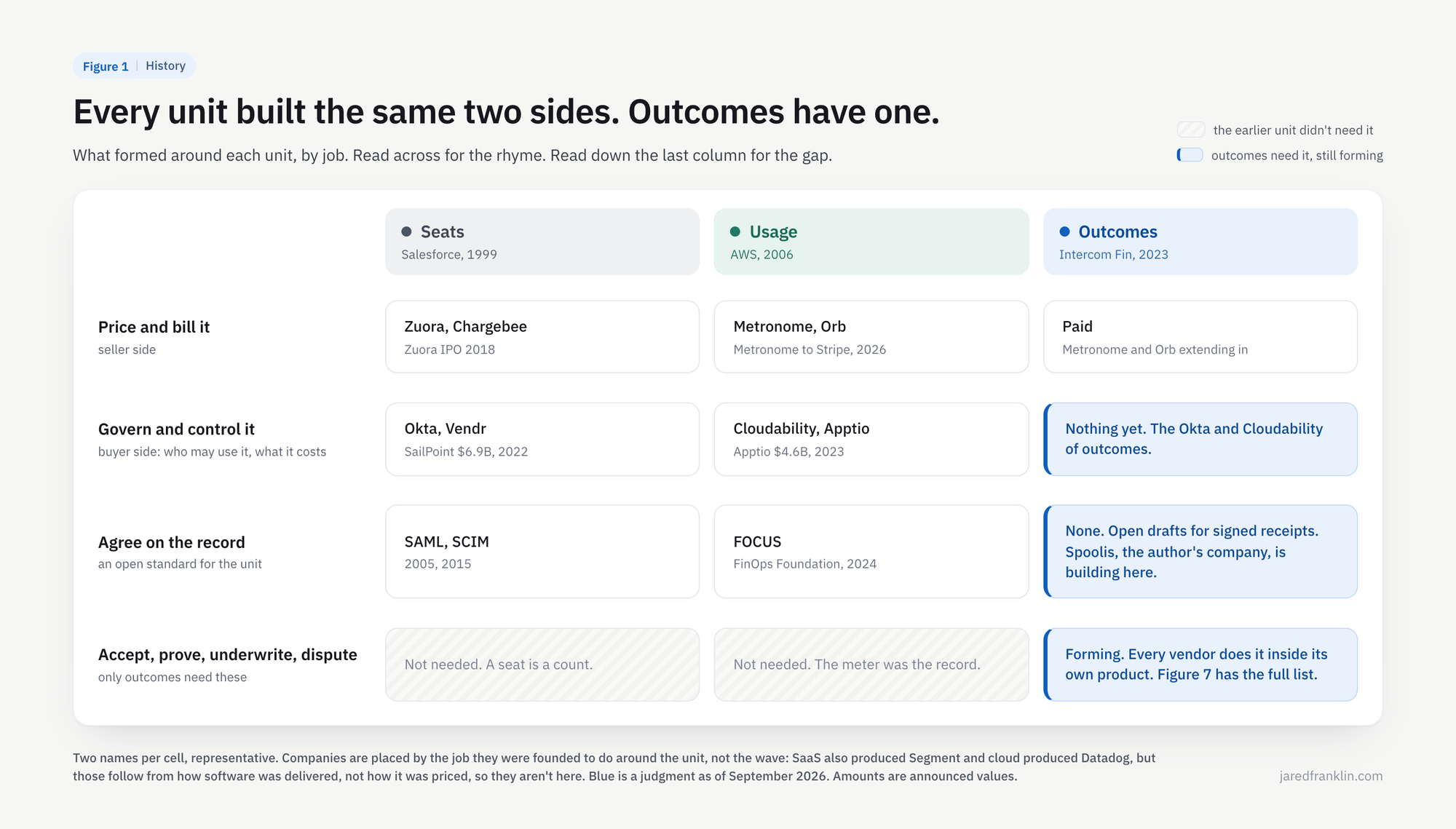
Subscriptions needed recurring billing, so we got Zuora and Chargebee. Companies piled up dozens of SaaS apps, so we got Okta and SailPoint to govern access and Vendr and Zylo to see the spend. And the seat itself got a standard. SAML let one login work across every app a company bought, and SCIM let a company provision and revoke a user everywhere at once, which is the only reason a buyer-side control layer could exist.
Usage needed metering and rating, so we got Metronome and Orb. Stripe bought Metronome in January. Patrick Collison called metered pricing "the native business model for the AI era," and for the model layer I think he's right. Agents push one step past it. Variable cloud bills needed control, so we got Cloudability and CloudHealth, then Apptio, which IBM bought for $4.6 billion. And the metered line item got its standard too, eighteen years after AWS. FOCUS, the FinOps Foundation's open spec for cloud billing data, shipped its 1.0 in June 2024 with AWS, Azure, Google, and Oracle exporting in it, and has since been extended to SaaS and AI providers.
None of these companies invented the unit. They made a complicated unit governable, job by job, and the jobs differed. Usage needed arbitrage and a profession, FinOps, that seats never did, because the bill turned variable. Each era also eventually wrote down a shared record of the unit that both sides could read. That's what infrastructure is.
One distinction, so it's clear what this piece is following. Each wave carried a unit. SaaS carried the seat, cloud and APIs carried usage, agents carry the outcome. But the wave and the unit aren't the same thing, and they produced different infrastructure. SaaS made it easy to buy forty apps, so Segment, MuleSoft, and Zapier appeared to stitch the customer record back together, and Twilio paid about $3.2 billion for Segment. Cloud scattered workloads across services, so Datadog appeared. Those follow from how software was delivered, not from how it was priced, and they aren't on the charts. The charts follow the unit, because the unit is what billing, control, and the shared record form around.
Outcomes have the billing companies. They don't have the standard, and they need jobs done that neither earlier unit ever created a need for. Deciding what counted. Proving it. Carrying the risk of a miss. Contesting the answer.
Outcomes are three years in, and the seller side is forming first
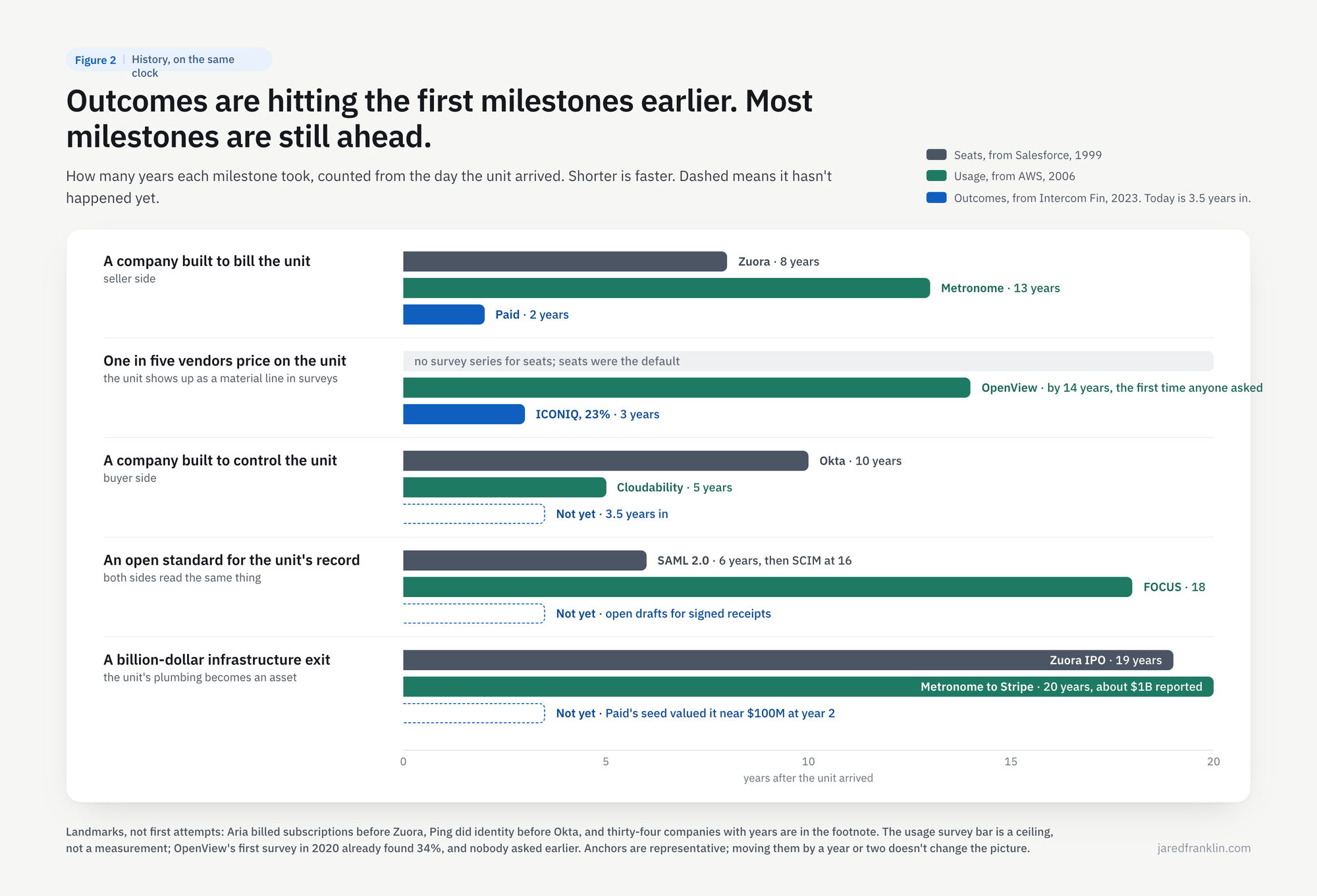
A new unit appears inside products first. Seller-side infrastructure follows as the pricing gets harder to operate. Buyer-side infrastructure shows up once the spend is large enough to need control. Then the exits, and a second generation built on the first.
Seats first. Salesforce in 1999, then Zuora, the subscription-native billing company, eight years later, Okta ten, and Zuora's IPO nineteen years in.11 Then usage. AWS in 2006, Cloudability five years later, Metronome, the usage-native billing company, thirteen. By 2020 a third of SaaS companies had some usage pricing, and three in five by 2022. Apptio sold seventeen years in. None of these was the first to bill the unit. Aria was billing subscriptions before Zuora, and Zuora was metering usage before Metronome. They're the companies built for it.
Outcomes are three and a half years in. Fin priced a resolution in 2023. Sierra, which prices on outcomes, was founded the same year and was valued at $15 billion this May. Paid, a billing company built for outcomes, launched out of stealth in 2025, and the usage billing platforms are adding outcome units themselves. By July, 23% of AI companies had an outcome component. Seller-side infrastructure is forming.
The buyer side is much less settled. Nobody yet gives a buyer one accepted result across several vendors, judges, and downstream systems, and no standard has formed for it. That doesn't mean one has to emerge. It's the clearest gap, and the rest of this piece is about how much has to be built around this unit, why more than last time, and why faster.
Seats don't disappear. Usage didn't kill them either; most companies blend models, 1.7 on average by ICONIQ's count. The new unit arrives as a component. The question is what the component does to everything around it.
Agents don't fit a seat, and vendors are already moving the bill
A copilot still maps to a seat. A person uses it. You count the people.
An agent that resolves a support case, qualifies a lead, or remediates a security finding doesn't map to a seat. Nobody's in the chair. It doesn't map cleanly to usage either. The customer doesn't care how many tokens it took. They care whether the case got resolved. And software that automates the work shrinks the seat count it's billed on, so the better the product works, the less the pricing model captures. Vendors can feel that, so they're moving.
Intercom charged $0.99 per resolution for Fin from the start, and its own research later put the reason plainly. "Zero buyers preferred paying for activity." Sierra charges when its agent resolves the conversation and, in most cases, nothing when it doesn't. HubSpot moved its Customer Agent from $1 per conversation to 50 cents per resolved conversation in April. Its chief customer officer's line was that too many AI deals mean "paying for potential rather than performance."
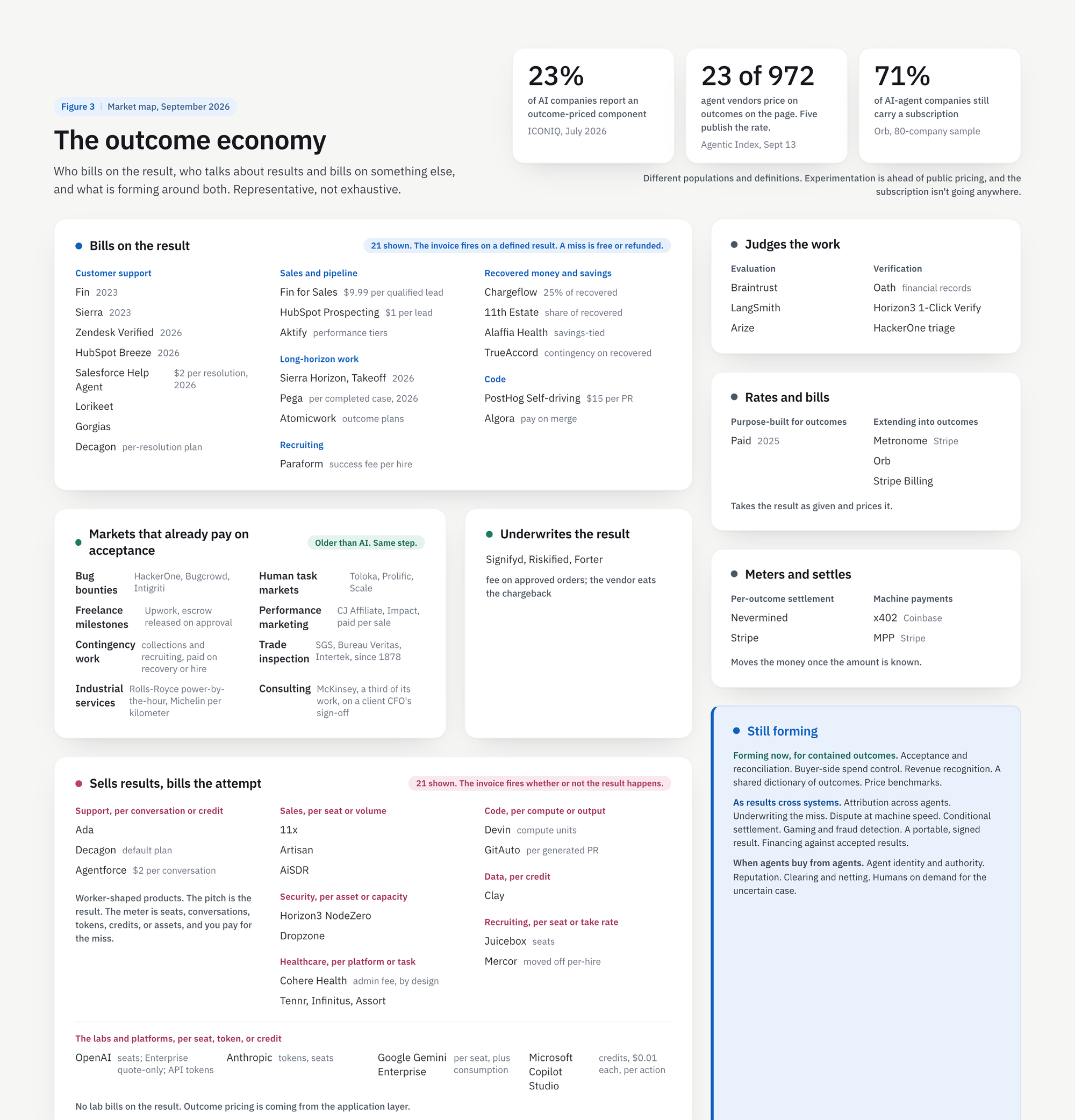
Buyers are pulling, with a catch. G2's 2026 survey found preference for outcome pricing doubled in a year, 11% to 23%. The same survey found buyers rejecting pricing they "cannot predict, defend, or connect to business value." They want the bill tied to results and they want to know what it will be. Both at once. ICONIQ's survey of AI builders found outcome pricing went from about 2% in mid-2025 to 18% in January to 23% by midyear. Orb's study of 80 AI-agent companies found 95% on hybrid pricing and 71% still carrying a subscription.
Support has been the wedge.
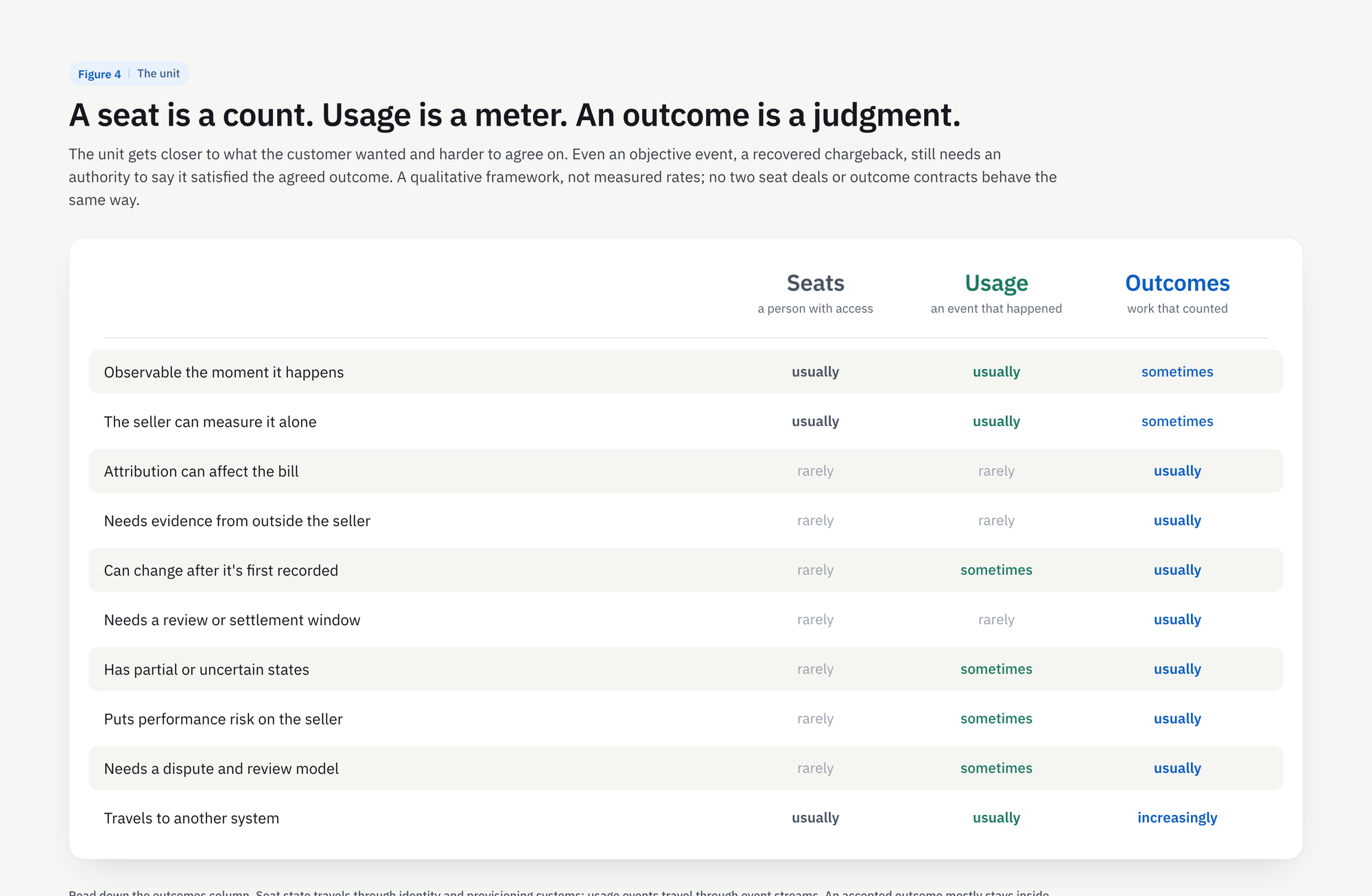
A seat is a count. Usage is a meter. An outcome is a judgment.
A seat is a person with access. You count them. Two vendors mean roughly the same thing by "a seat."
Usage is an event that happened. Harder to agree on, since one vendor's "request" includes retries and another's doesn't, but a meter can produce it without anyone's opinion.
An outcome is work that counted. Not work that ran. Not work the vendor says is done. Work that met a definition someone else had the authority to apply.
That last sentence is the whole difference. Ask what a finance team has to ask.
- Was the case resolved, or did the customer stop replying?
- Does "qualified lead" mean the vendor's definition or yours?
- If 92 of 100 records were good, did the vendor earn 92%?
- If five results couldn't be verified, are they failures or just unresolved?
- If something passed in March and new evidence overturns it in April, which answer does finance use?
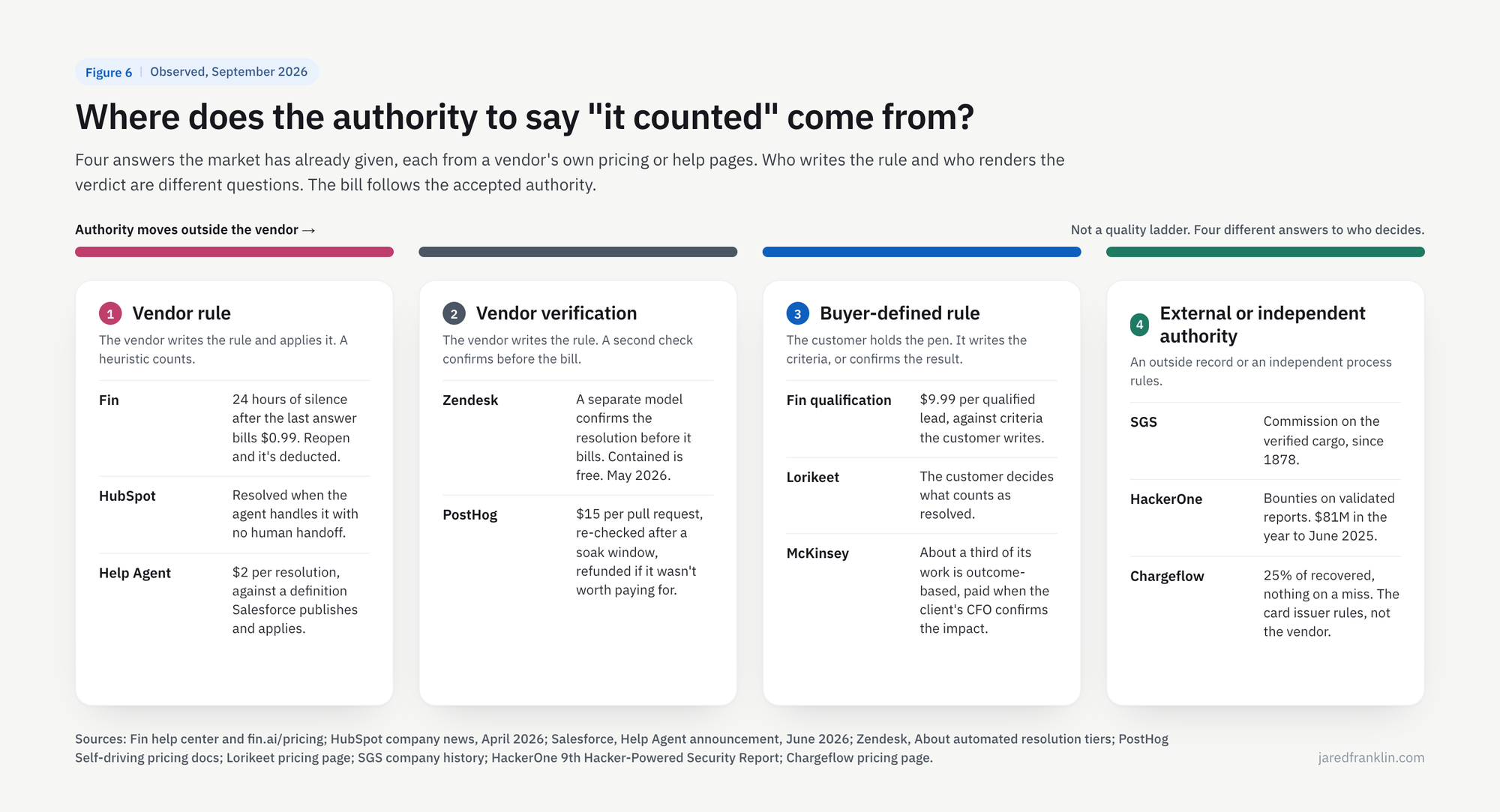
You can watch the industry work through these in public, and I mean that as a compliment. Fin prices four outcomes now, three at $0.99 and a qualified lead at $9.99, and the customer defines "qualified." When Intercom looked at charging a percentage of closed revenue for its sales agent, it decided attribution and measurement were too hard and chose the qualified lead instead. Zendesk split contained resolutions from verified ones in May after feedback showed "significant ambiguity concerning which statuses translate into billing metrics." It bills only the ones a second model confirms.
An outcome is also stateful. Fin bills an "assumed resolution" when a customer goes quiet for 24 hours after its last answer, then deducts the charge if the customer comes back to the same thread, even in another billing period. That isn't event, then bill. It's event, candidate outcome, accepted outcome, possible correction, then money. Stripe's guide for businesses adopting outcome pricing says why. "Both sides need confidence that the result really happened and that the product caused it."
Outcome pricing starts as a pricing idea. Then it becomes a measurement problem. Then a state problem. Then a trust problem.
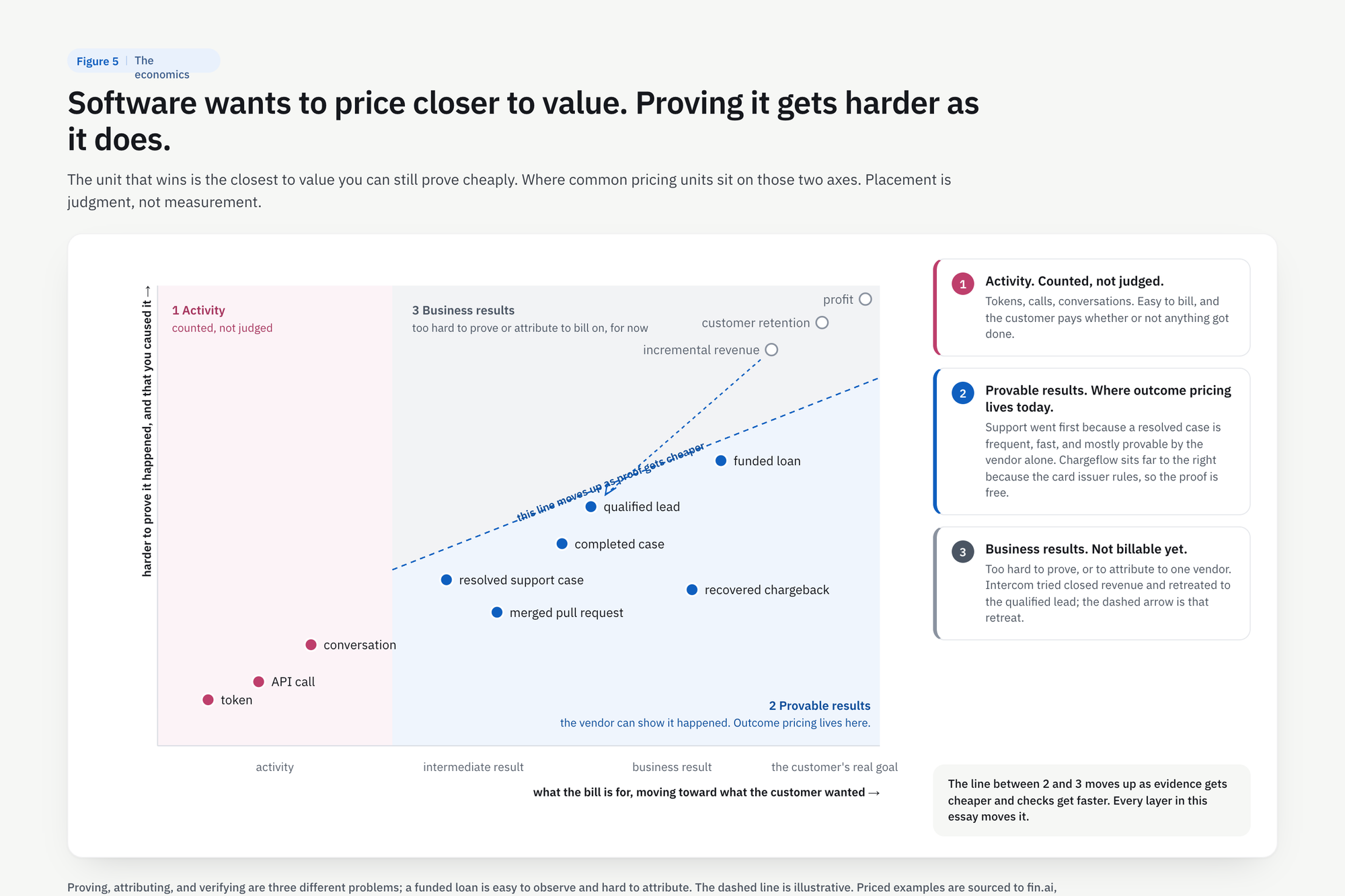
The winning unit is the closest to value you can still prove cheaply
Ronald Coase's answer to why firms exist was that using the market is expensive. You have to find a counterparty, agree on terms, inspect what you got, and settle disputes. AI lowers the cost of the work, and some of those costs too. But cheaper work means far more work bought, in smaller pieces, from more providers. If the cost of deciding whether the work counted doesn't fall as fast, that decision becomes a bigger share of what's left.
AI doesn't eliminate transaction costs. It can move the bottleneck from producing the work to agreeing on whether the work counted.
Bengt Holmström won his Nobel for the other half. When one thing is easy to measure and another important thing isn't, paying hard for the measurable thing distorts behavior. That's why pure pay-for-performance is rarely the right contract, and why many outcome-priced vendors stop short of the outcome the customer actually wants. Intercom didn't price on closed revenue. It priced on the qualified lead, the nearest thing it could observe, attribute, and defend.
So the law isn't "closer to value is better." The unit that wins is the closest-to-value unit you can still observe, attribute, control, and verify cheaply. Infrastructure is what moves that frontier outward.
There's a second reason vendors stop short. Every step toward the outcome moves risk from the buyer to the vendor. Price per resolution and you're underwriting resolutions. That's fine in support, where a miss costs a chat. It gets more consequential in lending, security, healthcare operations, or any workflow where a false positive creates real downstream cost, which is where the next wave is headed, and where somebody eventually gets paid to price the risk.
Outcome pricing sticks where results are frequent, fast, evidenced, and correctable
Look at the vendors that have made outcome pricing stick and the same conditions show up.
- The result happens often, so volume does some of the underwriting.
- The measurement window is short. A resolved ticket settles in days, not quarters.
- The vendor mostly controls it. Not entirely, but enough to carry the risk.
- An authority outside the worker's self-report exists. A card network's ruling, a funding record, a merged pull request, the buyer's own system.
- It's hard to game, or cheap to audit. Holmström's warning applies: pay on a proxy and people optimize the proxy.
- It can be corrected. Fin refunds on reopen. PostHog refunds a bad PR.
- The value is high relative to the cost of checking.
That's why a resolved support case works, why a recovered chargeback works, why a funded loan can plausibly work, and why "incremental revenue caused by the AI" mostly doesn't yet. Each condition is also a place infrastructure can move the line. Faster evidence, cheaper checks, and safe correction each let the unit move one step closer to the thing the customer wanted.
Two vendors that walked away from outcome pricing are as instructive as the ones that adopted it. Cohere Health, which automates prior authorization for insurers, charges an administrative fee and says so, because a vendor paid per approval or per denial has a reason to tilt the judgment. Mercor started out charging per hire and moved to a take rate on the work its contractors do. Both are Holmström's warning turned into a pricing page. When the result you'd bill on is one the vendor can tilt, bill on something it can't.
Markets that pay for results built an acceptance step, and software is building it one vendor at a time
Trade solved one version of this 148 years ago. In 1878 a Latvian immigrant named Henri Goldstuck noticed that grain exporters in Rouen were paid for what arrived, not what shipped, and nobody had a trusted record of either. He started inspecting cargo on arrival and took a commission on the verified shipment. Within a year he had offices in Le Havre, Dunkirk, and Marseille. An early product was a guarantee on the quantity at destination, backed by inspecting the cargo at both ends. That company is SGS. It has nearly 100,000 people and did CHF 6.8 billion in revenue in 2024.
The value wasn't in looking at the grain. It was in producing a trusted record, with a guarantee behind it, that another party could rely on. Trade finance still works that way. A letter of credit pays against documents, not wheat.
Markets that separate delivery from payment keep inventing some version of acceptance. Purchase order, goods receipt, inspection, invoice, then payment. Finance systems call it a four-way match, and Coupa and SAP Ariba run it on pallets every day. Freelance marketplaces hold the money in escrow until the client approves the milestone. Bug bounties pay on valid. HackerOne programs paid $81 million on validated reports in the year to June 2025. Chargeback recovery pays on recovered. Chargeflow takes 25% of what comes back and nothing on a miss.
Industrial companies have sold outcomes for decades. Rolls-Royce's power-by-the-hour, Michelin's pay-per-kilometer, Caterpillar's productivity contracts. A study published this February followed nine industrial firms scaling outcome-based models and found the same three things in the way every time. Measuring the outcome. Attributing it to the supplier. And the supplier's limited control over what the customer does with the advice. Those are the axes of the frontier chart, found by other people in mining, chemicals, and marine equipment. And consulting is doing it now. McKinsey's CFO said in April that about a third of the firm's work is outcome-based, and that McKinsey only gets paid when a CFO on the client side confirms the financial impact, or a KPI that proxies for it, was hit. That's the piece in one sentence from the largest consulting firm in the world. An outcome. A proxy when the outcome itself can't be measured. And a buyer-side authority who has to say it counted.
Software subscriptions skipped this layer because they didn't need it. Services never did; every implementation contract has acceptance criteria and a milestone bill. A seat invoice needs no inspector. A usage invoice needs a meter. An outcome invoice needs the thing Goldstuck sold, a judgment about the work that a second party will rely on.
There's no common four-way match for digital work. Each vendor is building its own. PostHog charges $15 per pull request, refunds it if it "wasn't worth paying for," and re-checks the fix after a soak window. Zendesk runs a second model over every resolution before it bills. Salesforce added a per-resolution price for its Help Agent with its own published definition of a resolution. Platforms that are the outcome, Fin and Sierra, keep the inspector because it's the product. Everyone retrofitting a seat product builds one as a patch, the kind every vendor in the category now has to build and none of them set out to.
Notice who eats the miss. A seat hides it. Usage bills the attempt. Fin's escalation to a human is free, but its silence bills the buyer unless the customer comes back. Chargeflow's miss costs Chargeflow. PostHog's costs PostHog. The closer the unit gets to the result, the more the miss has to land on someone specific.
Agentic Index tracks 972 agent vendors and counted 23 that price on outcomes as of September, five of which publish the rate. That doesn't contradict ICONIQ's 23%; one survey measures intent and the other measures what's on the price page. Cresta is the cleanest example. It sells into the same enterprise contact centers as Sierra and publishes containment and revenue figures on every customer page, but no price at all; its core is seats, and whatever outcome-linked terms its autonomous agent carries are negotiated, not posted. The labs bill the same way the activity vendors do. OpenAI sells seats and tokens, Anthropic tokens and seats, Google's Gemini Enterprise a seat plus consumption, and Microsoft's Copilot Studio a credit per action. None of them bills on the result. Outcome pricing is coming from the application layer, not from the model layer, which is what you'd expect if the unit is a judgment about a customer's work rather than a measure of compute. The rhetoric is ahead of the price list, and the price list is ahead of the inspector.
Advertising shows the platform can keep the acceptance layer for itself
Advertising sold impressions, then clicks (Overture in 1998, Google's AdWords by 2002), then conversions. The same ladder. And verification did become an industry. DoubleVerify and Integral Ad Science exist because buyers wanted assurance the seller's own measurement couldn't give them.
But those are businesses worth around $2 billion each, and the platforms kept the definitions. Google and Meta own the inventory, the measurement, and the transaction, so most of the acceptance state never had to leave. Independent verification stayed valuable at the edges, where a buyer needed something the platform wouldn't attest to itself.
That's the fork for software. If outcome state stays inside Sierra, Fin, and Zendesk, acceptance is a feature and the platforms keep it. If a buyer runs several outcome-priced vendors, owns its own source of truth, and has finance, procurement, and the next workflow all depending on the answer, a shared layer becomes plausible.
Outcomes need more infrastructure than seats or usage did, and it's arriving faster
Three things compound here, and they're the reason I think the industry that forms around this unit ends up larger than the last two combined.
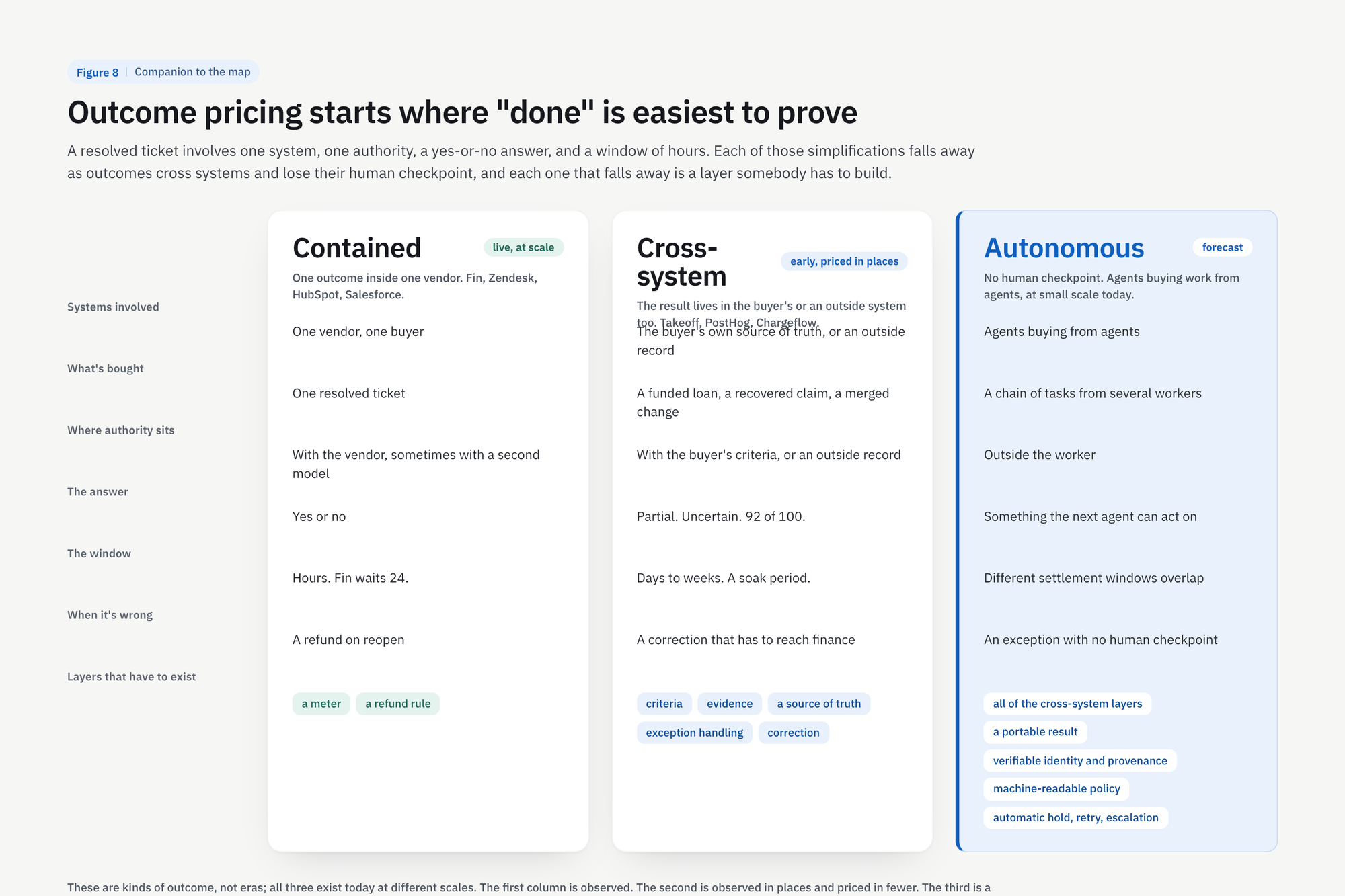
The unit has more states. A seat is a count. A meter is a number. An outcome is a judgment, and a judgment can be partial, uncertain, corrected, disputed, and reversed after the invoice went out, with a judge that isn't the same system as the worker. Every one of those states is a job the earlier units never created. Seats needed billing and access control. Usage added metering, cost control, a profession, and a standard. Outcomes need all of that and then acceptance, evidence, attribution, underwriting, dispute, and settlement that waits for the result. More states, more layers.
The unit competes with labor, not tooling. A resolved case competes with contact-center headcount. A recovered claim competes with manual revenue-cycle work. A completed research task competes with services. Seats and usage were paid out of software budgets; outcomes are paid out of work budgets, which are an order of magnitude larger. Each layer built around this unit sits on a bigger pool of money than the equivalent layer did last time.
And the clock is shorter. Stripe's top AI companies reached $1M in annualized revenue in a median of 11.5 months, against 15 for the fastest SaaS companies. Faster formation doesn't prove faster adoption of outcome pricing, but it compresses the time in which pricing gets tested and changed. By mid-2026, 23% of surveyed AI companies reported an outcome-priced component, up from about 2% a year earlier, and the unit turned up in surveys as a material line at year three, where usage wasn't even being asked about at year fourteen. Then there's the far end. When agents buy work from other agents, every one of those judgments happens at machine speed and machine volume, with no person to absorb the exceptions. Volume that used to be bounded by how many people a company could hire stops being bounded by that.
More layers, on more money, sooner, and then at a volume no earlier unit had. That isn't linear. It's the compounding I'd bet on.
This may look like:
- Seller-side rating of an event that's already true, which Paid and Metronome are building.
- Acceptance and reconciliation, which rules applied, what evidence supported the result, what counted, what changed later, and what amount follows; no dominant category or standard has formed there, and it's where I'm focusing with Spoolis.
- When the result has to travel, a shared receipt the next system can act on without learning each vendor's private definition of done.
Those are the near ones. Look at what the last two waves built for their unit and ask what outcomes need in a harder form, and the list runs to sixteen, in three stages. Five are forming now for contained outcomes, spend control and a shared dictionary among them. Seven are needed once results cross into the buyer's systems, attribution, underwriting, and dispute among them. Four are needed when agents buy from agents, identity, reputation, and clearing among them. Most have no named category yet.
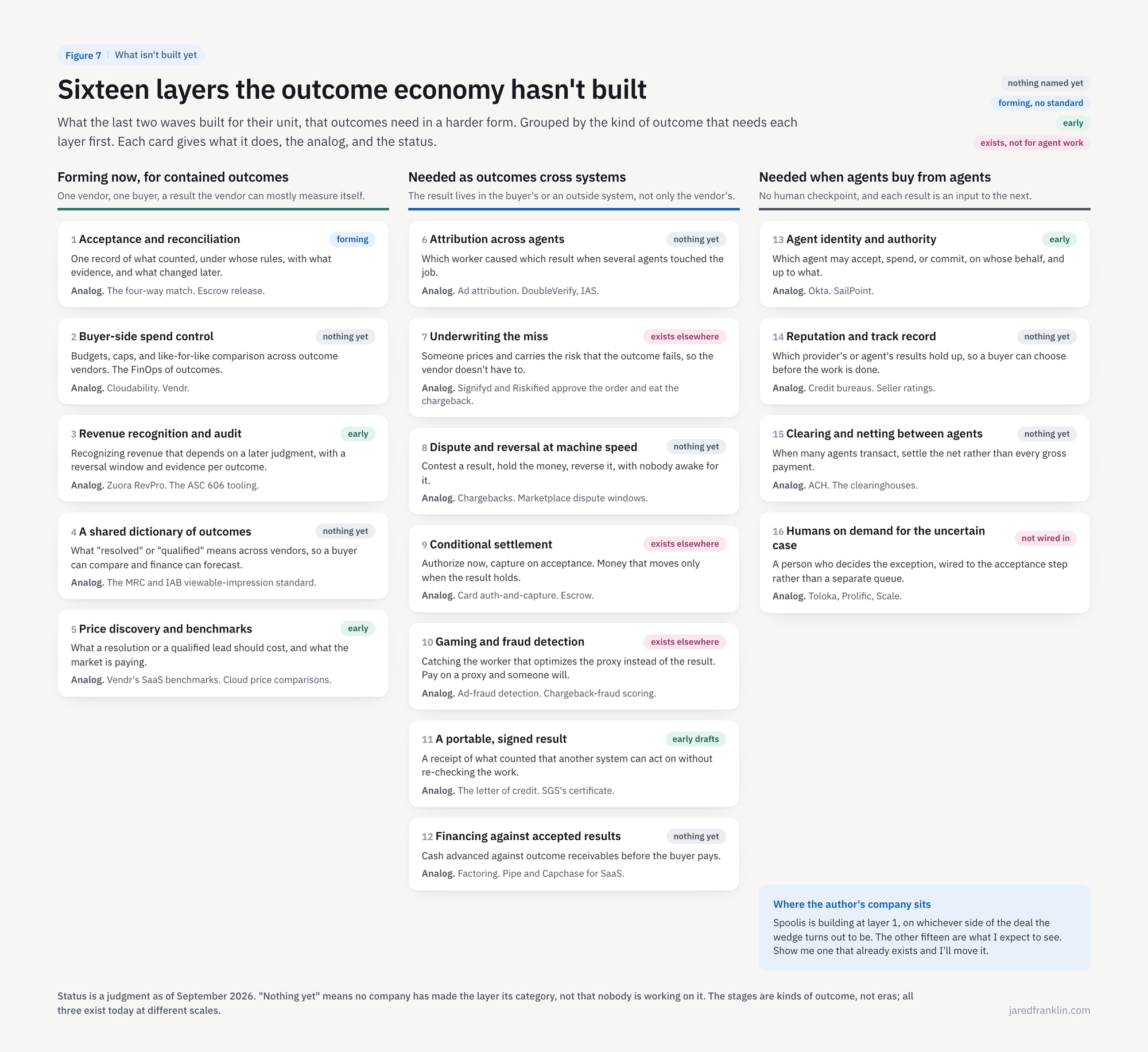
Those are reasons the surrounding infrastructure could be valuable. They aren't proof it will be horizontal. Sierra, Fin, and Salesforce could each build the whole stack inside their products and never let a result leave. The advertising precedent says that's possible. The four-way match, the letter of credit, and SGS say that when a result has to cross a company boundary, a shared record tends to win.
What's already true, and what I'm forecasting
Already true.
- Outcome-priced AI is live in support and spreading into sales, and the vendors doing it are having to define, measure, and separately verify what they bill.
- Security and coding already produce an outcome-shaped object, a mitigated finding or a merged pull request. Outside bug bounties, almost nobody bills it yet. Horizon3 retests a finding and marks it mitigated, then bills per asset. Devin bills compute.
- Prior units of value produced valuable infrastructure on both sides of the bill.
Still a forecast.
- That the infrastructure built around this unit ends up larger than the last two waves' combined, and gets there sooner, because it has more layers to fill, sits on labor budgets rather than software budgets, and compounds once agents buy from agents.
- That outcome pricing spreads from observable work into work with judgment in it. Sierra buying Takeoff in July, a three-person company that reached near eight-figure revenue in seven months selling outcomes in lending and healthcare, is the earliest sign.
- That one accepted result starts being consumed by more than one downstream system, finance, payment, operations, another agent, and that buyers come to insist on a result that's independent of any one provider's private billing state. The far end of that is agents buying work from other agents, where the last human checkpoint leaves the acceptance loop.
Selling work builds a bigger industry than selling access did
Software spent twenty years getting better at measuring what we used. Agents will spend the next twenty getting better at delivering what we wanted, and the bill will follow the work.
That's better for the customer and a much bigger job for everyone around the transaction. The last two waves built companies worth tens of billions around units that were easy to count. This unit is a judgment, paid out of labor budgets, spreading faster than either of them did, and headed toward agents buying work from agents at a volume and speed no person can referee. The infrastructure that forms around it has more to do than any before it, and I think it ends up larger than the last two waves' combined.
Metering told us what happened. The next layer has to say what counted.
I'm working on Spoolis which is what I call the acceptance layer.
SGS didn't become a company of 100,000 people by growing more grain. It sold a record other people could rely on. The companies that do that for work, and the fifteen other jobs around it, are the ones I'm most interested in right now.
This piece was researched, drafted, and argued with heavy help from several AI models. They pulled pricing pages and press releases, checked dates and figures, reviewed each draft as a hostile reader, and helped generate the charts.
Sources
- Salesforce, "Salesforce signs definitive agreement to acquire Fin," June 15, 2026, and "Salesforce completes acquisition of Fin," September 10, 2026. https://www.salesforce.com/news/press-releases/2026/06/15/salesforce-signs-definitive-agreement-to-acquire-fin/ and https://www.salesforce.com/news/press-releases/2026/09/10/salesforce-completes-acquisition-of-fin/
- Eoghan McCabe, "Salesforce signs definitive agreement to acquire Fin," Intercom blog, June 15, 2026. https://www.intercom.com/blog/salesforce-signs-definitive-agreement-to-acquire-fin/
- Fin pricing page. Resolutions, procedure handoffs, and disqualifications at $0.99; qualifications at $9.99 against criteria the customer defines. https://fin.ai/pricing ↩
- Intercom pricing page (seat plans underneath Fin's per-outcome charge); Salesforce, "Agentforce pricing," help article listing per-conversation, Flex Credit, and per-user models. https://help.salesforce.com/s/articleView?id=004811240&language=en_US&type=1
- Salesforce, Help Agent pay-per-resolution announcement, June 25, 2026, general availability July 2026, $2 per resolution (400 Flex Credits) with a published definition of a qualifying resolution. ↩
- Stripe Economics, "The SaaSpocalypse was more like a RenaiSaaS," 2026. Actual versus pre-October-2025 trend, including the index by business age. https://www.stripeeconomics.com/p/the-saaspocalypse-was-more-like-a
- SAML 2.0 was ratified by OASIS in March 2005. SCIM (System for Cross-domain Identity Management) is IETF RFC 7643 and RFC 7644, September 2015, built to provision and deprovision users across SaaS applications. https://datatracker.ietf.org/doc/html/rfc7644
- Stripe newsroom, "Stripe completes Metronome acquisition," January 14, 2026. Terms not disclosed; Upstarts Media reported a price of about $1 billion. https://stripe.com/newsroom/news/stripe-completes-metronome-acquisition
- Patrick Collison, on the Metronome agreement, December 2025, as reported by PYMNTS, January 16, 2026. https://www.pymnts.com/acquisitions/2026/stripe-completes-purchase-of-billing-firm-metronome/
- CNBC, "IBM to acquire software company Apptio for $4.6 billion," June 26, 2023. https://www.cnbc.com/2023/06/26/ibm-to-acquire-software-company-apptio-for-4point6-billion.html
- Founding years from company histories: Salesforce 1999, Zuora 2007, Okta 2009, Cloudability 2011, Metronome 2019, Sierra 2023, Paid 2025. Zuora listed on the NYSE in April 2018. Cloudability was acquired by Apptio in 2019. Paid launched out of stealth in March 2025 with a €10M pre-seed from EQT Ventures, Sequoia, and GTMFund, and raised a $21.6M seed led by Lightspeed in September 2025 (TechCrunch, GeekWire).
- OpenView, "Why is usage-based pricing on the rise?" November 2021 (45% of roughly 600 SaaS companies, up from 34% in 2020), and TechCrunch on OpenView's State of Usage-Based Pricing, second edition, February 2023 (61% in 2022). https://openviewpartners.com/blog/usage-based-pricing-trends/ and https://techcrunch.com/2023/02/02/usage-based-pricing-is-rising-but-not-replacing-other-models/
- Sierra, "We're raising $950 million at a valuation of over $15 billion," May 4, 2026, referenced on sierra.ai. https://sierra.ai/blog/sierra-acquires-takeoff
- ICONIQ, "2026 State of AI: The Builder's Economy," July 2026, based on a Q2 2026 survey of about 305 executives. Outcome-based pricing 18% to 23% in six months; companies blend 1.7 pricing models on average. https://www.iconiq.com/growth/reports/state-of-ai-2026 ↩
- Intercom, "Building outcome-based pricing for Fin for Sales," May 2026. https://www.intercom.com/blog/building-outcome-based-pricing-for-fin-for-sales/ ↩
- Sierra, "Outcome-based pricing for AI agents." https://sierra.ai/blog/outcome-based-pricing-for-ai-agents
- HubSpot, "HubSpot's Customer Agent and Prospecting Agent: now you pay when the task is complete," April 2026, effective April 14. Quote from Jon Dick, chief customer officer. https://www.hubspot.com/company-news/hubspots-customer-agent-and-prospecting-agent-now-you-pay-when-the-task-is-complete
- G2, "2026 Buyer Behavior Report: The Evaluation Maze," July 22, 2026, survey of more than 1,000 B2B software buyers. https://company.g2.com/news/buyer-behavior-2026
- ICONIQ, "State of AI: bi-annual snapshot," January 2026 (18%, up from 2%), and the July 2026 report above (23%). https://www.iconiq.com/growth/reports/2026-state-of-ai-bi-annual-snapshot
- Stripe, "Outcome-based pricing: a guide for businesses," September 2025. The same guide reports that 77% of business leaders say customers are increasingly pushing for outcome-based pricing, while only 32% of businesses define usage in outcome terms. https://stripe.com/resources/more/outcome-based-pricing
- Zendesk, "Announcing changes to AI agent reporting," effective May 18, 2026. Contained versus verified resolutions; verified resolutions confirmed by Zendesk's evaluation model. https://support.zendesk.com/hc/en-us/articles/10677925692698-Announcing-changes-to-AI-agent-reporting
- Ronald Coase, "The Nature of the Firm," Economica, 1937.
- Bengt Holmström and Paul Milgrom, "Multitask Principal-Agent Analyses: Incentive Contracts, Asset Ownership, and Job Design," Journal of Law, Economics, and Organization, 1991. Holmström shared the 2016 Nobel Memorial Prize in Economic Sciences with Oliver Hart for contributions to contract theory.
- SGS, "Our history." Founded December 12, 1878 in Rouen by Henri Goldstuck; offices in Le Havre, Dunkirk, and Marseille within a year; the Full Outturn Guarantee. https://www.sgs.com/en/our-company/about-sgs/our-history
- SGS 2024 annual results. Revenue CHF 6.79 billion; roughly 99,500 employees.
- International Chamber of Commerce, Uniform Customs and Practice for Documentary Credits (UCP 600). Banks deal in documents, not in goods.
- Oracle Fusion Cloud Payables documentation, "Matching invoice lines." A four-way match requires the purchase order, receipt, accepted quantity from inspection, and invoice to agree. https://docs.oracle.com/en/cloud/saas/financials/25d/fappp/matching-invoice-lines.html. SAP, "Understanding purchasing (MM integration)." https://learning.sap.com/courses/configuring-additional-settings-in-financial-accounting-in-sap-s-4hana/understanding-purchasing-mm-integration
- Upwork, fixed-price contract terms. Milestones funded to escrow; release on client approval or after the review period; disputes handled before release. https://www.upwork.com/legal
- HackerOne, "HackerOne report finds 210% spike in AI vulnerability reports amid rise of AI autonomy," October 1, 2025. $81 million paid across bug bounty programs, July 2024 to June 2025. https://www.hackerone.com/press-release/hackerone-report-finds-210-spike-ai-vulnerability-reports-amid-rise-ai-autonomy
- Chargeflow pricing page. 25% of recovered chargebacks; no payment until a chargeback is recovered. https://www.chargeflow.io/pricing
- Fin help center, "Fin pricing: outcomes." Assumed resolution after 24 hours of no reply; a resolution is deducted if the customer returns to the same conversation, even across billing periods. https://fin.ai/help/en/articles/13975800-fin-pricing-outcomes
- PostHog, "Self-driving pricing" and "Anatomy of a pull request." https://posthog.com/docs/self-driving/pricing and https://posthog.com/docs/self-driving/anatomy-of-a-pr
- Agentic Index, "Agentic AI pricing models and benchmarks," figures measured September 13, 2026 across 972 pricing records. https://agenticindex.io/pricing
- GoTo.com (later Overture) introduced pay-per-click search advertising in 1998. Google launched AdWords Select with cost-per-click pricing in February 2002.
- Market capitalizations of DoubleVerify (about $1.8 billion) and Integral Ad Science (about $1.7 billion), August 2026. https://companiesmarketcap.com/doubleverify/marketcap/ and https://companiesmarketcap.com/integral-ad-science/marketcap/
- Stripe, "Indexing the AI economy," 2026. Median months to $1M and $5M annualized revenue, AI top 100 versus SaaS top 100, and by year founded. https://assets.stripeassets.com/fzn2n1nzq965/1MsdRUHsQdAU6lT1b3zU0f/236e54ef95023050d42056e6c5414e6c/Indexing_the_AI_economy__2_.pdf
- Horizon3.ai documentation, "Run 1-Click Verify." NodeZero is priced per asset. https://docs.horizon3.ai/portal/test_types/1cv/
- Cognition, Devin pricing page. Plans are billed on Agent Compute Units.
- Sierra, "We're excited to share that Sierra is acquiring Takeoff," July 23, 2026. https://sierra.ai/blog/sierra-acquires-takeoff
- Lorikeet, "Best per-resolution-priced AI customer support platforms (2026)," on its own pricing rule. https://www.lorikeetcx.ai/articles/best-per-resolution-priced-ai-support-2026
- Orb, "40 SaaS pricing statistics," citing its 2026 study of 80 AI-agent companies. 95% hybrid, 91.3% usage-based, 71.3% with a subscription component. https://www.withorb.com/blog/saas-pricing-statistics
- Spoolis, product documentation and thesis. https://spoolis.com
- Yuval Atsmon, CFO and senior partner at McKinsey, on the CFO Thought Leader podcast, episode 1181, April 2026: about a third of McKinsey's work is outcome-based, and the firm is paid only when a client-side CFO confirms the agreed financial impact or proxy KPIs. Summarized by PodStreet, April 29, 2026. https://www.podstreet.ai/cx-o/mckinsey-one-third-is-outcome-based/
- Cohere Health describes its model as an administrative fee rather than a fee tied to approvals or denials. Funding: $90M Series C led by Temasek, May 2025 (Fierce Healthcare). https://www.fiercehealthcare.com/ai-and-machine-learning/cohere-health-lands-90m-series-c-round-expand-ai-use-cases
- Mercor moved from per-hire pricing to a marketplace take rate on contractor work; $350M Series C led by Felicis at a $10B valuation, October 27, 2025 (TechCrunch). https://techcrunch.com/2025/10/27/mercor-quintuples-valuation-to-10b-with-350m-series-c/
- Lakka, Keränen, Mero, and Leppäniemi, "Scaling outcome-based business models: A maturity framework," Industrial Marketing Management 133 (February 2026), open access. The paper cites industry estimates that more than 60% of industrial manufacturers offer outcome-based service contracts, and identifies measurement, attribution, and limited control over customer actions as the recurring scaling barriers. https://doi.org/10.1016/j.indmarman.2026.01.007
- Founding years, from company sites and press coverage. Seats era, from Salesforce (1999): Aria 2003, Zuora 2007, Recurly 2009, Chargify 2009, Chargebee 2011, Paddle 2012; Ping Identity 2002, SailPoint 2005, Okta 2009, OneLogin 2009, BetterCloud 2011, Zylo 2016, Torii 2017, Productiv 2018, Vendr 2018, Cledara 2018, Tropic 2019. Usage era, from AWS (2006): Cloudyn 2011, Cloudability 2011, CloudCheckr 2011, CloudHealth 2012, Spot 2015, CloudZero 2016, ProsperOps 2018, Kubecost 2019, FinOps Foundation 2019, Vantage 2021; Metronome 2019, Amberflo 2020, m3ter 2020, Orb 2021, Lago 2021. Outcomes era, from Intercom Fin (2023): Paid launched 2025; Braintrust 2023, LangSmith 2023; Nevermined 2022.
- Microsoft, Copilot Studio pricing: Copilot Credit packs of 25,000 for $200 per month, or $0.01 per credit pay-as-you-go, drawn down per agent action or response. Google Cloud, Gemini Enterprise pricing: per-seat editions plus consumption. OpenAI's Business plan is per user; Enterprise is quote-only. https://www.microsoft.com/en-us/microsoft-365-copilot/pricing/copilot-studio and https://cloud.google.com/products/gemini-enterprise-agent-platform/pricing
- Twilio completed its acquisition of Segment on November 2, 2020, for approximately $3.2 billion in Twilio stock (Twilio press release).
- FinOps Foundation, "FOCUS 1.0 is generally available," June 2024, with native exports from AWS, Microsoft Azure, Google Cloud, and Oracle. Later releases extended the schema to SaaS and AI providers. https://www.finops.org/insights/focus-1-0-available/
- Cresta publishes no pricing page (cresta.com/pricing returned a 404 when checked in May 2026, per eesel's pricing guide). UsagePricing's Cresta blueprint describes a seat-based core with containment-linked commercials on the autonomous AI Agent SKU, with no published per-resolution rate. https://www.eesel.ai/blog/cresta-pricing and https://www.usagepricing.com/blueprint/cresta