Why $250K might not be enough: the code is cheap but the customer isn't (post 2 of 3)
This is post 2 of 3 in a series about AI's impact on company building and the fundraising landscape.
In part 1, I asked whether AI could make $250K enough again for some software companies.
There's a pretty obvious reason I might be wrong: maybe building the software isn't actually the expensive part.
At least, not once the company starts working.
Where the money actually goes
For mature SaaS companies, R&D isn't usually the biggest expense.
Sales and marketing is.
Typical benchmarks put sales and marketing around 40%-45% of revenue, compared with roughly 20%-25% for R&D.
So even if AI dramatically reduces the cost of engineering, it may be attacking the cost that matters most at formation while leaving the cost that matters most at scale relatively intact.
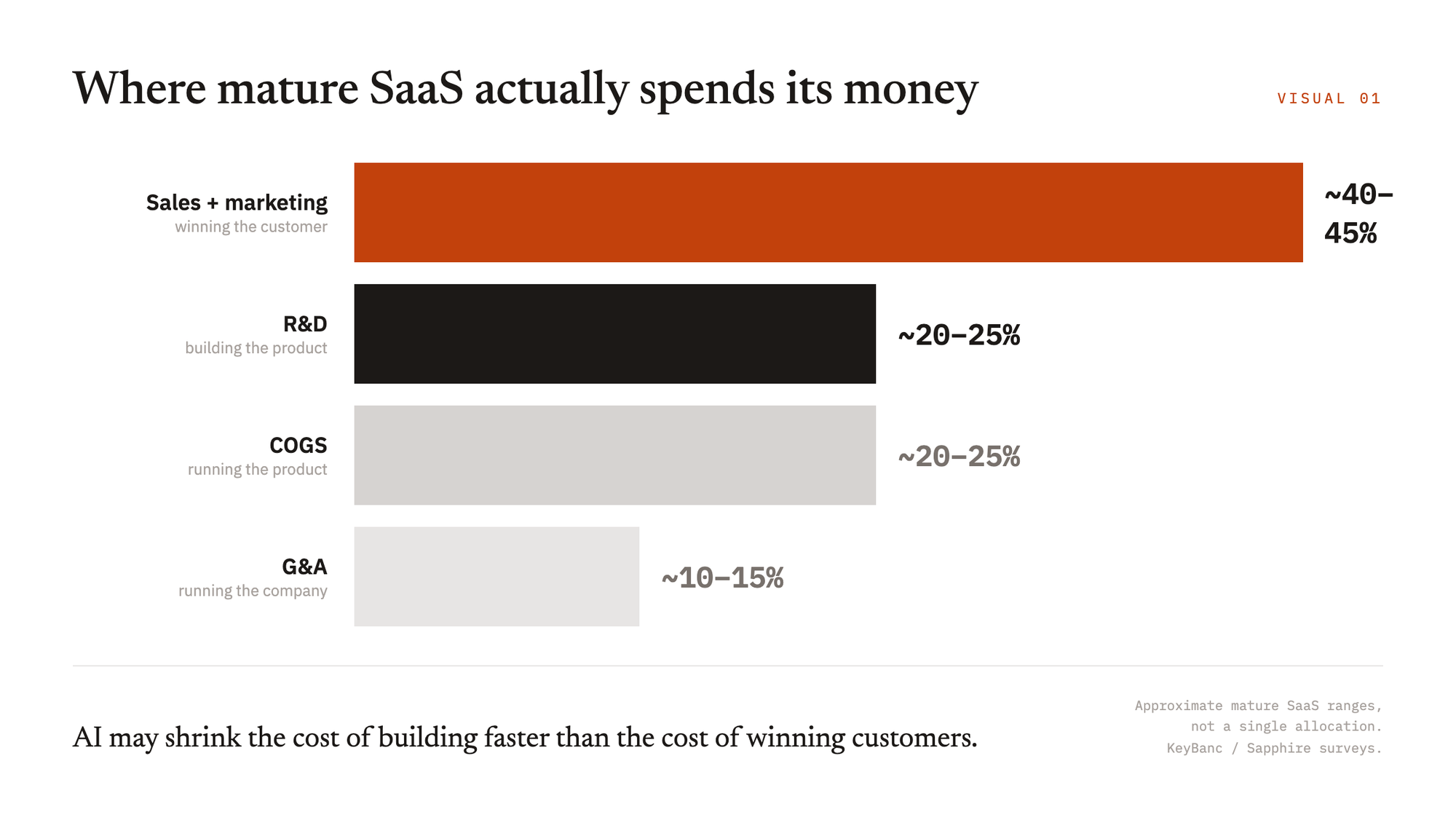
That's a pretty strong rebuttal to my $250K thesis.
But it also needs a caveat.
Not every customer is expensive
There isn't one distribution model any more than there is one capital model.
I see at least three:
- Self-serve and product-led software: developer tools, some consumer products and simple SaaS can spread through search, word of mouth, virality or the product itself. AI may compress both sides of the equation: cheaper product creation and relatively cheap distribution.
- SMB and vertical software: the product may be cheap to build, but getting thousands of dentists, trucking companies, property managers or medical practices to discover, trust and pay for it is a different problem. Distribution can become the dominant cost.
- Enterprise and regulated software: large contracts still involve salespeople, procurement, security reviews, integrations, compliance, partnerships and trust. AI can make the product cheaper without making the customer dramatically cheaper.
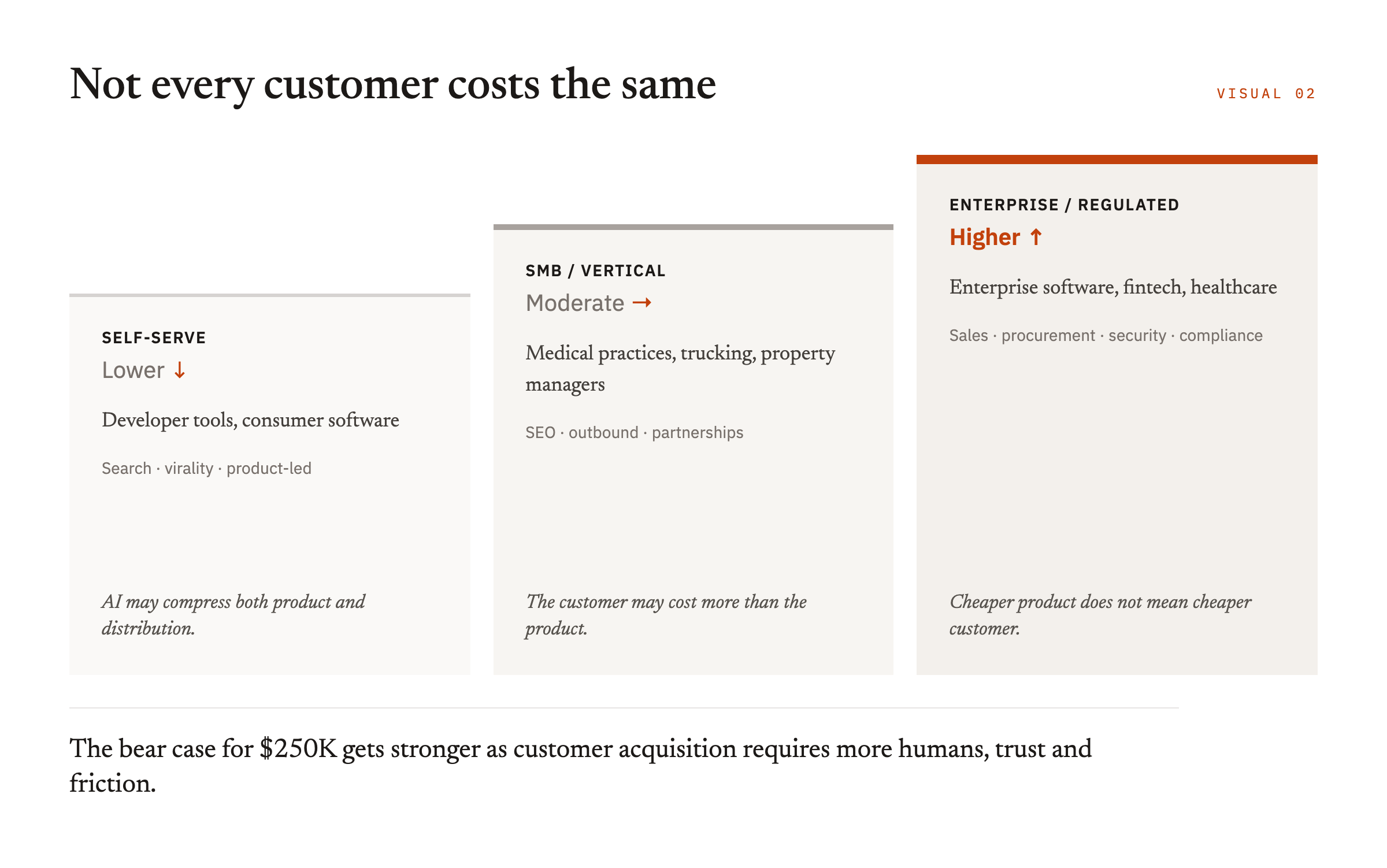
$250K goes a lot further when the product can distribute itself.
It goes a lot less far when every new customer still requires salespeople, trust, procurement or expensive acquisition.
Cheap software could make customers more expensive
There is a second-order effect too.
If everyone can build, everyone can launch.
More products compete for the same Google result, inbox, ad impression, procurement budget and customer attention.
The engineering barrier falls.
The attention barrier rises.
So the savings may not disappear into profit.
They may get competed away.
And if the obvious parts of a product become easier to reproduce, more of the moat has to come from things outside the code.
Proprietary data... brand... distribution... integrations... workflow lock-in... network effects... regulatory position... cstomer trust.
A lot of those things cost money too.
Maybe AI doesn't eliminate the need for capital.
Maybe it changes what the capital buys.
We've run something like this experiment before
AWS is probably the most useful historical comparison.
Before cloud infra, starting an internet company could mean buying servers, renting data center space and hiring people just to keep everything running.
AWS made that dramatically cheaper.
And something interesting happened.
More companies got started... seed investing expanded... competition increased.. the winners became more ambitious.
And venture capital didn't disappear. It eventually got much bigger.
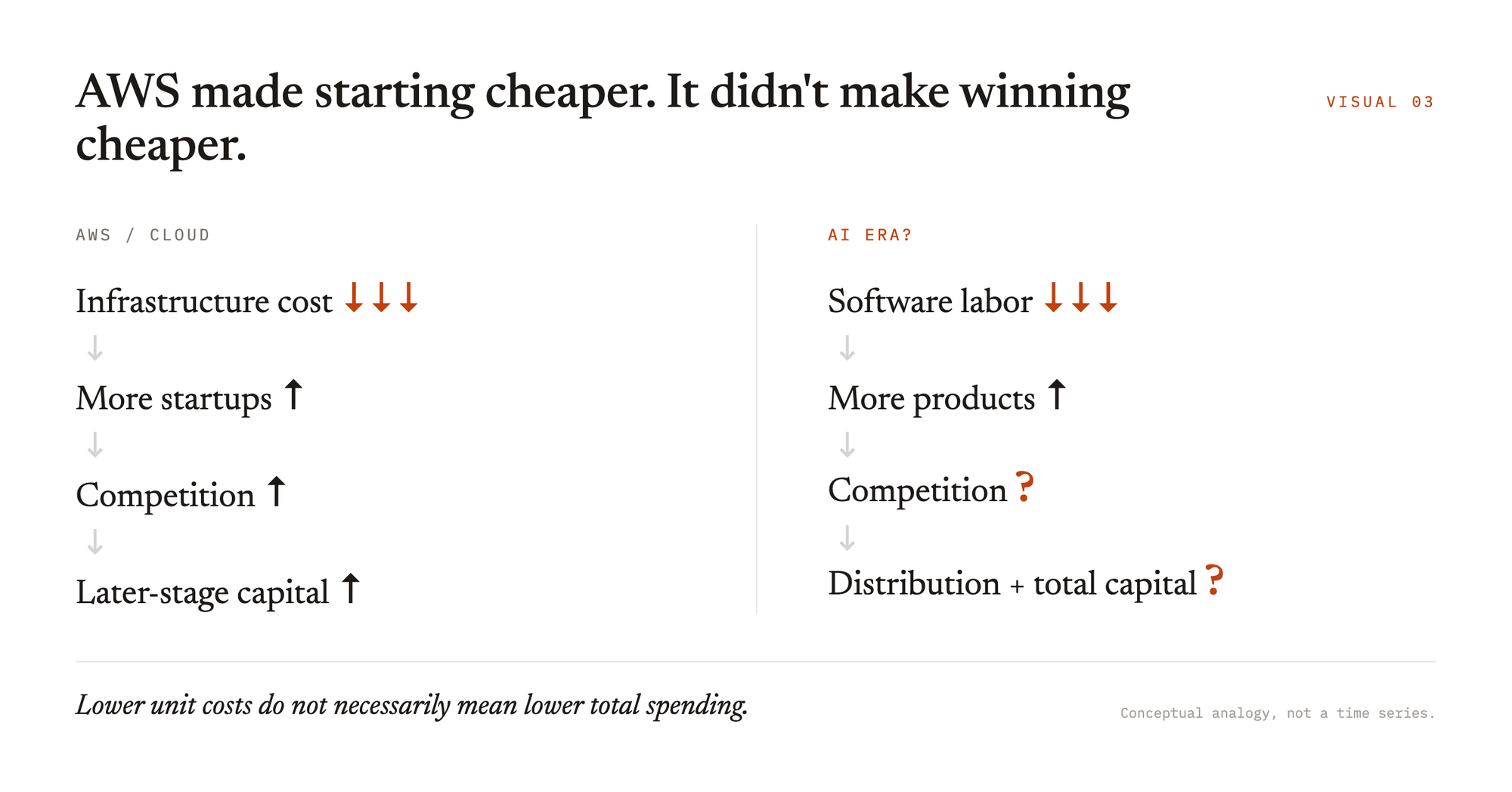
AI is obviously different from AWS.
It potentially touches much more of the company than infrastructure ever did.
But the history is a useful warning: lower unit costs do not necessarily mean lower total spending.
Sometimes they just mean we do much more.
Maybe startups have their own Jevons paradox
There is an old economic idea called the Jevons paradox.
When something becomes dramatically more efficient, total consumption can actually increase.
If AI makes an engineer five times more productive, maybe a startup does not hire one-fifth as many engineers.
Maybe it keeps the engineers and builds five times as much.
More features... more products... more markets... more experiments... more ambition.
We may be confusing lower cost per unit of output with lower total capital consumption.
Those are very different things.
Maybe "need" is the wrong question
There is one more problem with my original thesis.
Companies don't necessarily raise the minimum amount of capital they need.
They raise capital they can deploy productively.
Imagine two companies reach $2M in revenue with tiny teams.
One stays lean.
The other raises $30M and uses it to acquire customers, hire exceptional people, subsidize pricing, buy competitors and expand faster.
The second company may not have needed the money.
That doesn't mean the money wasn't valuable.
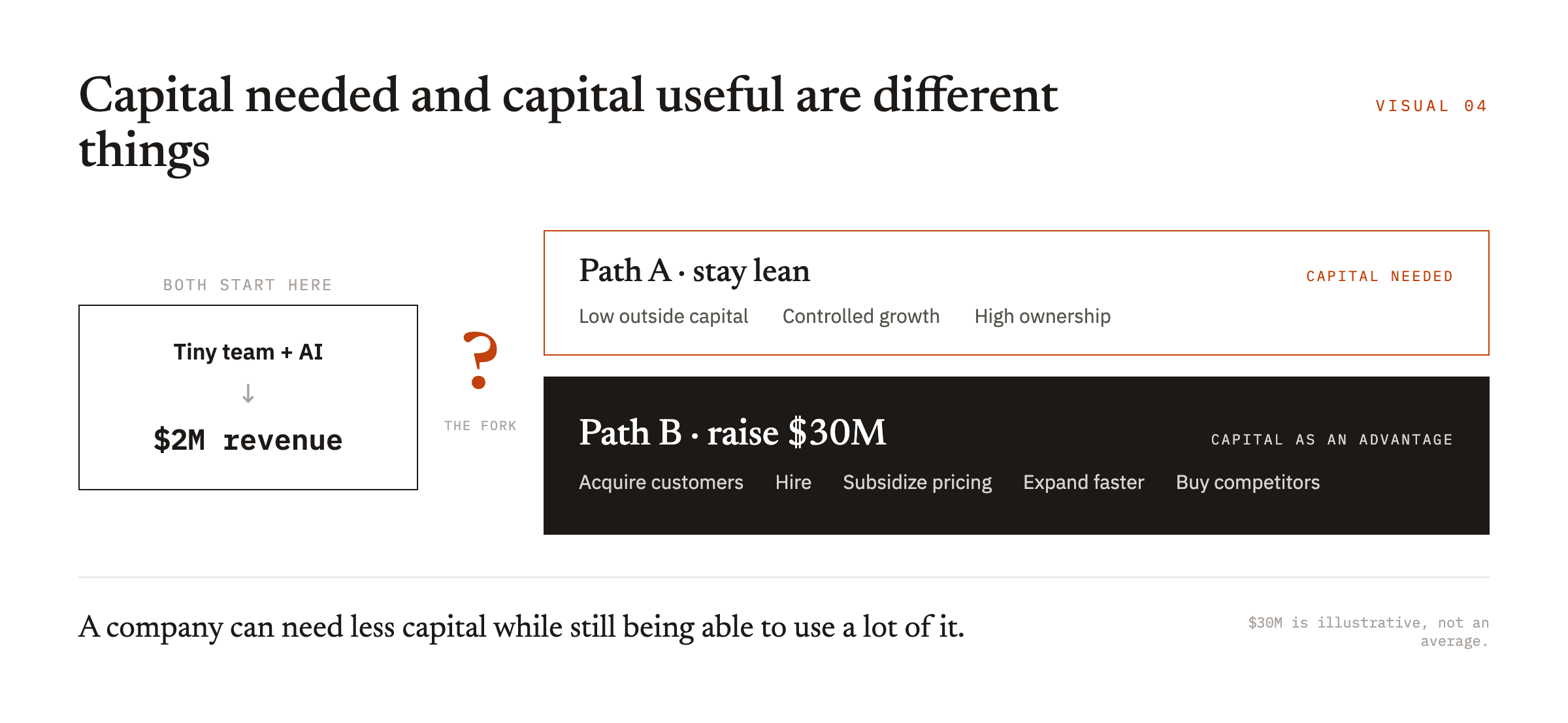
AI could make a company dramatically less capital intensive while leaving venture capital extremely useful as a competitive advantage.
And that distinction may matter more than whether the company technically needs the money.
So is $250K enough?
Sometimes, maybe.
That's the point I missed when I first started pressure-testing the idea.
For a product that can distribute itself, AI may compress almost the entire company.
For vertical SaaS, winning the customer may cost much more than building the product.
For enterprise or regulated software, the things surrounding the product may still require millions.
So I still think AI changes what it costs to build a software company.
I'm just less convinced that tells us what it costs to win.
The code is getting cheap.
The customer isn't always.
And if cheap software creates dramatically more competition for those customers, the cheapest era of software creation could produce the most expensive fight for distribution.
In part 3, I question what happens to venture if some great companies really do stop needing very much capital.