Maybe $250K is enough again
Early-stage venture capital has gotten much bigger.
A typical seed round was roughly $500K to $1M around 2010.
Today it's ~$3M.
YC went from investing ~$20K in its earliest batches to $500K today. Somewhere along the way, we also invented pre-seed that can itself mean raising $1M before the seed.
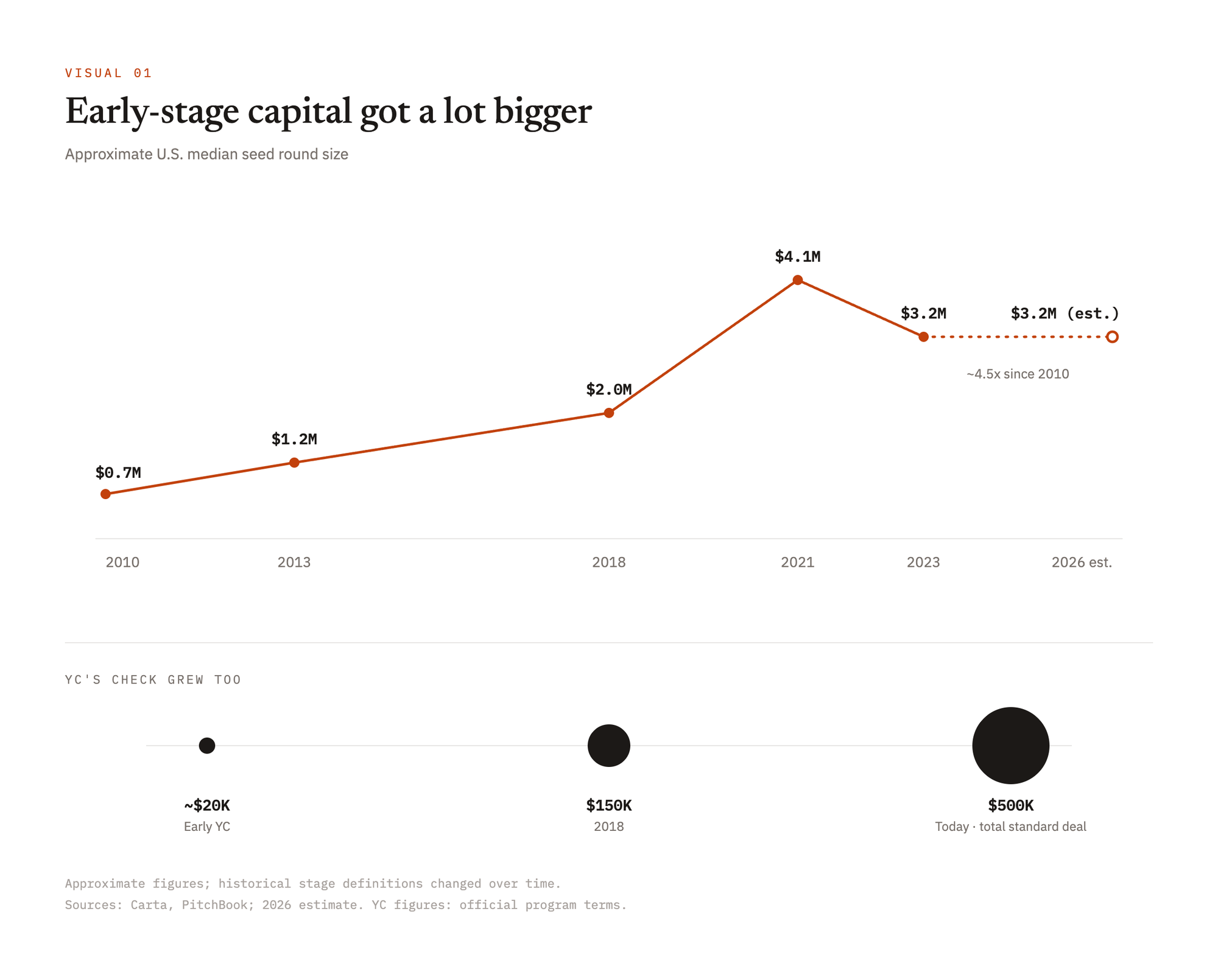
There are plenty of reasons for this... venture funds got bigger, competition for ownership increased, software engineers became expensive, and [some] startups became more ambitious.
But all that early capital was also buying something pretty basic: people.
What were we funding?
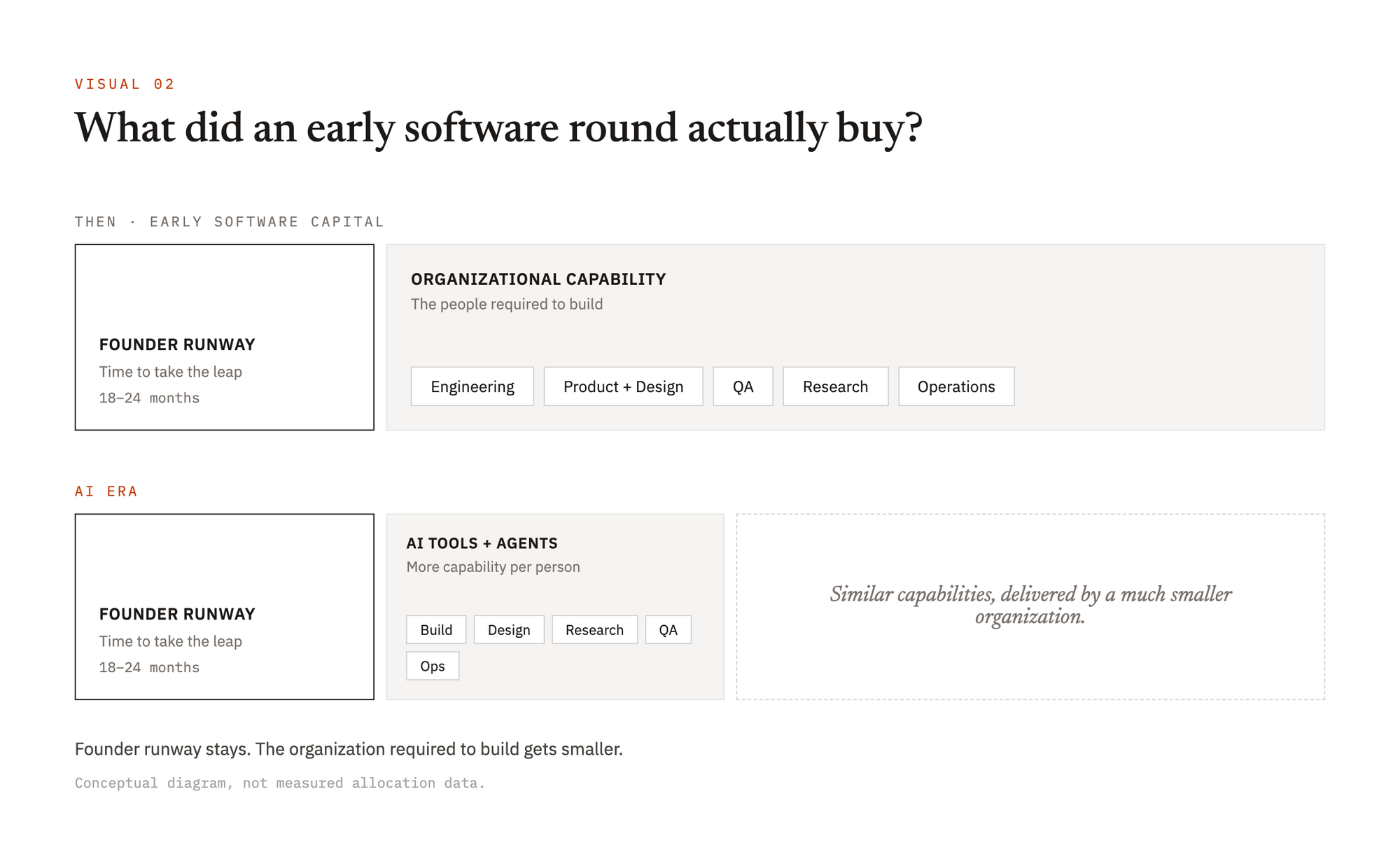
A lot of early software funding effectively bought two things:
- Founder runway. Enough financial security to quit a good job and spend 18 to 24 months on something that might not work.
- Organizational capability. The engineers, designers, product people and operators required to actually build it.
The second part was expensive.
A five-person engineering team can easily cost more than $1M a year. Add founders, design, infrastructure and enough runway to find product-market fit, and a multi-million-dollar seed round starts to make plenty of sense.

AI does not eliminate the first cost.
Builders still need to eat. They still need time. They still need to take the risk of leaving a job to pursue something that may go nowhere (or to remain unemployed in this market instead of spending all their time interviewing for 3-12 months).
But AI obviously does something strange to the second cost.
And maybe not just at the beginning.
If AI reduces the organization required to build a product, there is no reason to assume that leverage disappears once the product starts working.
Software is getting cheaper... like, really cheap. Companies are not necessarily.
This is where I think the AI conversation gets muddled.
OpenAI, Anthropic, hyperscalers, model companies and AI infrastructure are consuming extraordinary amounts of capital.
That is real.
But it tells us very little about what it should cost to build and grow a company in a completely different part of the stack.
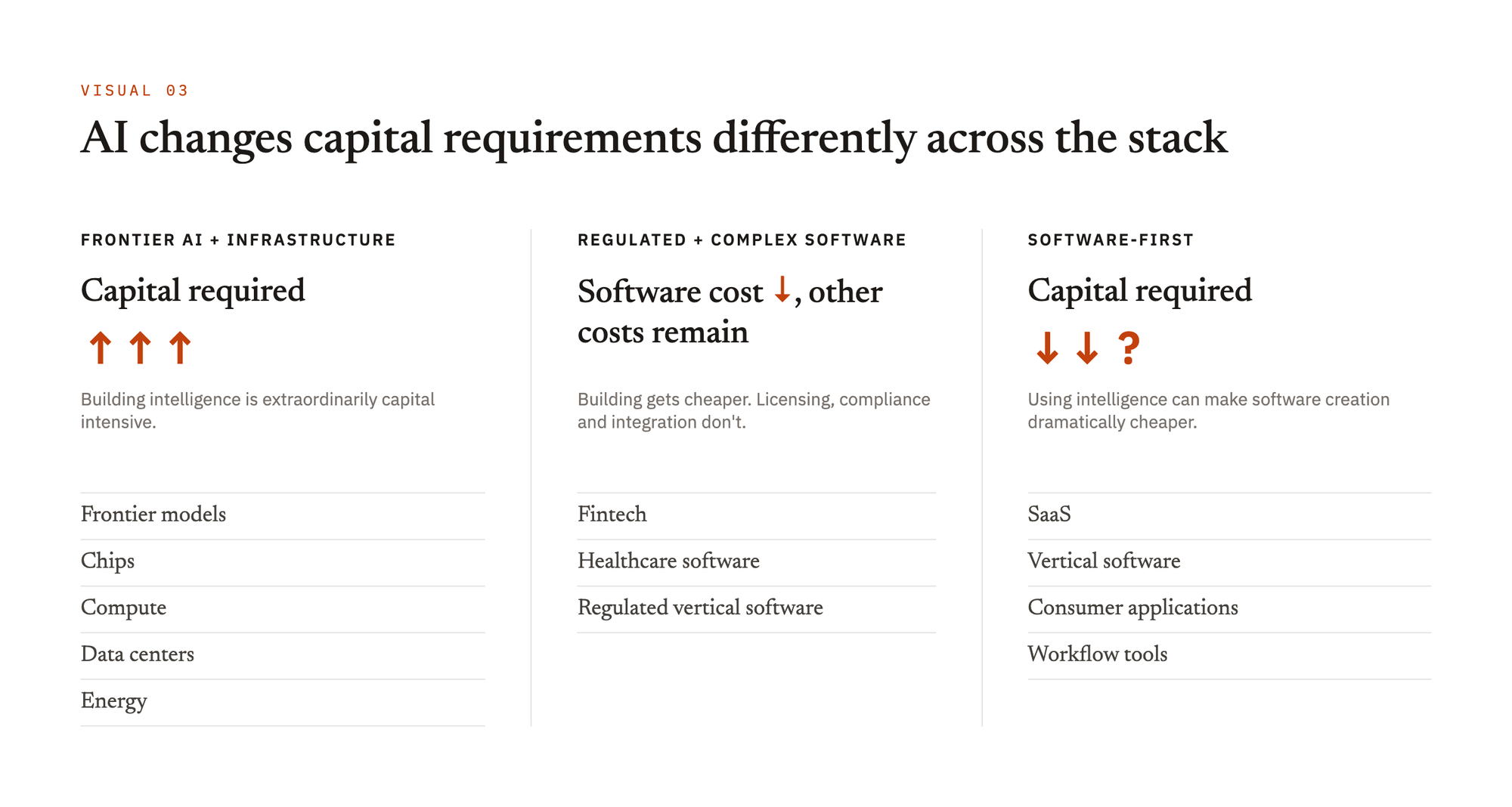
There may actually be three different capital stories emerging.
- Frontier AI and infrastructure are becoming more capital intensive. Models, chips, data centers, energy and compute can require extraordinary amounts of money.
- Regulated and operationally complex software gets cheaper to build, but not necessarily cheap to operate. Fintech still has licensing and compliance. Healthcare still has regulation and integrations. Marketplaces may still need liquidity.
- Software-first businesses may be different. SaaS, vertical software, developer tools and many consumer products can potentially use AI to reduce not only the team required to build, but eventually the teams required for support, sales, marketing, operations and continued development.
All three can be true at the same time.

That is why aggregate AI funding numbers can be misleading. Record amounts of capital can flow into AI while an entirely different class of software company becomes dramatically less capital intensive.
Cheaper software doesn't mean a cheaper company
Claude Code can help someone build a fintech product incredibly quickly.
It cannot give them licenses, a compliance program, bank relationships or regulatory approvals.
The same applies to healthcare, biotech, hardware, defense, marketplaces that require liquidity, and plenty of other businesses.
AI is most disruptive to startup economics when human software labor was one of the biggest costs in the first place.
So I would not claim that AI makes startups cheap.
I think the narrower claim is much more interesting: AI is collapsing the cost of creating software. How much that changes the cost of creating a company depends on everything else the company requires.
What if $250K is enough again?
For one particular category, software businesses where building the product historically consumed a large share of the early capital, this creates an interesting question.
What is the first $3M actually for now?
A talented founder or tiny team can increasingly build, launch, measure, kill, rebuild and try again without assembling a traditional startup organization.
They still need runway.
And they still have to solve the thing AI has not made easy: distribution.
That makes me wonder if $100K to $300K starts to become interesting again.
Not because small checks disappeared. They didn't.
Because a small check might once again be enough.
Enough runway for a talented person to take the leap.
Enough time to build multiple things.
Enough time to discover whether anyone actually cares.
Enough time to find distribution. And perhaps, for some businesses, enough to get surprisingly far beyond that.
Small checks never went away. They got bigger.
This is one place where my original intuition was wrong.
I initially wondered if the old $100K to $300K bets on people had disappeared.
They didn't.
But the institutions writing those early checks moved up considerably.
YC started around $20K. Its standard deal today totals $500K.
Techstars started around $18K. Its current investment is $220K.
Some newer founder programs invest $400K, $750K or even $1M.
So perhaps the interesting question is not whether small checks come back.
It's whether small checks become enough again.
There is a reason the market moved the other way. More runway reduces financing risk. Accelerators compete for founders. Investors compete for ownership.
And there is an even bigger structural issue.
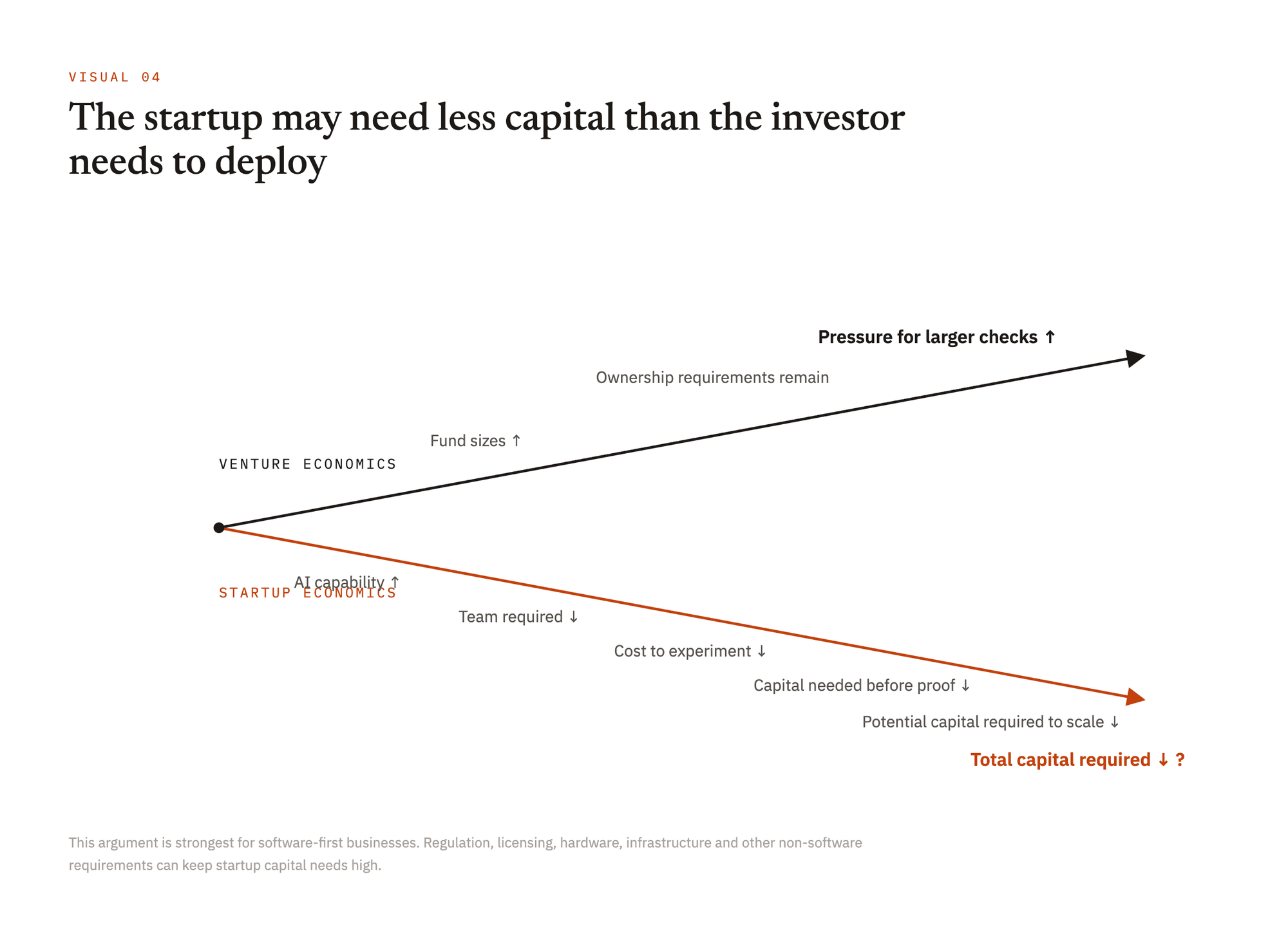
The startup may need less money than the investor needs to invest
Venture funds got much bigger too.

A $500M fund cannot build a meaningful strategy around $250K checks. It would need hundreds or thousands of investments.
Even if $250K is enough for a founder to get started, and even if the company never needs a giant round later, that may not work for the fund.
A $500M venture fund still needs to deploy $500M. It still needs meaningful ownership. It still needs outcomes large enough to return the fund.
The amount a startup needs and the amount an investor needs to invest are two completely different questions.
That creates a strange divergence.
The startup may need less money.
The investor may need to write a bigger check.
This might be the most interesting part of the whole thing.
If the economics really are diverging, maybe this new model does not come from traditional large venture firms.
Maybe it comes from angels, accelerators, micro-funds, fellowships or some new structure designed to make small bets on exceptional people before there is an obvious venture-scale company.
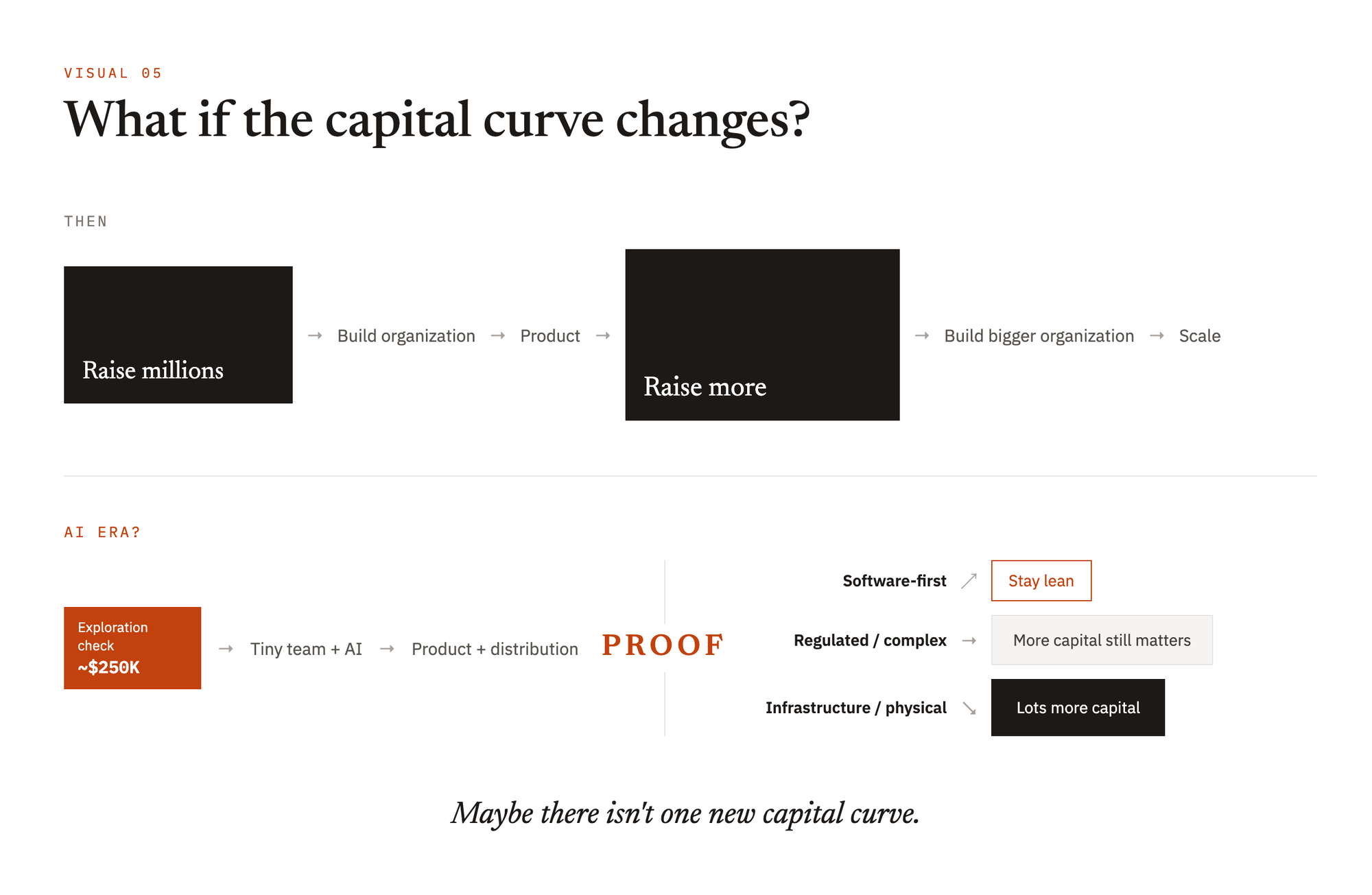
Maybe the whole capital curve gets smaller
Maybe the $250K question is only half the question.

For some software companies, AI could mean: less capital to search.
And then: less capital to scale.
That won't be true everywhere.
Frontier AI, chips, data centers and other infrastructure may require more capital than ever. Regulated industries, hardware, biotech and marketplaces will still need capital for things AI cannot make disappear.
But there may be another category emerging: great software companies that simply are not very capital intensive.
A company that becomes very valuable on $250K or $1M could be a fantastic business and a strange fit for a $500M venture fund.
Maybe that changes fund sizes and creates more micro-funds, angels, fellowships and new financing models. Maybe founders simply own more of their companies. Maybe more businesses never get on the venture treadmill at all.
I started with a narrow question: could $250K become enough to start a software company again?
I think the more interesting question is: what if some great software companies just don't need that much capital anymore?
That would not just change startups.
It would change what venture capital is for.
This post was inspired after I saw a startup funding announcement... tens of millions raised and I just couldn't understand.
In ~4 weeks, I launched 8 products from scratch, and I'm not a designer or engineer. And it only cost me $4,277 + foregone income from the man.

- LabLookup.com: specimen-collection requirements across major laboratories, consolidated into one clinician-verified workflow for medical practices.
- AppealSeason.com: a nationwide property-assessment appeal platform that identifies the local season, evaluates whether the evidence supports an appeal, and helps homeowners prepare.
- UnderstandMyRating.com: a simple decoder for VA disability rating decisions, grounded in the federal rating schedule and designed to help veterans have more productive conversations with accredited representatives.
- UnderstandMyCert.com: guiding small businesses through diverse-owned certifications (veteran, women, minority-owned) that unlock government and corporate contracts. Consultants traditionally charge $2,000–$5,000 per application.
- UnderstandMyPolicy.com: a household insurance operating system that organizes policies, maintains history, and identifies document-grounded changes and inconsistencies across the household.
- TruckCompliant.com: a dashboard for every DOT deadline an owner-operator has to hit. New carriers face a mandatory safety audit in year one, and a missed filing can mean fines, out-of-service orders, or revoked authority.
- NoticeOfChange.com: turning the benefits notices an aging parent receives into clear deadlines. Every fall Medicare mails a dense Annual Notice of Change, and a missed window can quietly raise a parent's drug costs by thousands.
- HOACompliant.com: helping Condo and HOA boards stay ahead of association deadlines. Missed filings, lapsed insurance, or blown reserve-study timelines can trigger fines, special assessments, or personal liability for board members.