Great software companies may become too capital efficient for venture (post 3 of 3)
This is post 3 of 3 in a series about AI's impact on company building and the fundraising landscape.
In part 1, I wondered if AI could make $250K enough again for some software companies.
In part 2, I made the case against it. Building may get dramatically cheaper while distribution, competition and everything surrounding the product remain expensive.
But let's assume the original idea is even partly right.
Some great software companies need much less capital to start. Maybe some need much less capital to scale too.
That creates a weird mismatch: what happens when the startup needs less money than the investor needs to invest?
Venture is already becoming a barbell
I originally thought one consequence might be that venture becomes a barbell.
Small funds on one end. Giant funds on the other. Not much in between.
Except parts of that are already happening.
Capital has increasingly concentrated among giant, established venture platforms, while a long tail of smaller and more specialized funds operates at the other end.
So AI would not create the barbell.
But it could create an entirely new reason for it.
Today's bifurcation is largely about the economics of venture itself.
Large firms attract enormous pools of LP capital. Successful funds raise larger successor funds. Brand, access and ownership compound.
Small funds survive by being specialized, early or different.
AI could add another force underneath all of that: the companies themselves may increasingly need radically different amounts of capital.
The companies could become a barbell too
Think about the three company types from post 1.
On one end are software-first businesses... SaaS... vertical software... developer tools... consumer applications.
If AI really does reduce the teams required to build, support, sell and operate some of these companies, they may need surprisingly little outside capital.
On the other end are businesses where capital is very much still the product. Frontier models... chips... data centers... energy... robotics... defense... biotech.
Those companies can consume billions.
And then there is everything in between: fintech, healthcare, marketplaces, regulated software and businesses where AI makes one part cheaper without eliminating the other costs.
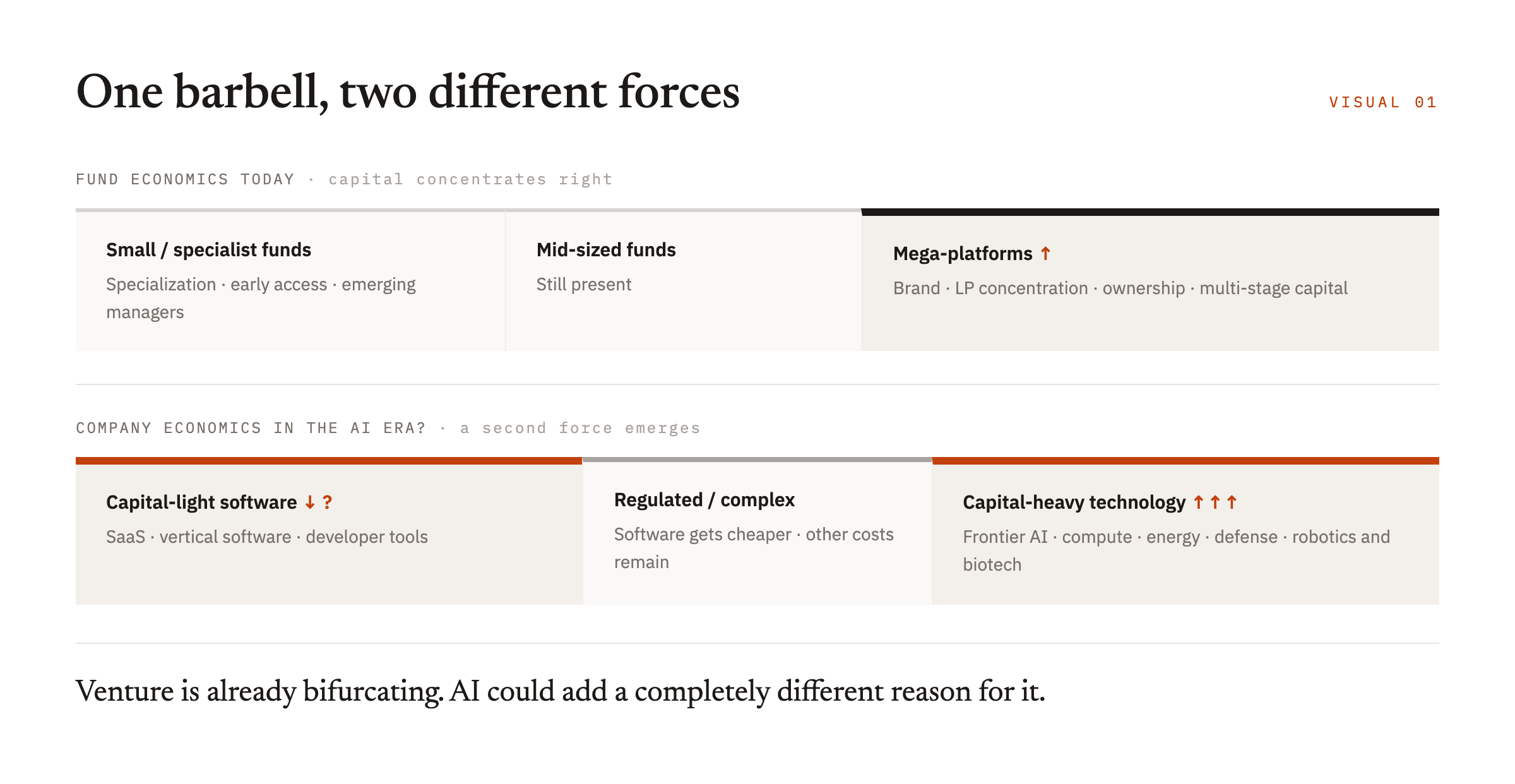
So maybe the interesting prediction isn't that venture becomes a barbell.
It's that the capital requirements of the companies underneath venture become more polarized too.
A $500M fund still has $500M to deploy
Imagine a $500M early-stage fund reserves half its capital for follow-ons.
That leaves $250M for initial investments.
At $5M per initial investment, that's 50 companies.
At $500K, it's 500.
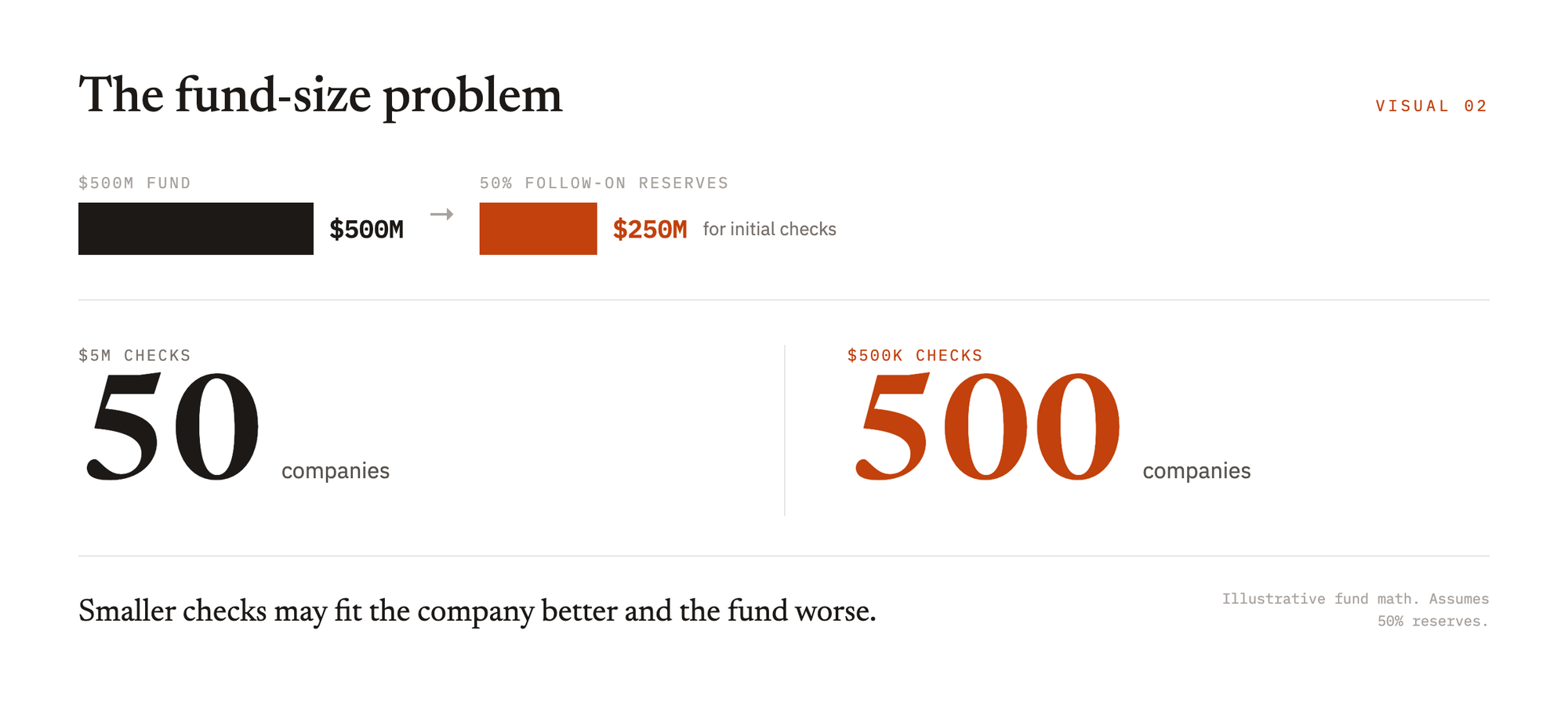
Obviously a $500M fund can write a $500K check.
The problem is doing it enough times for those checks to matter.
500 companies means sourcing, evaluating and supporting hundreds of investments.
And even if one of those companies becomes a fantastic $50M or $100M outcome, that may barely matter to a giant fund.
This is the tension I keep coming back to: the startup may need less capital at exactly the same time the investor needs to deploy more of it.
And venture firms keep getting bigger
This is what makes the whole thing stranger.
If AI is making some companies more capital efficient, you might expect the investors financing them to get smaller too.
That is not obviously what is happening.
Successful venture firms have spent much of the last decade moving in the other direction. Larger successor funds... opportunity funds... growth funds... continuation vehicles... more capital to maintain ownership in the winners.
Even some investors that start extremely early have continued raising larger pools of capital so they can invest more as their best companies grow.
There are rational reasons for this. Ownership matters... follow-on rights matter... management fees matter... LPs want access to successful franchises.
And if a great company can productively absorb another $50M, investors want the ability to provide it.
So we could end up with two forces moving in opposite directions:
- Startup economics push capital requirements down.
- Venture economics keep pushing fund sizes up.
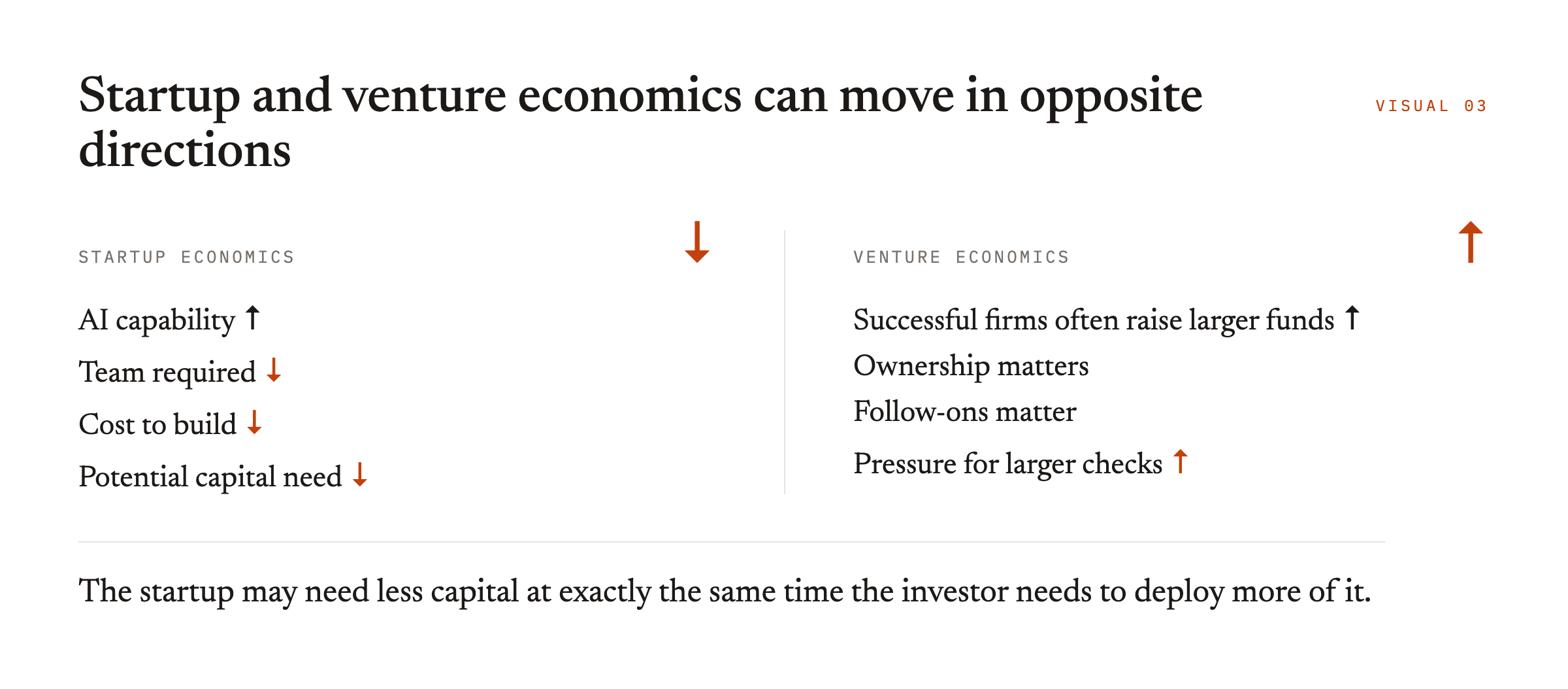
Something eventually has to give.
Maybe big funds just don't finance these companies
My first instinct was that large venture firms might create smaller vehicles.
Venture spent the last decade creating opportunity funds so firms could keep investing up the capital curve.
Maybe AI creates a reason to invest down it too.
A $2B flagship fund... a $500M opportunity fund... a $25M exploration vehicle making $250K bets.
It's a fun idea.
I'm just not sure it makes economic sense.
Why should a senior partner at a giant venture firm spend time on a $250K investment that might produce a fantastic $50M exit but barely affect the overall fund?
Scout programs can help... accelerators can help... separate vehicles can help.
But maybe the simplest answer is: they don't.
Maybe some great software companies simply become bad customers for giant venture funds.
That could make small funds much more interesting
Now flip the math.
A $50M exit may be irrelevant to a $2B fund.
It can be transformative for a $25M fund.
A $250K or $500K investment can matter.
A niche vertical SaaS company does not necessarily need a believable path to a $10B valuation.
A $50M or $100M acquisition can be an excellent result.
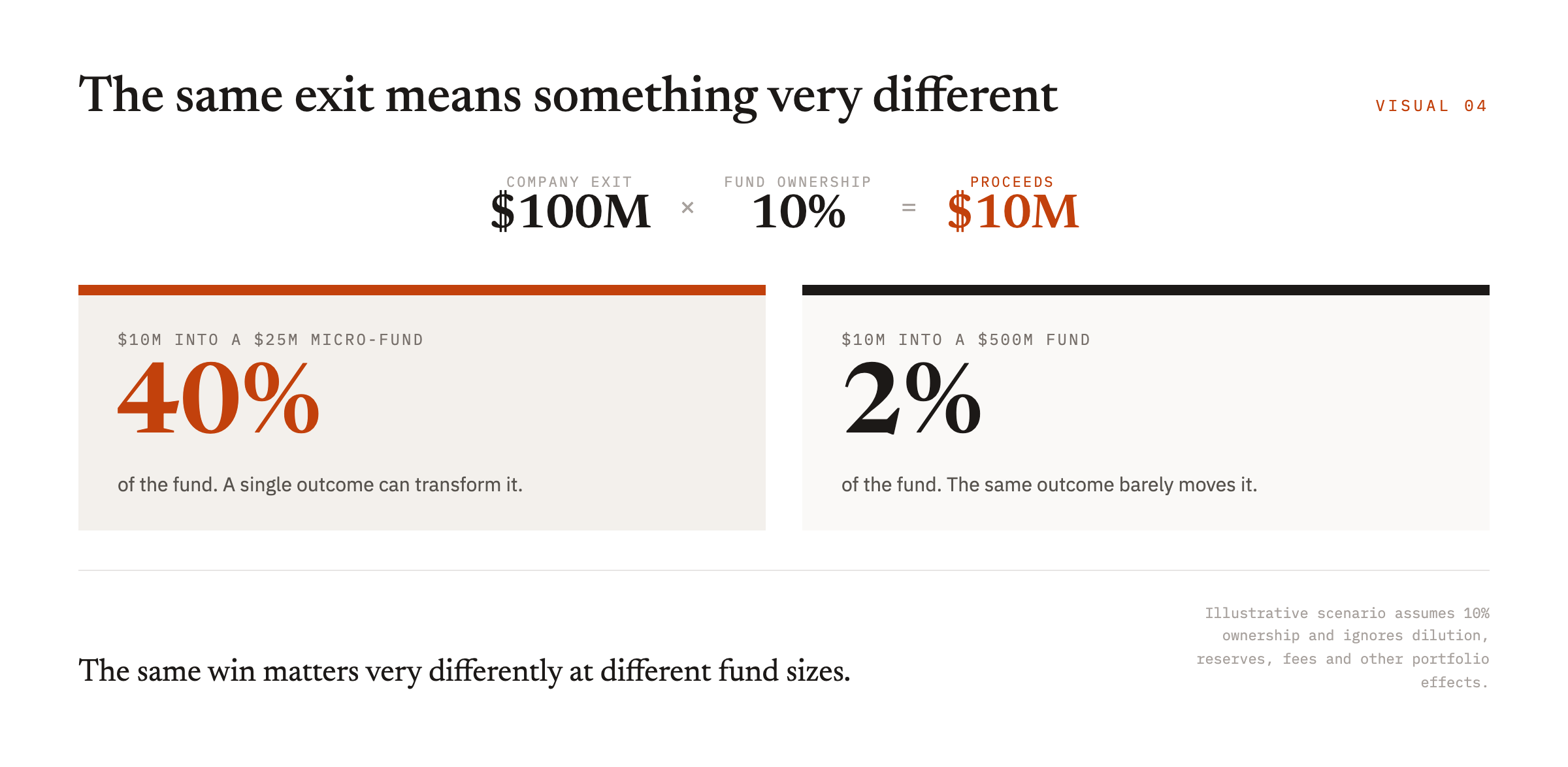
That could create a real economic niche for micro-funds, angels and other small investment vehicles.
Not because small funds are new.
Not because $250K checks disappeared.
But because the companies they finance may increasingly be capable of becoming much more valuable without graduating into progressively larger financing rounds.
The financing model could finally match the capital requirements of the business.
Smaller capital changes what counts as a win for founders too
This matters on the other side of the cap table.
If you raise $50M or $100M and dilute through several rounds, a $50M acquisition is usually not the outcome everyone signed up for.
If you raise $500K and still own most of the company, it can be life-changing.
The exact math depends on dilution, option pools, liquidation preferences and deal terms.
But the direction is simple:
If you raise much less, you can win with a much smaller outcome.
That could make smaller markets more interesting.
It could make founders more willing to sell.
It could create more $30M, $50M and $100M outcomes that are fantastic for everyone involved.
And it could make plenty of businesses attractive that would traditionally fail the "venture-scale TAM" test.
Investors already back people so maybe they can stop pretending they're backing the idea
This isn't actually a new concept.
Early-stage investors have always made bets on people.
A great repeat founder can raise before the product exists. Accelerators select teams with half-formed ideas. VCs regularly say they would rather back an exceptional founder in the wrong market than an average founder in the right one.
But then we mostly force the investment into a company-shaped process anyway.
Pick the idea... define the market... size the TAM... explain the competition... build the deck... tell me how you'll distribute it... raise $2M around that particular thesis.
There is something increasingly strange about doing all of that when the founder could just... build it and find out.
AI changes the cost of being wrong.
If testing one serious software idea requires a team, $2M and 18 months, investors have to spend a lot of time deciding whether the idea is right before funding it.
If $250K of runway lets one talented builder put five real products in front of customers, maybe neither the investor nor the founder needs to pretend they know which one is right yet.
The financing could look less like: here's $2M because we believe this idea will work.
And more like: here's $250K because we believe you'll find something that works.
Fellowships, accelerators, studios and entrepreneurs-in-residence already rhyme with this. So do the pre-idea checks that exceptional founders sometimes get.
The difference is what the money can now buy.
It isn't funding five pitch decks.
It could fund five actual products, five launches and five encounters with the market.
Maybe that makes a very old style of investing newly rational at much greater scale.
Call it seed capital. Call it a fellowship. Call it personal R&D capital.
The interesting part isn't the name.
It's that AI may let investors be more honest about what some of their earliest investments really are: a bet on a person, their judgment and enough time to figure out what deserves to become the company.
Where does all the money go?
There is still a much bigger question.
If a meaningful category of software company absorbs less private capital, the money doesn't disappear.
LPs still have capital to allocate.
And plenty of technology businesses can consume enormous amounts of it.
Frontier AI already can. So can energy, defense, robotics, biotech, manufacturing and other physical technologies.
Maybe venture funds get smaller.. maybe more capital shifts toward those capital-intensive categories... maybe some money stays in other private-market strategies or public markets.
Or maybe nothing shrinks at all... maybe an abundance of venture capital simply encourages companies to consume more money than they technically need.
We saw some version of that during the zero-interest-rate era.
Capital has its own gravity.
Maybe venture has two barbell problems
I started this post thinking AI might create a barbell in venture.
I think that's too simple. Venture is already bifurcating.
What AI could do is add a second barbell underneath it.
Fund economics are pulling investors toward very small and very large vehicles.
And now: company economics may increasingly pull capital requirements toward very small and very large amounts too.
Those forces will not line up perfectly.
Some capital-light companies will still raise huge rounds because capital helps them win.
Some giant funds will still invest very early because ownership in exceptional companies is worth fighting for.
Some tiny companies will become huge companies.
But if a meaningful class of valuable software businesses stops needing traditional venture-scale amounts of capital, something in the financing stack has to adjust.
Maybe funds get smaller... maybe small funds become more important... maybe founders own more... maybe smaller exits become great outcomes again... maybe big venture firms simply stop being the natural financing partner for a large category of software.
The interesting question isn't whether venture capital goes away.
It won't.
It's what happens when some of venture's best potential companies stop needing very much of it.