Every totaled car has to go somewhere. Often that's Copart, a $30B company most people have never heard of.
Why I'm writing about a company that sells wrecked cars
I came across Copart when I wrote about Garage. Then I went down the rabbit hole.
It's a profitable, hard (impossible?) business to copy, and almost nobody outside cars and insurance knows it exists.
When your car is totaled, your insurer usually pays you and takes the car. Now it owns a wreck it wants gone. Copart picks it up, stores it, sorts out the title and sells it online to a buyer somewhere in the world, maybe a rebuilder in Ohio, a parts recycler in Texas or an exporter shipping it to Nigeria.
It sold more than 4M vehicles last year from 286 facilities in 11 countries. It keeps about $0.32 of profit on every $1.00 of revenue, has no debt, and is still run by the family that started it with one California salvage yard in 1982.
It's also seemingly stuck. Revenue was flat last year (up about 2% if you strip out an unusually big hurricane season the year before). It lost a big insurance customer to its main rival. The stock fell about 30% in 2025 and is down roughly another 20% this year. The former CEO is back, and Copart just spent $1.9B on ACV, an online auction for dealers' used cars.
The short version
My view is that Copart is close to impossible to replicate but no longer growing on its own, and at about 20 times earnings the stock already reflects that. It isn't an obvious bargain. It becomes one if Copart can raise revenue per car and win back volume without squeezing insurers. In my base case the stock returns about 6% a year over five years. If a plan like the one I lay out works, maybe closer to 13%.
| Copart at a glance | |
|---|---|
| Founded | 1982 in Vallejo, California. Public since 1994 |
| What it does | Sells wrecked and used vehicles online, mostly for insurance companies |
| Vehicles sold | More than 4 million a year, from 286 facilities in 11 countries |
| Revenue (fiscal 2026, ended July) | $4.67B, up 0.4% |
| Net income | $1.48B, down 4.4% |
| Profit per $1 of revenue | About $0.32 |
| Market value | About $28.5B (November 19, 2026) |
| Price to earnings | About 20x |
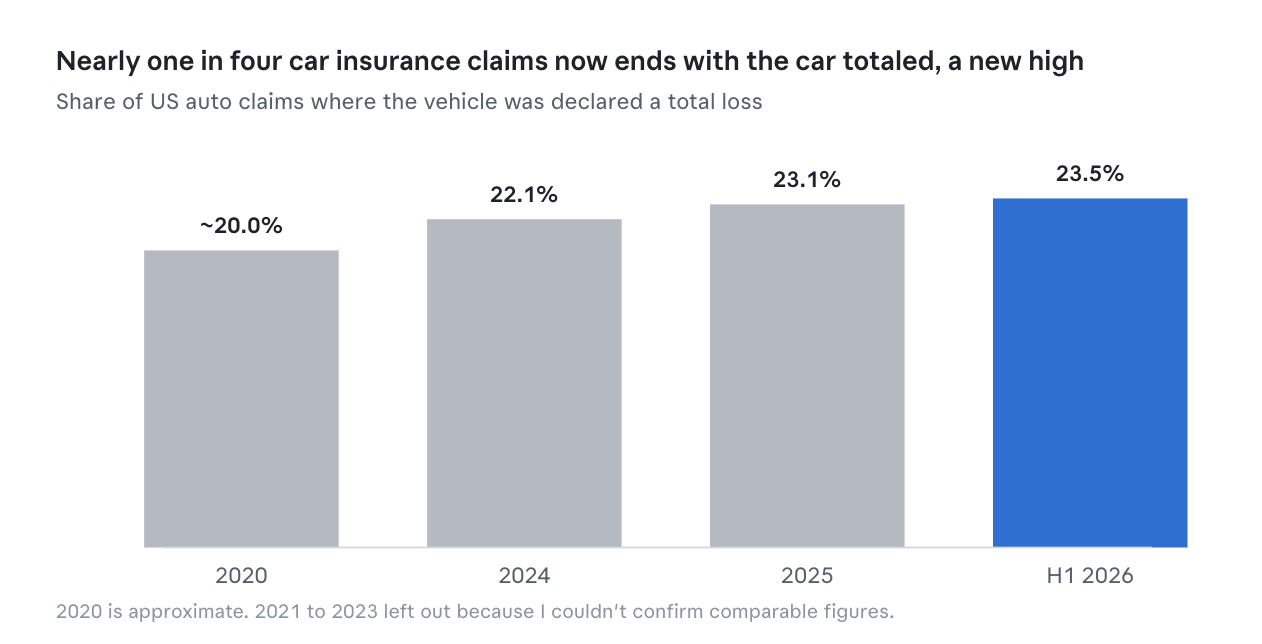
- It turns insurers' wrecks into cash. About 1 in 4 car insurance claims now ends with the car totaled. Copart handles the pickup, storage, title and sale, charges both the insurer and the buyer, and almost never owns the car.
- It won insurers by taking their risk. In the 1980s the founder offered to cover towing and storage in exchange for a cut of each sale, as long as the insurer sent him every car in a region. Going fully online in 2003 did the rest.
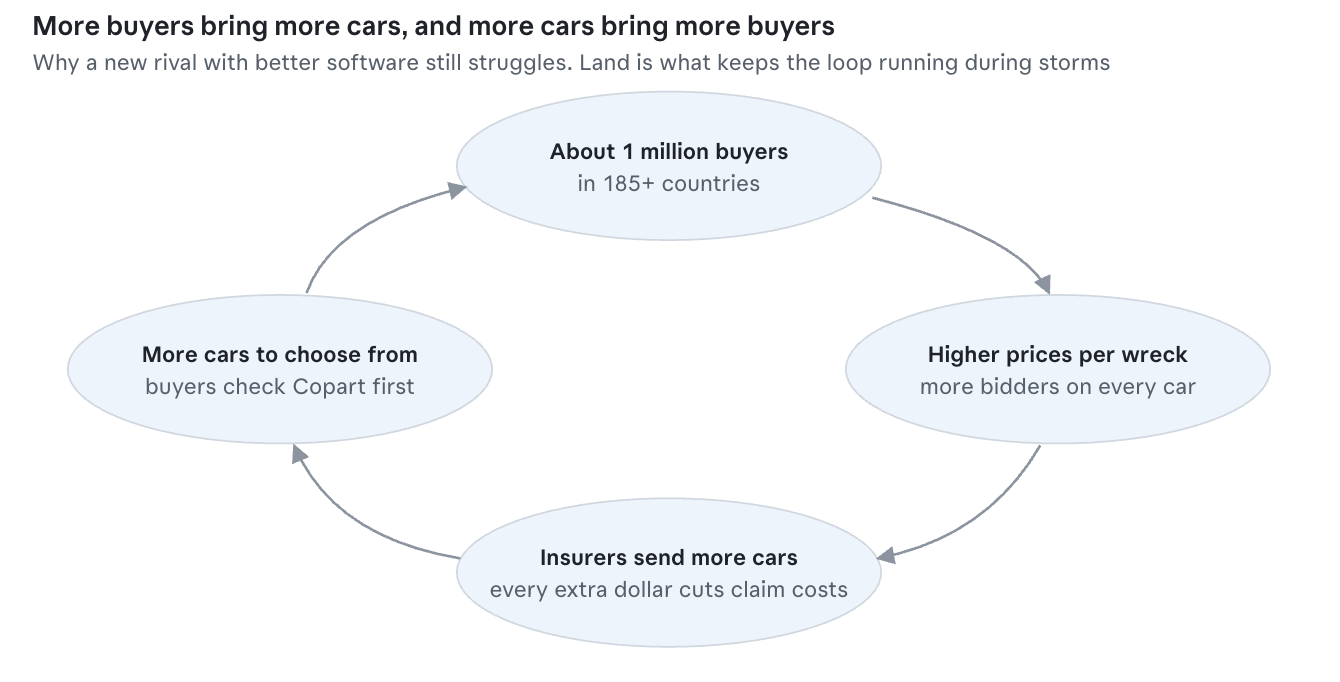
- The moat is land, buyers and relationships. New salvage yards near big cities are close to impossible to permit. About a million registered buyers bid on its cars, and buyers outside the US paid 46% of the money spent on Copart's US cars last year.
- The tailwind has a catch. A record share of claims ends in a total loss, but fewer claims are being filed at all. A higher rate doesn't automatically mean more cars.
- Copart is buying its way into used cars. It bought ACV, a logical step, but clean used cars are a tougher, lower-margin business.
- IAA is their real threat, not startups. Its rival, owned by RB Global, got faster, started cutting fees for big insurers and has been winning accounts back, reportedly including Progressive.
- Startups can't take the core, but they can take the edges. Title paperwork, loan payoffs, payments and services for overseas buyers are all soft spots.
Your totaled car goes to an auction yard, then to a rebuilder, a parts recycler or a ship overseas
Most people's last memory of a totaled car is a tow truck and a check. But the car keeps moving.
An insurer totals a car when fixing it would cost too much compared with what it's worth. Each state sets the line, often around 70% to 80% of the car's value. The insurer usually pays the owner and takes the car and title (sometimes the owner keeps the wreck for a smaller check).
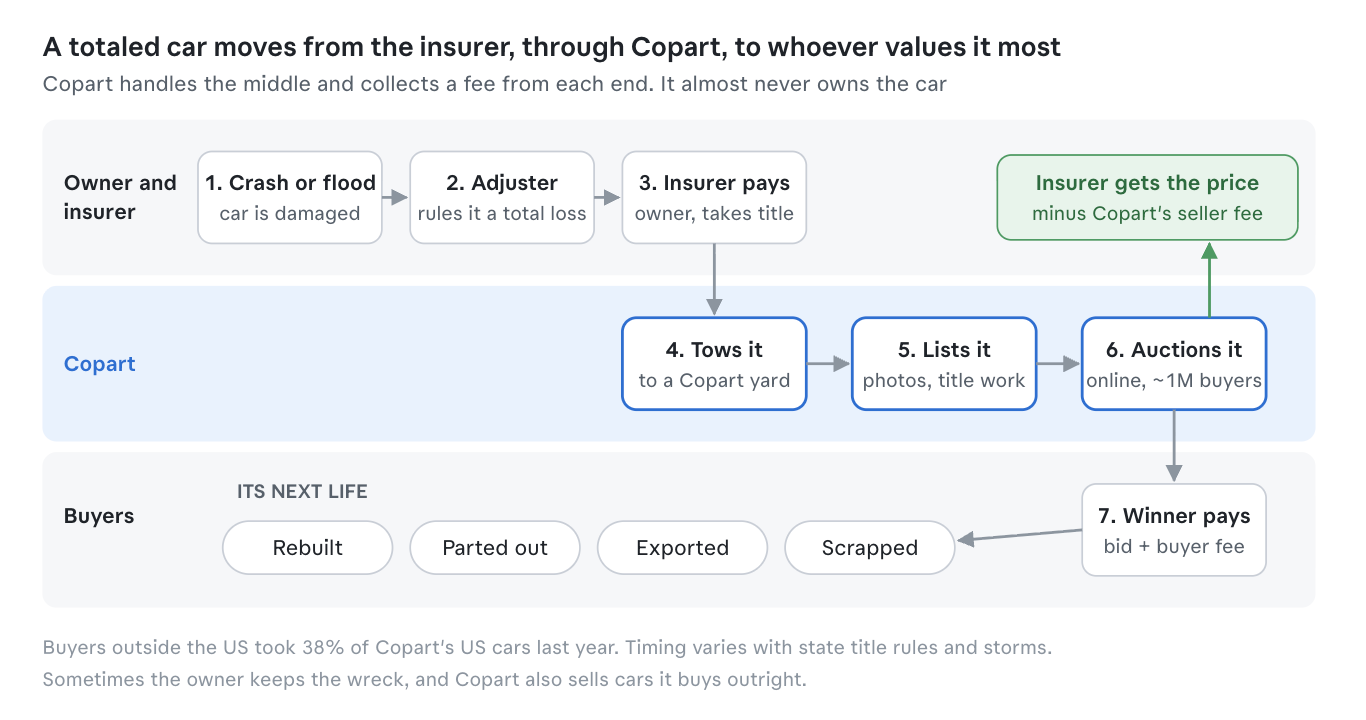
From there the insurer wants two things. Speed, because every day a claim stays open costs storage, rental car days and staff time. And the highest price, because whatever the wreck sells for comes off the cost of the claim.
Copart built its position by doing both exceptionally well, moving cars fast and bringing more bidders, which pushes prices up.
A bigger share of claims ends in a total loss, but fewer claims are being filed
Copart's raw material is totaled cars, and two forces pull that supply in opposite directions.
- Repairs got expensive and cars got old. A fender bender on a newer car can mean replacing and recalibrating thousands of dollars of cameras and sensors, and repair labor is scarce. Meanwhile the average car on US roads hit ~13 years in 2025, and an old car doesn't take much damage before it's not worth fixing. That widening gap between repair costs and used car values is Copart's long-run tailwind.
- Fewer claims are being filed. After premiums spiked, some drivers dropped collision coverage and others raised deductibles or stopped filing small claims. CCC says claim counts fell 8.3% in the first nine months of 2025 and another 3.5% over the same stretch of 2026, and the share of collision claims with a $1,000-plus deductible went from about 20% in early 2022 to about 28%. An uninsured wreck is much less likely to reach Copart, though its consumer buying arm can still catch some.
So part of the record total loss rate is just small claims disappearing. What Copart cares about is the number of cars, which fell in the US last year. There's one hopeful sign. Total loss counts ticked up about 1% through September 2026, after falling 3% a year earlier.
Copart benefits when cars get too expensive to fix, and it suffers when they get too expensive to insure.
The bigger trends behind it
Step back and most of what's happening to cars pushes more of them toward the salvage yard.
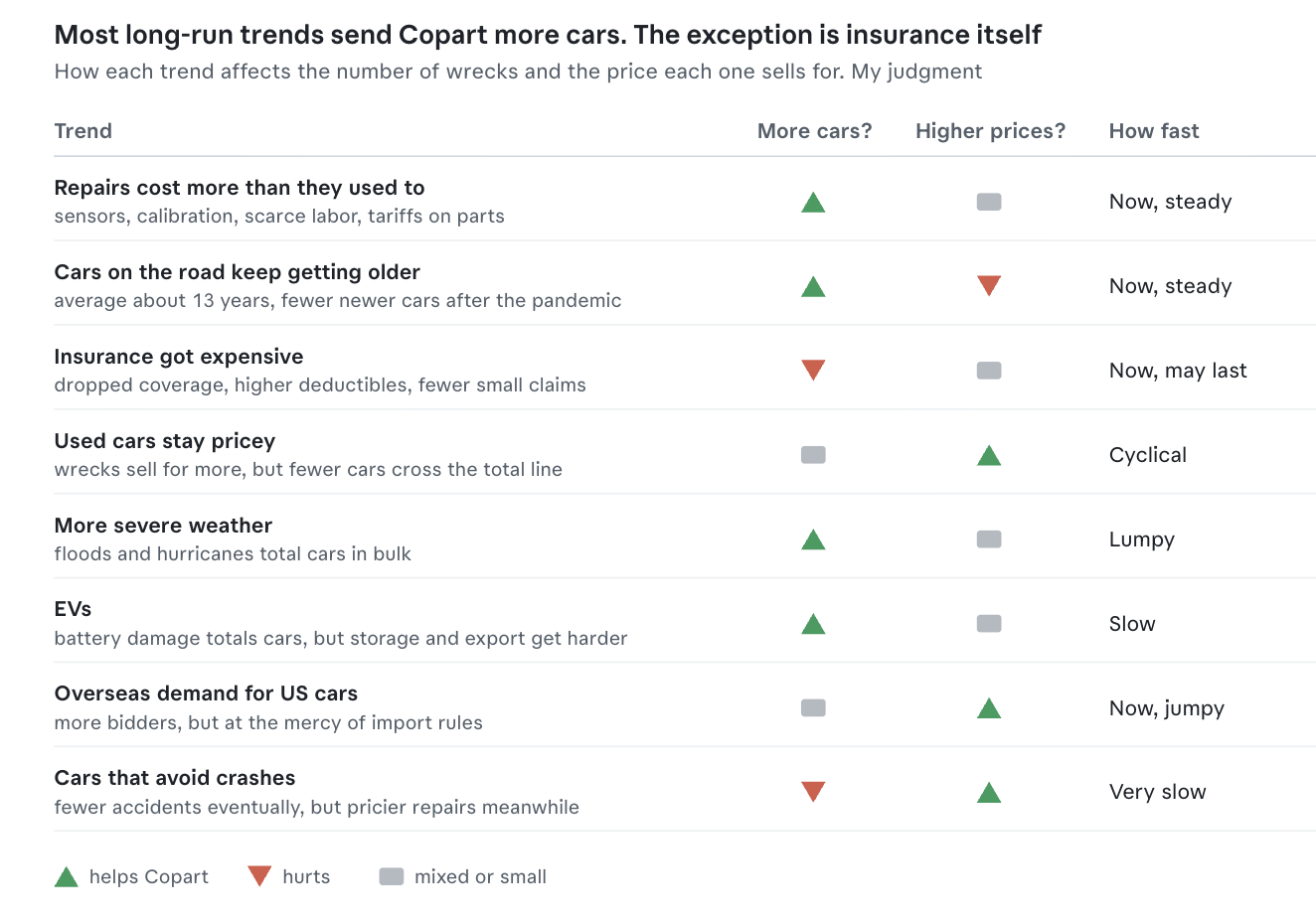
The biggest one is that a crash is now as much an electronics repair as a body repair. CCC says 28.3% of repair estimates now include calibrating cameras or sensors, and tariffs on imported parts add cost on top. Meanwhile the pandemic left a gap of about 12M fewer cars six years old or newer on US roads, so the fleet skews older and cheaper. An expensive repair on a cheap car is how you get a totaled car.
Two trends cut the other way.
- High used car prices make each wreck worth more, which helped Copart's US insurance selling prices rise 8.4% in one quarter this year, but they also keep some cars just under the total line.
- Insurance affordability problem above shrinks the pool of insured wrecks no matter how high the total loss rate climbs. Driver-assist tech will reduce crashes eventually, but the fleet turns over so slowly that it's a next-decade problem, and in the meantime it makes repairs pricier.
Put together, I think the supply of wrecks keeps growing over the long run, in fits and starts. So the real questions for Copart are how many of those wrecks still come through insurers, and how many of those it wins versus IAA.
Copart charges both sides and almost never owns the car
Copart mostly works on consignment. The insurer still owns the car while it sits in Copart's yard. When it sells, the insurer gets the price minus Copart's fees, and the buyer pays the price plus Copart's fees. Copart collects from both and never has to guess what a wreck is worth.
| Where the money comes from (fiscal 2026) | Revenue | What it is |
|---|---|---|
| US services | $3.39B | Fees for towing, storage, title work and selling, charged to sellers and buyers |
| International services | $581M, up 12% | The same thing in the UK, Canada, Germany, Brazil and seven other countries |
| Selling cars it owns | $697M | Cars Copart buys outright and resells. About $419M in the US and $278M internationally |
| Total | $4.67B | About $1,150 per car sold (my estimate, total revenue divided by about 4 million cars) |
Service fees were 85% of revenue. Revenue per car rose about 5.7% last year, which is how revenue held flat while the number of cars fell.
The two sides pay very differently.
- Big insurers negotiate low fees because they bring huge volume and can take it elsewhere.
- Buyers pay a published fee schedule that rises with the price, plus extras for bidding online, leaving the yard and picking up late. On a cheap wreck those fees can add a big chunk to the winning bid.
It's easy to call buyer fees free money. They aren't quite. A rebuilder knows what a car is worth to them all-in, so if Copart adds $200 in fees, they bid about $200 less. Over time some of every fee increase comes out of the insurer's pocket, and getting insurers the best net price is the whole reason they stay. Push buyer fees too far and IAA has its sales pitch.
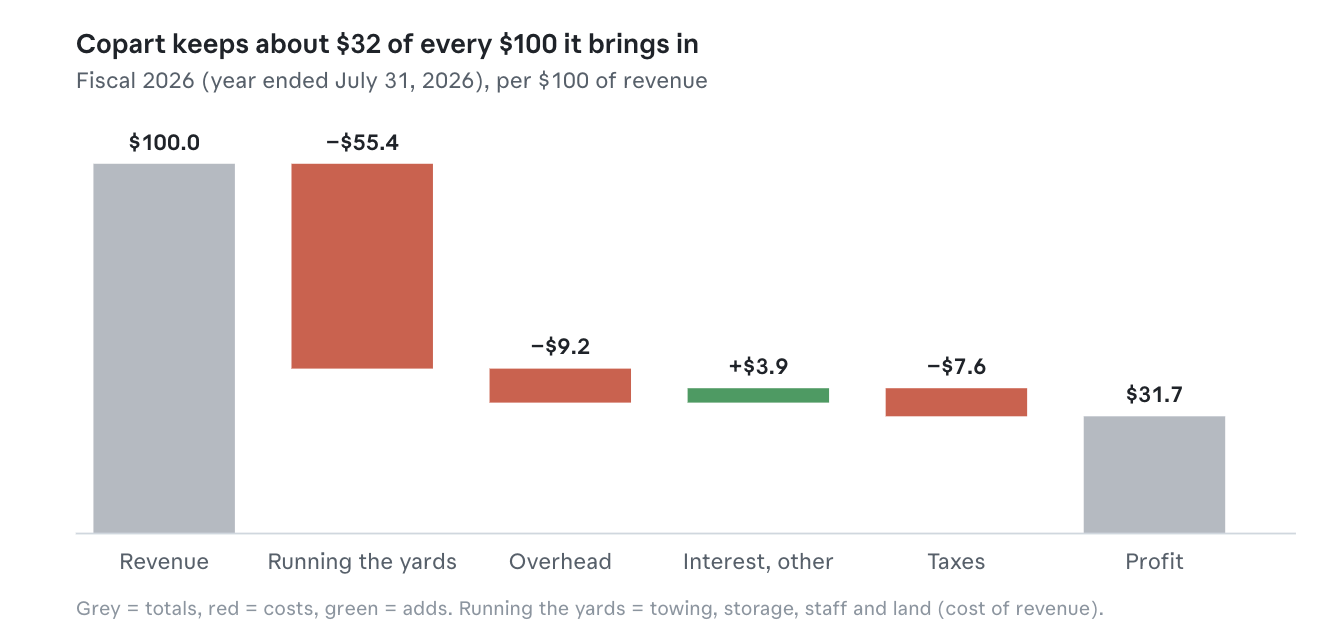
That's a remarkable margin for towing wrecks and parking them in fields. Three things explain it.
- It owns its land. About $2.5B of yards at original cost, much of it bought decades ago near cities where you couldn't get a salvage permit today. No rent hikes, and room for a hurricane's worth of cars.
- Sales are online. One yard serves bidders everywhere, with no auction lanes or auctioneers to pay.
- Volume spreads fixed costs. Towing and handling cost money on every car, but yards, software and title teams don't grow much with each extra sale.
Copart also sits on a big pile of cash with no debt, and spent about $1.6B buying back its own stock last year.
A wreck goes to whoever values it most, and that's often a buyer overseas
A totaled car still has a lot of value in it. It's just worth different amounts to different people, and Copart's job is to find the person who values it most.
| Buyer | What they do with it | What they care about |
|---|---|---|
| Rebuilders | Fix it, get it inspected and sell it with a rebuilt title | Cars with mostly cosmetic damage, cheap enough to leave room for profit |
| Parts recyclers | Pull the engine, doors, airbags and electronics and sell them as used parts | Popular models whose parts are in demand. Big chains like LKQ buy at scale |
| Exporters | Ship it overseas to be repaired or stripped | Cars that are worth more abroad than at home |
| Small dealers and individuals | Buy a project car or cheap transport, often through a broker | A bargain, and sometimes a hard lesson about hidden damage |
| Scrap processors | Crush it for metal | Weight and the price of steel |
The most interesting group is the exporters.
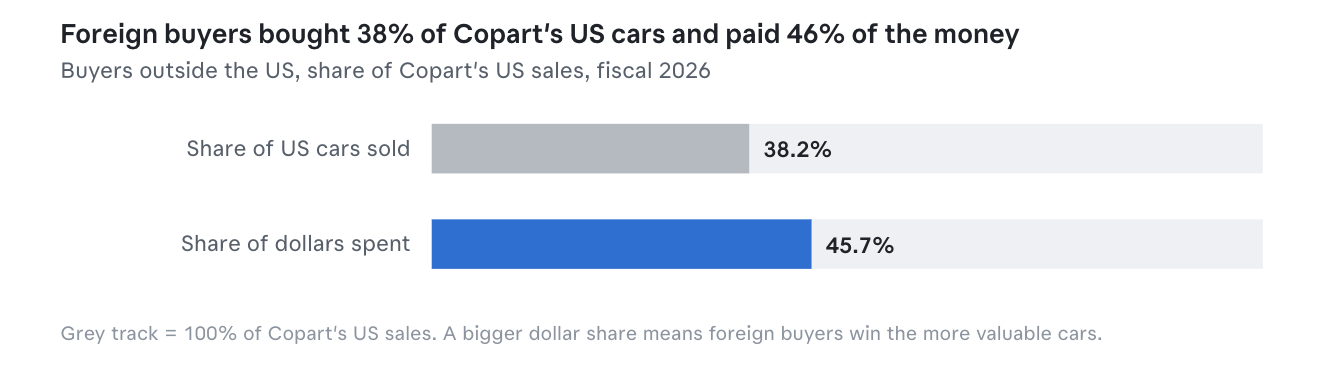
Wrecks are worth more abroad for a few reasons.
Repair labor is far cheaper in Nigeria, Ukraine or Poland than in Texas, some countries make it easier to get a rebuilt car back on the road, and even a damaged US car can undercut a comparable car locally. A Toyota with a crushed front end might fetch $3,000 from a rebuilder in Dallas and $4,500 from a buyer who can fix it for a fraction of the US cost.
That demand swings with other countries' rules. Census data compiled by a shipper shows US used car exports to Georgia, long the biggest hub by sea, fell in 2026 after it changed its import laws. The UAE dropped sharply and Nigeria grew. Saudi Arabia has tightened rules on salvage imports. Each shift changes who bids on Copart's cars.
Every extra bidder in every extra country nudges prices up for insurers, which is why the million buyers matter so much.
There's a darker side. Flood cars can be cleaned up, moved to a state with looser title rules and sold to someone who never learns what happened. Copart lists the title type and photos, but that isn't a full damage history, and what happens after the sale is out of its hands.
Copart is several businesses stacked together, and only some of them are hard to attack
From the outside Copart looks like one auction. Inside, it's a stack of pieces with very different economics.
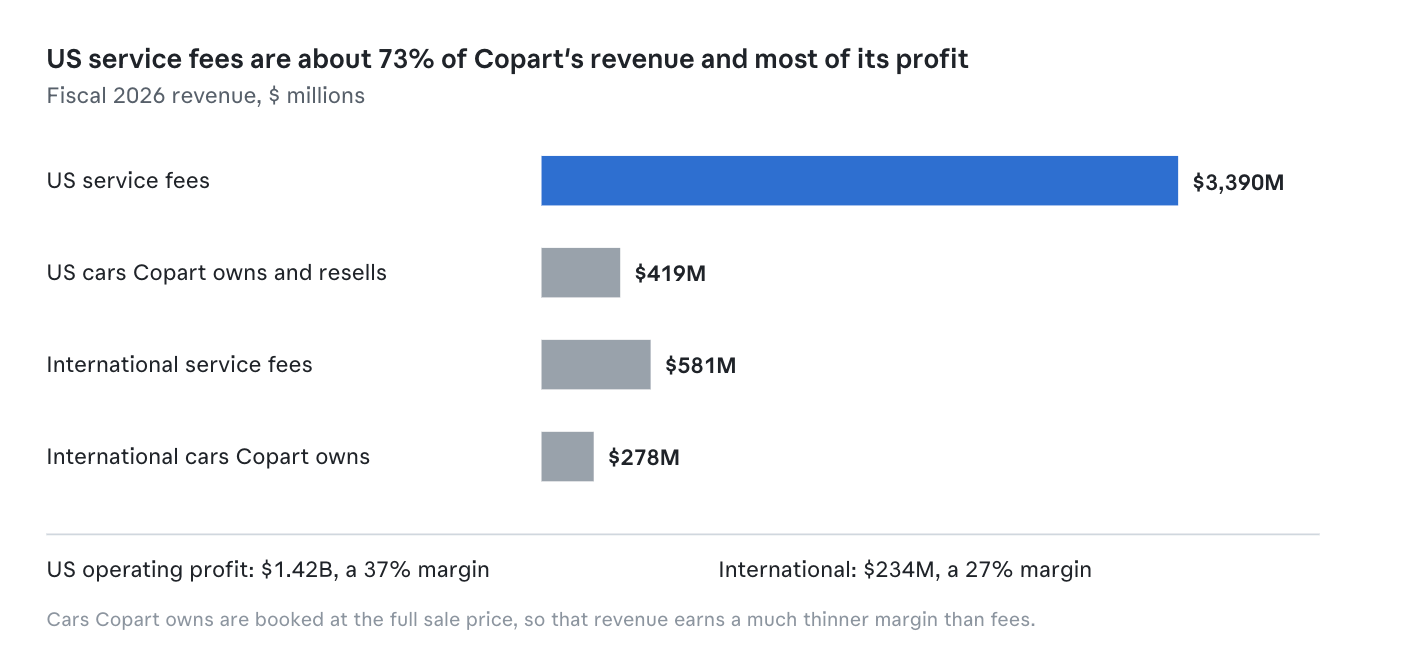
A few things stand out.
- Insurers supply the cars. 79% of the vehicles Copart processed last year came from insurance companies.
- Non-insurance hasn't been the hedge it should be. Dealers, lenders, rental fleets, charities and Copart Direct (which buys from consumers as CashForCars.com) supply the rest. That volume fell 3.9% in the US last year, mostly because Copart Direct shrank.
- International grows faster in dollars than in cars. International service revenue grew 12.4% while cars sold grew only 3.7%, with help from currency. It also earns less, $0.27 of operating profit per dollar versus $0.37 in the US.
- New buyers keep showing up. Buyers who joined in the last two years bought 21.7% of Copart's cars, though some of them simply replace buyers who left.
So which of these pieces could someone actually take?
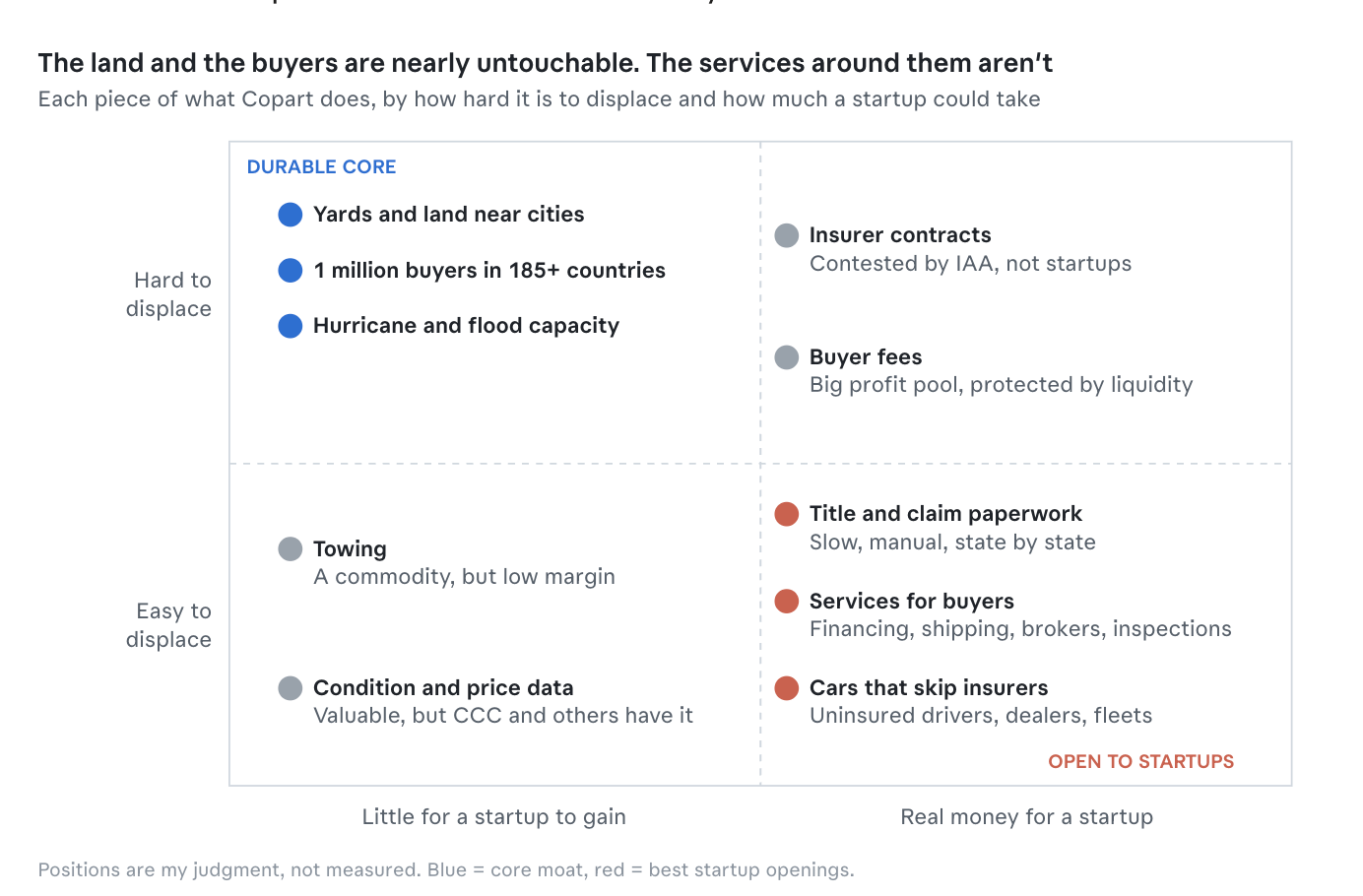
The land and the buyers are nearly untouchable, and they're exactly where a startup couldn't compete anyway. The soft spots are the paperwork and services around each sale, which Copart never had to be great at because the land and buyers carried the business.
Underneath the auction, Copart runs a small financial system
For fintech readers, this is the part I find most interesting. Copart looks like a towing and auction company, but a lot of what it does is move money, manage credit risk and clear liens.
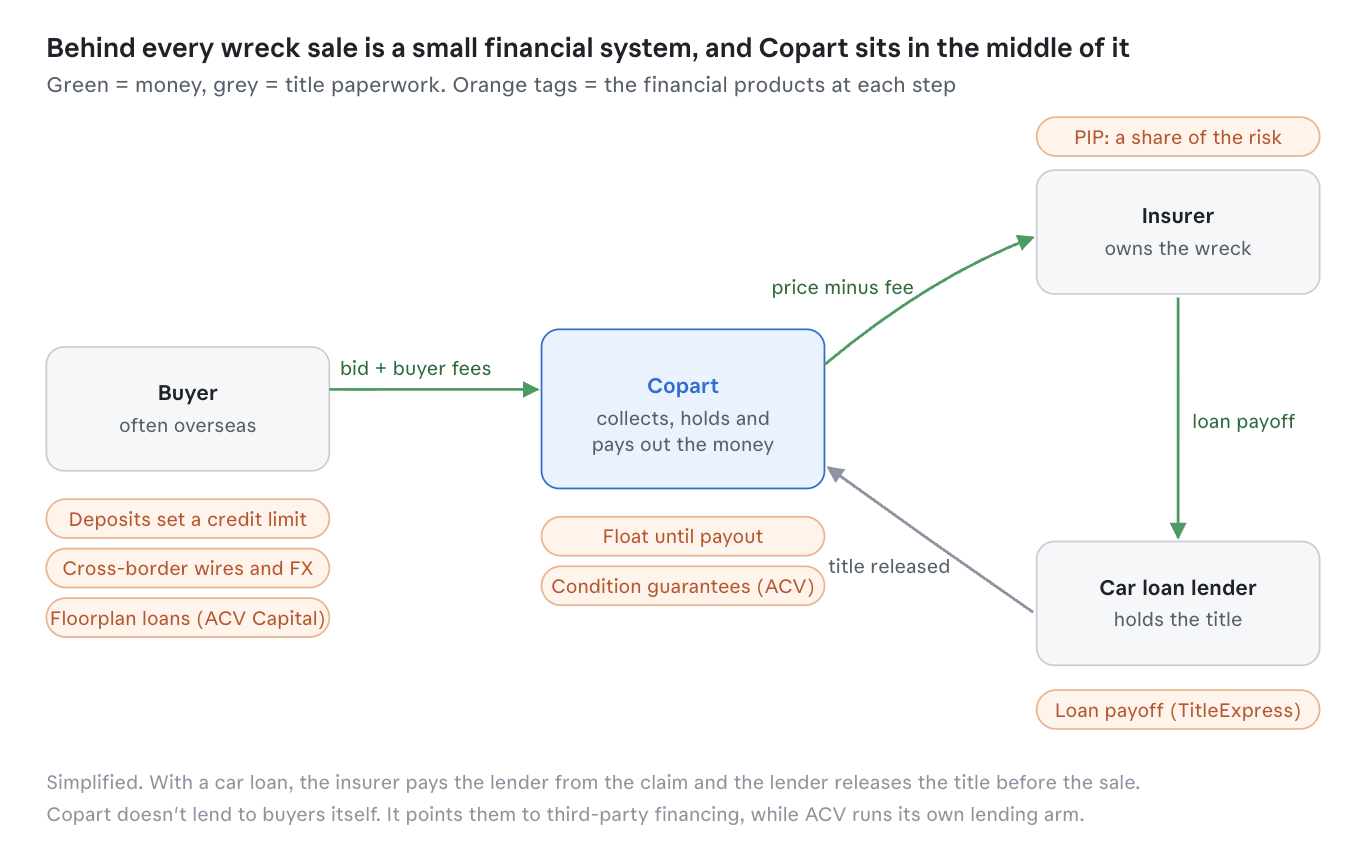
- Buying power works like a secured credit line, without the loan. New members can bid up to $2,000. Beyond that, buyers post a deposit of 10% of their max bid, or pay for Premier ($249 a year plus a refundable $400 deposit) and bid up to $100,000 a day. That's about 250 to 1. Nobody is borrowing money, it's permission to bid, but Copart is still deciding whom to trust and how much. It can be that generous because it never releases a car until it's paid for, and a buyer who doesn't pay loses access to the world's biggest supply of wrecks.
- It's a cross-border payments business. Overseas buyers take 38% of Copart's US cars, mostly paying by international wire, Western Union or MoneyGram. Copart charges $20 a car to pay in person and has buyers email wire notices so it can match money to cars.
- It holds float. Buyers pay Copart before Copart pays sellers. At the end of July, Copart's 10-K showed about $212M owed to sellers and $175M of buyer deposits and prepayments. That's real money in transit, though Copart doesn't say how long it holds it or what it earns on it, and most of its interest income comes from its own cash.
- Loan payoff is becoming a product. Many totaled cars still carry a loan, and the lender has to be paid off and release the title before the car can be sold. Copart's TitleExpress chases payoff amounts and titles, and management credited services like it with helping revenue per car rise 5.4% in the quarter that ended in July. IAA also has its own version.
- Copart doesn't lend, but now it owns a lender. Copart sends buyers to outside financing. ACV Capital makes floorplan loans to dealers, short-term loans repaid when the car sells. It grew revenue about 70% in late 2025, then pulled back after a customer default. ACV also sells condition guarantees, which work more like insurance than an auction fee.
| Product | Who it's for | How it makes money | The risk |
|---|---|---|---|
| Deposits and buying power | Buyers | Annual membership fees, plus losses avoided | A buyer who wins and never pays |
| Cross-border payments | Overseas buyers | Surcharges and fewer bad payments | Fraud, wire errors and sanctions screening |
| Float | Copart | Interest on cash between buyer and insurer | Shrinks if insurers demand faster payment |
| TitleExpress and loan payoff | Insurers | A fee per car, and faster sales | Lenders and states that move slowly |
| Floorplan loans (ACV Capital) | Dealers | Interest and fees | Dealer defaults |
| Condition assurance (ACV) | Dealers buying clean cars | A fee per car, priced like insurance | Paying out on cars that were described wrong |
| PIP | Insurers | A share of each sale, pooled across many cars | Lots of low-value cars that don't cover their costs |
I think Copart under-uses all this.
- It has years of payment history on about a million buyers and now owns a lending team.
- Offering credit to its best overseas buyers, or paying insurers the same day a car sells, would raise what buyers can pay and make Copart harder to leave.
- ACV shows why to start small. Its condition guarantees brought in about $82M in 2025 but cost about $73M to honor, and the bankruptcy of Tricolor, a subprime auto lender, left it with $18.7M of credit losses. Guarantees and credit look like revenue, but they carry a very different kind of risk.
Moving money for buyers in 185+ countries brings bank-style obligations too. Copart has disclosed an open Justice Department investigation into whether its controls for spotting illicit activity by buyers broke money laundering laws, and no violation has been established. The lesson for anyone building here is that a marketplace moving cross-border money gets judged like a bank on knowing its customers, which is one more reason to partner on credit rather than lend.
Copart became the default for insurers by taking their risk, then going online before anyone else
Willis Johnson grew up around junkyards. After serving in Vietnam he bought his own dismantling yard on interest-only payments and made it work by doing things others skipped, like selling engines in pieces and stocking the Chrysler parts nobody else carried.
In 1982, at 34, he and a friend put $50,000 each toward a $1M business in Vallejo, California, that towed totaled cars for an insurer and auctioned them to dismantlers. That became Copart.
His big idea was about pricing. Salvage yards charged insurers flat fees for towing, storage and selling. A burned-out car might sell for $25 and cost $200 to process, so insurers lost money on their worst wrecks, and yards had no reason to chase a higher price. Johnson offered to pay those costs himself and take a cut of each sale instead, about 10% on most cars and 20% on badly damaged ones. He called it the Percentage Incentive Program, or PIP. The catch was that the insurer had to send him every car in the region.
Why PIP was such a clever business model
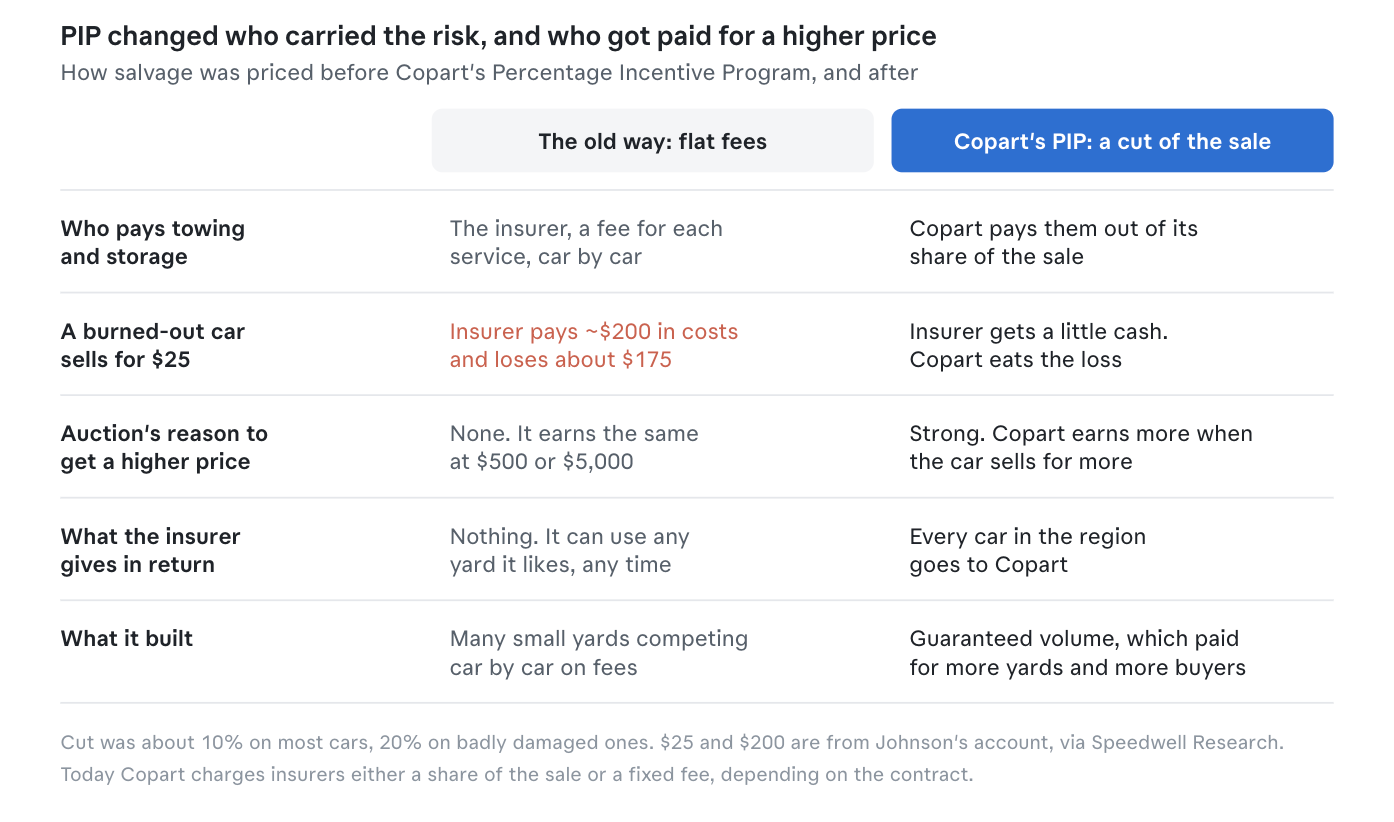
PIP did four things at once.
- It moved risk to the party that could pool it. One insurer loses money on a burned-out car. Copart, handling thousands of cars from many insurers, could lose on the junk and make it back on the rest. That's insurance logic, which is probably why insurers got it.
- It made Copart care about the sale price. Under flat fees a yard earned the same at $500 or $5,000. Under PIP a better price paid Copart too, so it cleaned cars up, photographed them and found more buyers.
- It turned a better deal into a lock-in. Every car in the region meant predictable volume, which paid for land and buyers before competitors could match the offer.
- It set up the flywheel. Anything that brought more bidders, like going online, paid off for Copart and insurers at once. Buyer fees rise with price too, so Copart gets paid on both sides.
It isn't perfect alignment. On an extra $1,000, Copart earns about $100 and the insurer keeps $900, so Copart won't spend $300 of effort chasing it. Real estate commissions have the same flaw. But it's still far better than a flat fee.
You see this elsewhere since then. Rolls-Royce charges airlines for engine upkeep by the flight hour. Contingency-fee lawyers get paid only when the client wins. In each case the seller takes a risk the customer hates, gets paid when the customer does well and asks for a long relationship in return.
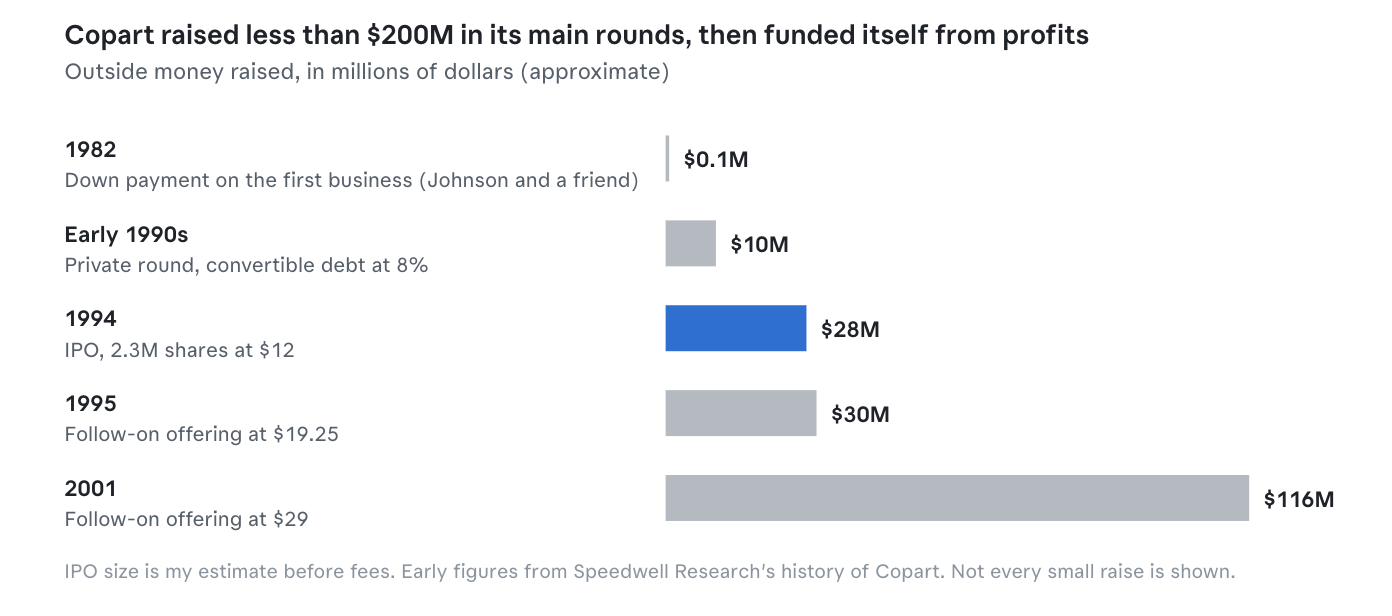
A private round of about $10M in convertible debt funded early yard purchases. The 1994 IPO, 2.3M shares at $12, paid for a national footprint, which mattered because national insurers wanted one partner everywhere. Two follow-on offerings, including $116M raised after 9/11, bought more yards. After that, the business funded itself.
| Year | What happened | Why it mattered |
|---|---|---|
| 1982 | Johnson buys the Vallejo business | The start of Copart |
| 1982 to 1993 | Grows to 11 locations in California, Texas and the Pacific Northwest | Proved the model could travel |
| 1994 | IPO on Nasdaq at $12 a share | Paid for buying yards across the country |
| 1996 | Copart.com launches | Early, for a salvage company |
| 1998 | First to accept online proxy bids | Buyers no longer had to show up |
| 2002 | 100 locations | National coverage, which national insurers need |
| 2003 | Goes fully online and opens in Canada | Every car, every buyer, anywhere |
| 2007 | Buys Universal Salvage in the UK | Start of the international business |
| 2010 | Jay Adair, Johnson's son-in-law, becomes CEO and later moves headquarters from California to Dallas | Second-generation family leadership |
| 2012 | Enters Germany, Brazil and the UAE | The international push widens |
| 2026 | Adair returns as CEO. Copart buys ACV | A reset after its first down year in five |
PIP was the first big bet.
The second was going all-in online. Copart first posted its weekly lists online to save paper, and Jay Adair, Johnson's son-in-law, saw that online bids could replace the paid proxy bidders buyers used. A hybrid that relayed online bids to live auctioneers worked badly, so in 2003 Copart shut down live auctions entirely. IAA kept them for years. Because most cars were on percentage deals, the higher prices from remote bidders helped Copart and insurers alike.
The third bet was cheap land. IAA bought big, expensive lots inside cities. Copart bought smaller yards at the edges of metro areas for a fraction of the price, which kept tows short. Those yards are now very hard to replace.
Since its 1994 IPO, Copart's stock has risen about 200-fold, roughly 18% a year by my math, even after this year's drop. Johnson is still on the board. Adair joined at 19, ran the company from 2010 to 2024 (sharing the job with Jeff Liaw for part of that), became executive chairman and is now CEO again.
Lessons for anyone trying to become the default for big companies
- Solve the customer's worst problem, not just the task. Insurers didn't need another tow yard. They needed to stop losing money on junk cars.
- Treat pricing as product. Copart's biggest innovation was how it charged, not what it built.
- Trade a better deal for all the volume. The risk only worked because Copart got every car in a region.
- Be everywhere the customer is. National insurers want one national partner, so the IPO money went to coverage first.
- Commit fully to the better technology. The half-online version failed. The fully online one won.
It's the same pattern I wrote about with Garage. Make life easier for the scarce, powerful side of the market, then become part of how it works every day.
Copart's acquisitions show where it thinks its buyers and yards can go next
Copart grew mostly by opening and buying yards. Its bigger deals are rarer, and each one tells you what the company believes its two real assets, the buyer network and the land, can be reused for.
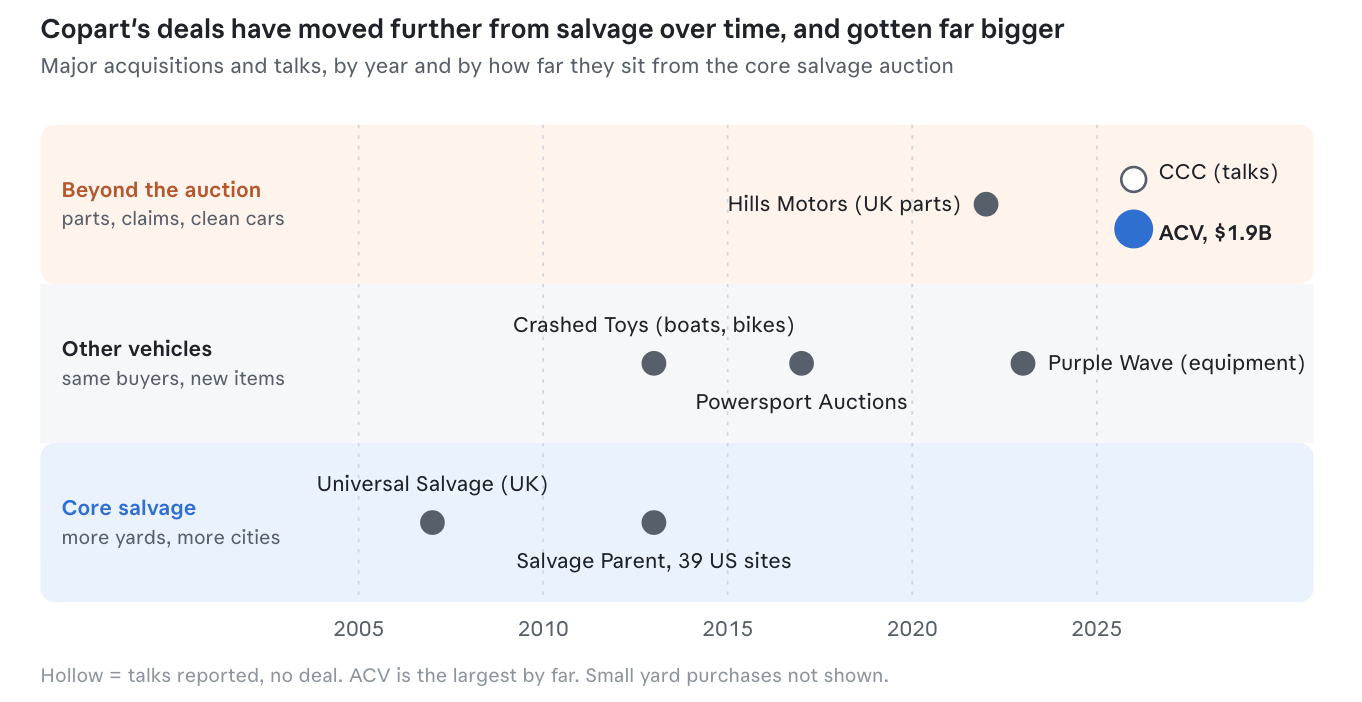
The deals fall into three phases.
- Buy coverage (1990s to 2013). Local salvage pools for land and insurer relationships, then the UK's Universal Salvage in 2007 (seven yards, about $120M) and Salvage Parent in 2013 (39 US locations, including Crashed Toys).
- Point the same buyers at other vehicles (2013 to 2023). Crashed Toys for wrecked boats and motorcycles, National Powersport Auctions in 2017, and 80% of Purple Wave in 2023, an online heavy equipment auction that sells from the seller's own lot, much like Garage.
- Move beyond the auction (2022 to now). Hills Motors, a UK parts recycler, so Copart can strip some wrecks itself. Reported talks to buy CCC, whose software helps insurers decide whether a car is totaled, before CCC agreed to a $6.1B private equity deal. And ACV, closed October 16, a much bigger version of the dealer sales Copart already ran at about 25 yards.
My read is that Copart wants to touch a vehicle every time it changes hands. CCC would have given it the very start of that chain. ACV gives it the cars that never crash.
For founders, notice what got bought. Each was a niche marketplace Copart could have built but didn't, usually because the niche needed its own kind of trust. A focused startup that wins one category and builds real buyer liquidity is exactly what Copart, RB Global and ACV have shown they'll pay for.
Salvage is a duopoly, and the second company is finally fighting back
You can't understand Copart without understanding IAA, short for Insurance Auto Auctions. The two have dominated North American salvage for decades. Back in 2019, IAA estimated that the two of them together handled over 80% of the market, with the rest split among small local auctions. Both started in 1982. Every big insurer in the US works with one or both.
| Copart | IAA | |
|---|---|---|
| Owner | Independent, founder's family still involved | RB Global, the heavy equipment auction company formerly called Ritchie Bros., since 2023 |
| How it got here | Grew on its own, public since 1994 | Spent years inside KAR, a used car auction company, before a 2019 spin-off. RB Global bought it for about $6.6B |
| Footprint | 286 facilities in 11 countries | 210+ facilities in the US, Canada and the UK |
| Rough size | 4M+ cars a year worldwide | Not broken out. RB Global sold about 652,000 vehicle lots last quarter, salvage and other |
| Recent momentum | Cars sold down 2.9% in its latest quarter | Parent's car volume up 8.4% in its latest quarter |
| What it's selling to insurers | The most buyers, the most land, the best record in storms | Faster claims, lower fees for big accounts and an owner eager to grow |
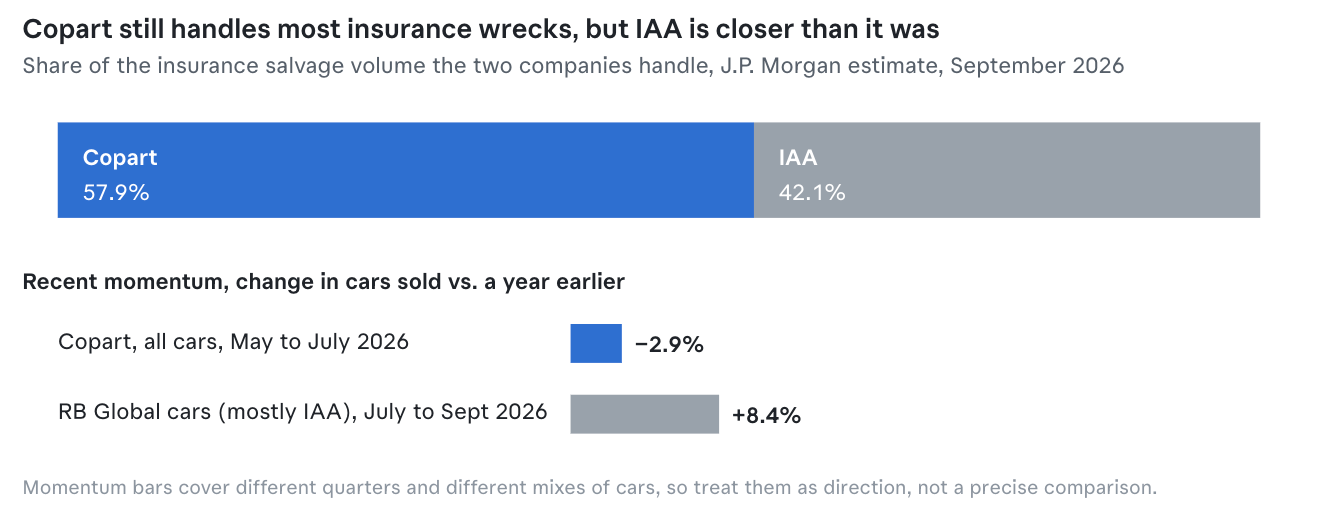
For most of the last decade IAA was clearly second. It kept live auctions longer, owned less land and struggled in big storms. A former GEICO executive told the research firm In Practise that insurers, his included, had to bail IAA out after Hurricane Harvey because it ran out of room.
Then Ritchie Bros. bought it in 2023 and renamed itself RB Global. Ritchie Bros. is a Canadian company founded in 1958, best known for auctioning used bulldozers and farm equipment. Its bet was that selling an excavator and selling a wrecked Camry take the same skill, and that steady insurance volume would smooth out a business tied to construction cycles.
A two-company market can be very profitable when both players are strong and neither has much reason to give up margin. That changes when one starts gaining share. IAA now runs a better operation, and RB Global has made growth a priority, so it can accept lower fees on some accounts if the extra volume brings in more total profit. That puts Copart in a bind. Match IAA's pricing and risk resetting fees across every customer, or hold the line and maybe lose more cars.
How IAA went from second place to a real threat
IAA really was a distant number two that got its act together. What it fixed says a lot about where Copart's edge actually is.
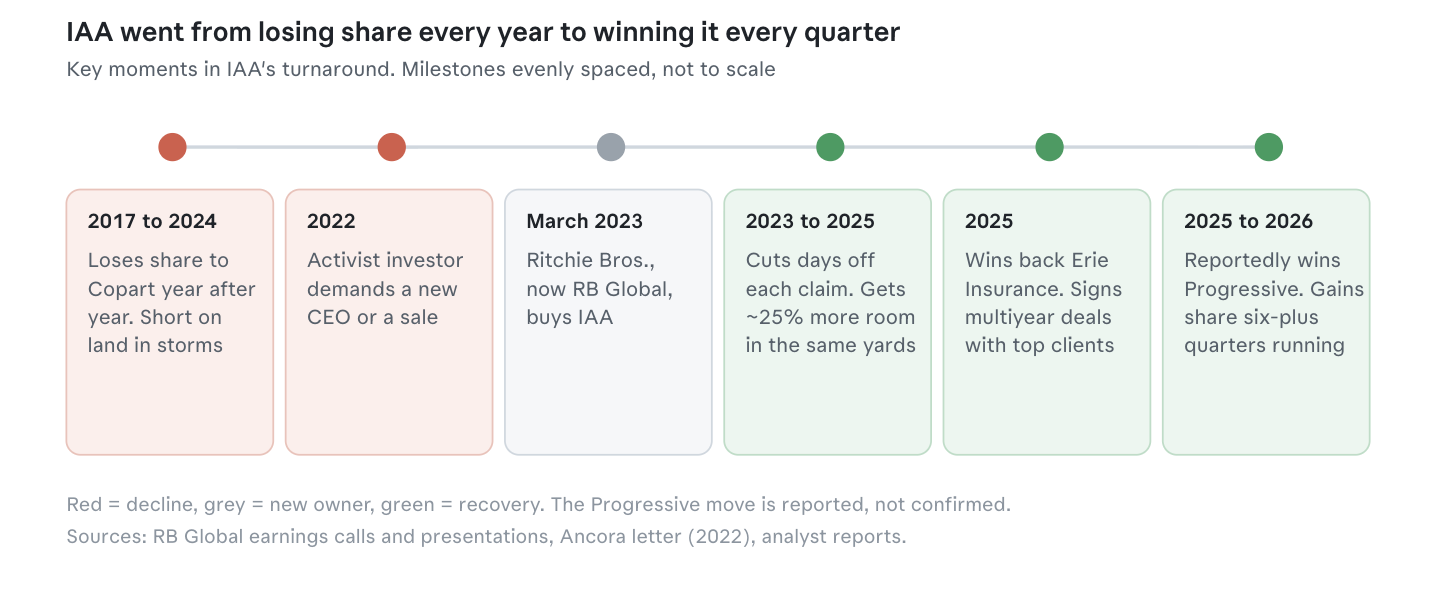
IAA was in rough shape before the sale. One analysis of RB Global estimates IAA lost US share to Copart every year from 2017 through 2024, and in 2022 the activist investor Ancora pushed for a new CEO or a sale.
Under RB Global it didn't try to out-Copart Copart. It went after speed, the thing insurers measure most.
- Faster cars mean cheaper claims. One report says IAA cut almost seven days from its cycle in a year, and RBC estimates cycle times are about 20% shorter than before the deal. Every day saved is a day of storage and rental car the insurer doesn't pay for. Progressive reportedly figures it saves about $140 a car.
- Speed is also land. Faster turnover gave IAA about 25% more capacity in the same yards. Copart's land advantage is really an advantage in car-days per acre, and IAA found a quarter more without buying a lot.
- Fewer dropped balls. Over 99% of cars picked up on time by RB Global's count, up from about 89% before the deal, its own loan payoff service, virtual inspections and electronic titles in about 30 states.
- Moving upstream. A Total Loss Predictor, rolling out in 2026, tells an insurer right after a crash whether a car is likely totaled.
The wins followed. IAA took back Erie Insurance, about the twelfth-largest US auto insurer, signed multiyear deals with its two largest partners and added a federal contract for about 35,000 government vehicles a year. Collision Repair Magazine reported that Progressive moved nearly all of its wrecks to IAA after Copart declined a lower-priced contract. Neither company has confirmed it, but it fits Copart's own description of one big lost customer.
Without that customer, it said, the number of cars US insurers assigned to it would have grown 2.3% in the quarter that ended in July. The number of US insurance cars it actually sold fell 7.5%. Those are different measures, so you can't net one against the other, but the message is clear. The lost customer looks like a major driver of Copart's US weakness, more than a collapsing market, though these figures can't say exactly how much. That's reassuring and worrying at once, because losing an insurer also means fewer cars for buyers, which can soften prices on everything else.
IAA is also openly cheaper. RB Global's CEO has said he'll prioritize service revenue dollars over percentage take rates, which in practice means volume discounts for big insurers. In the quarter that ended in September, its seller fees grew about 9% while the value of everything it sold grew about 20%. That covers all of RB Global, equipment included, so business mix plays a part, but the direction fits what management has said.
If the Progressive report is right, Copart didn't lose that business because it couldn't do the job. It chose not to match the price. That's defensible, since it protects margins and avoids teaching every insurer that Copart folds under pressure. It's also a bet that IAA can't keep winning on price and speed, and it's the biggest question for Copart's next five years. The same fight is happening in the UK, where IAA's SYNETIQ holds about 30% of salvage to Copart's roughly 60% and recently won Allianz in Germany and Direct Line in Britain.
Here's my scorecard on what insurers care about.
| What insurers care about | Edge | Why |
|---|---|---|
| Highest price for each wreck | Copart | More buyers and more foreign demand, though IAA's prices are rising too |
| Speed from crash to payment | Roughly even now | IAA's cycle times now roughly match Copart's, by one report |
| Room for storm surges | Copart | More owned land, though IAA's faster turnover narrows the gap |
| Lowest fees | IAA | Openly trading fee rate for volume |
| Tools that save claims work | Even, IAA pushing hard | Both offer loan payoff and title tools. IAA is moving earlier into the claim |
| Track record and trust | Copart | Decades of reliability, especially in hurricanes |
Copart still wins on the things that are hardest to copy. IAA now wins or ties on the things insurers measure every month.
There's a paradox in Copart's margins. They prove how hard the business is to replicate, but they're also what makes IAA's challenge possible. An insurer doesn't care whether Copart earns 30% or 20% margins. It cares about the net recovery on each car and how fast the claim closes. If IAA can deliver something close for less, some of Copart's extraordinary economics become something insurers can negotiate away. That, more than any threat to the moat, is why investors now pay less for Copart's earnings.
I don't think Copart should answer with a fee war. Its edge is the bigger buyer base and the better storm record, so the smarter response is getting insurers more money per car and faster closed claims. That's where my plan below starts.
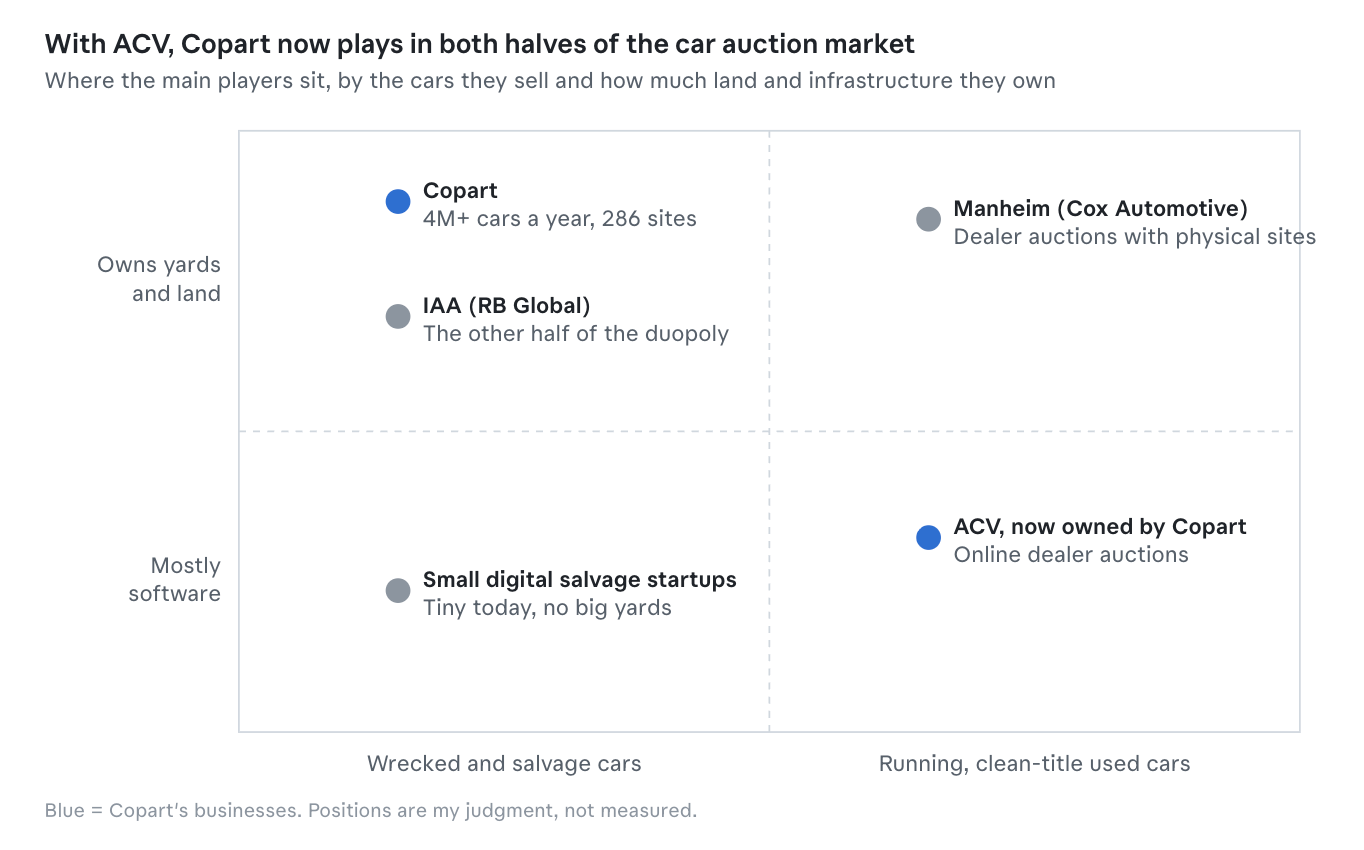
Startups are nibbling at the edges. Salvato, launched in Texas in 2025, pitches faster claims and lower buyer fees and is expanding into the Midwest. Beyond salvage, dealers trade running cars through Manheim (owned by Cox Automotive) and online platforms like ACV. That's a bigger market, but one where inspections and trust matter more than towing and storage.
Copart's moat is land, buyers and habit. It protects profits better than it protects market share.
Three things make Copart hard to copy, and they feed each other.
- Land nobody wants next door. Try getting a permit for a 50-acre salvage yard outside Houston. Neighbors object, zoning boards stall and environmental rules pile on. When a hurricane totals tens of thousands of cars in a week, the company with spare acres near the coast gets them, and insurers remember.
- A million buyers. More bidders mean higher prices, which bring more cars, which bring more bidders. A rival with better software but fewer buyers gets insurers less money on day one. Many professional buyers bid on both Copart and IAA, though, so the edge isn't owning buyers nobody else can reach. It's having enough cars and enough bidding competition on each one to get insurers consistently better net prices.
- Habit and plumbing. Copart's systems plug into insurers' claims software, adjusters know the process, and moving thousands of cars a month to a new partner is risky.
All three stop newcomers. None of them stops IAA, which has land, buyers and insurer contracts too, and faster turnover can stand in for some of Copart's land. Copart's own 10-K notes that some insurer agreements are non-exclusive and can be changed on short notice. So Copart is nearly impossible to attack from scratch but quite possible to lose business to. The moat protects its profits but doesn't guarantee growth.
The stock fell because of one lost insurer and fewer insurance claims.
The stock fell about 30% in 2025 and kept falling this year, closing as low as $26.27 on October 14 before bouncing. It's still down roughly 20% for the year, and profit fell for the first time in five years. Here's how I'd rank the worries.
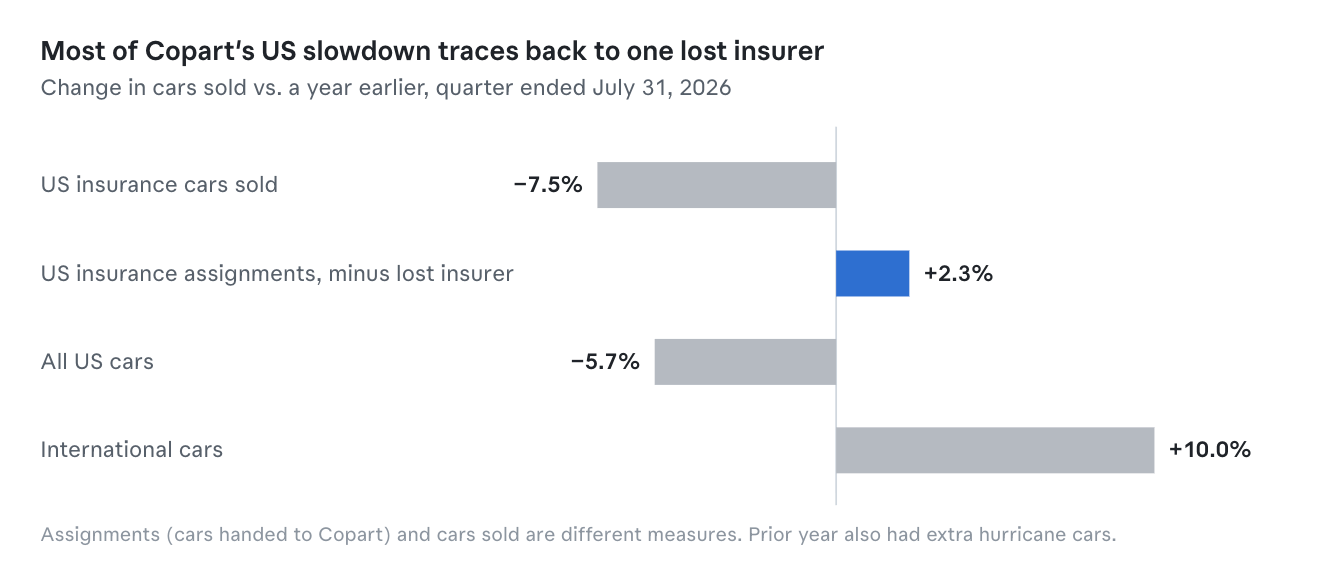
- Losing insurers to IAA (the big one). If Copart really did refuse to match a lower price, it's in a classic duopoly bind. Hold price and keep losing share, or match and watch margins fall everywhere. One more large insurer leaving would change the story from one bad contract to a lost edge.
- Fewer insured drivers and claims (maybe lasting). Some drivers will come back as premiums ease, but higher deductibles and skipped small claims may stick.
- Costs (fixable). Operating cost per car rose 12.7% in the quarter that ended in July, partly because fixed costs were spread over fewer cars. Adair's return probably means cuts.
- Safer cars (overrated for now). Crash-avoidance tech should mean fewer accidents, but it also makes each repair pricier, which pushes more crashes into total losses. With the average car almost 13 years old, the fleet changes slowly, so even self-driving cars would arrive gradually.
- EVs (mixed). A damaged battery can total an otherwise fixable car, which helps volume. Wrecked EVs can also catch fire, need special storage and are harder to export, which raises costs.
- A new appetite for deals. For decades Copart mostly bought land and its own stock. This year it reportedly explored buying CCC and did buy ACV, which had about $760M of revenue in 2025 and lost $66M. Copart says ACV won't add to earnings per share until fiscal 2028.
The best startup openings help insurers and buyers, the two sides Copart charges
A $30B company most people have never heard of usually leaves smaller problems around it that nobody seems to be solving well.
| Idea | The problem | Who pays | What makes it defensible | The risk |
|---|---|---|---|---|
| 1. Software that lets insurers shop each wreck | Insurers send most of a region's wrecks to one auction, even when the other would pay more for a given car | Insurers, from a share of the extra recovery | Price data across both auctions that neither auction will build | Copart and IAA refuse to integrate, or contracts block car-by-car routing |
| 2. A neutral network for loan payoffs and title release | A totaled car with a loan can sit for weeks while the insurer, lender and DMV trade paperwork | Insurers and lenders, per claim | Connections to thousands of lenders and every state, usable by both auctions | TitleExpress and IAA's version turn out good enough |
| 3. A trusted grade for rebuilt cars | Rebuilt titles sell at a steep discount because buyers can't tell good repairs from bad | Rebuilders per car, later lenders and retail buyers | Becoming the grade lenders and buyers ask for | Carfax-style players add it |
| 4. Trade finance and logistics for overseas buyers | A buyer in Lagos needs a broker, shipping, customs help and cash up front for every car | Buyers, through fees and a financing spread | Volume in one shipping corridor, which lowers costs for everyone in it | Fraud, sanctions and credit losses, or Copart bundles it |
| 5. Battery grading for wrecked EVs | A wrecked EV's value is mostly its battery, which bidders can't see | Auctions, recyclers or insurers | Data linking battery tests to later sale prices | Automakers lock battery data away |
If I had to pick one, it's the first, but I wouldn't start with routing. Routing needs auction-by-auction results and contractual permission that a new company won't have. I'd start by taking an insurer's own sales data and comparing Copart and IAA on net recovery, fees and days to close, car type by car type, beginning with mid-sized insurers that already split their volume. That's useful on day one, needs nobody's permission and builds the data and trust that routing needs later. It's the Garage lesson again, help the scarce side everyone competes for, and it's the startup Copart would like least. I'd sell it the way Johnson sold PIP, with no fee up front, just a share of the extra money each insurer recovers.
For fintech founders, the payoff network is the sleeper. It's unglamorous plumbing between insurers, lenders and DMVs, the kind of thing that becomes very hard to dislodge once enough parties are connected.
If I ran Copart, I'd change how it gets paid, not just what it sells
Startups attack from the outside. The harder question is what Copart should do itself. Its problem isn't the moat. It's that growth now depends on things it doesn't control, like how many people carry collision insurance and whether IAA keeps undercutting it.
Johnson's best move was a new way of getting paid, not a new feature, and I think the next leg of growth comes from the same kind of thinking. IAA competes on lower fees and faster claims. Copart should compete on what the insurer actually keeps, the net recovery on each car and the total cost of the claim, where its bigger buyer base gives it the edge. Here's what I'd try, roughly in order of impact.
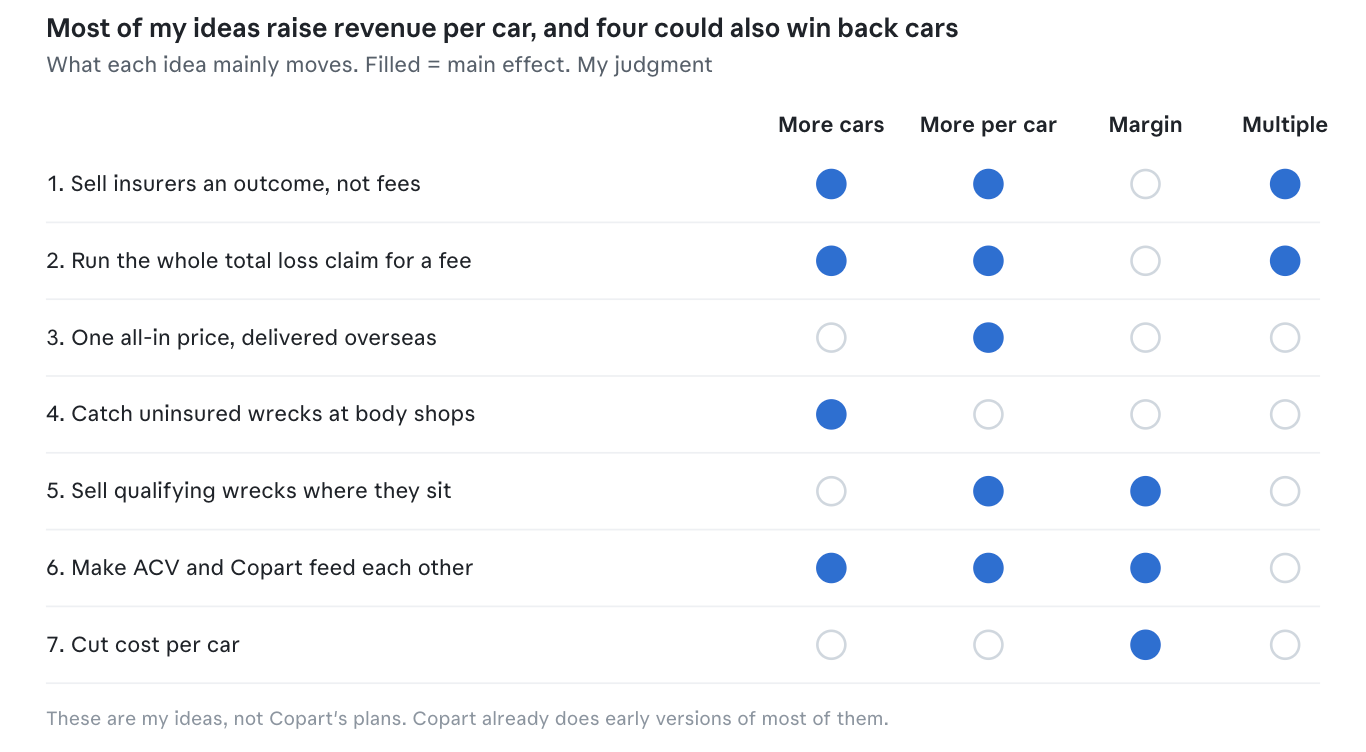
- PIP 2.0, a contract priced on what the insurer keeps. Guaranteed prices on single cars aren't new. IAA's BidFast gives policyholders a guaranteed 30-day offer on their wreck, and Copart buys wrecks outright at formula prices in the UK. The bigger version covers a whole book of an insurer's total losses. Copart promises a minimum net recovery across the portfolio, a cap on the fees it controls and service standards like days to pickup, and shares the upside when it beats them. The insurer buys an outcome instead of a menu of fees, and Copart gets a way to compete with IAA that isn't just a lower price. It won't speed up the claim itself, since insurers pay the policyholder based on the car's pre-crash value without waiting for the sale, but it takes the guesswork out of what they'll get back. The obvious objection is Opendoor, which lost a fortune guaranteeing home prices, but wrecks are cheap, sell in weeks and come by the thousand. The real dangers are insurers sending only their worst cars and used car prices falling mid-contract, so I'd pilot it with one carrier, require a representative mix of cars (Johnson's every-car-in-the-region rule again), cap the downside and reset the floor when the market moves.
- Run the whole total loss for a fee per claim. What drags out a total loss is everything around the car, the tow and storage bills at the body shop, release paperwork, the loan payoff and the title. Copart already has much of this in TitleExpress, its loan payoff tools and a lender payments partnership with One Inc. I'd package it with a promise, a cap on pre-auction fees and a deadline for getting the car released, priced per claim and sold first to small regional insurers with thin claims teams. Paired with the first idea, it covers both things insurers want, more money back and less hassle.
- One all-in price, delivered overseas. A buyer in Lagos has to stack the bid, Copart's fees, trucking, ocean freight, customs and a broker, and that uncertainty lowers bids. A single delivered price should raise bids, earn Copart a logistics margin and, unlike a fee hike, leave insurers with more money.
- Catch uninsured wrecks at body shops and tow yards. Copart Direct's volume fell 26% in one quarter this year. Finding individual sellers through ads is expensive, but uninsured wrecks all pass through the same places. A Copart offer printed right on a body shop's estimate, with a referral fee for the shop, is a much cheaper channel.
- Decide car by car which wrecks skip the yard. Many totaled cars still run, because they're totaled on repair cost rather than wrecked beyond use. Copart already sells some cars from where they sit. I'd make that the default for cars that qualify, inspected and photographed at the body shop, possibly with ACV's inspection tools, and sold without a tow or weeks in a yard. The test is net proceeds after every cost, not the winning bid, since raising a price $100 while adding $200 of handling leaves everyone worse off. Badly wrecked EVs are a cousin of this idea, with the battery sold separately, but that's work for specialist partners.
- Make ACV and Copart feed each other. Dealers' damaged trade-ins can flow to Copart's buyers, and Copart's overseas buyers want ACV's clean cars too. Copart's yards can double as ACV inspection and pickup points. Copart plans to run ACV as a separate subsidiary at first, which is fine. But if in two years there's no measurable cross-platform volume, better margins or better dealer economics, the $1.9B will be hard to justify. A longer shot is helping the policyholder. J.D. Power found a quarter of total-loss claimants with car loans got paid less than they still owed. Helping them into a replacement car through ACV's dealers could give insurers a way to keep customers after the worst claim they'll ever have.
- Cut cost per car. Bring the 12.7% cost increase back down through fewer unnecessary tows, faster yard turnover, automated inspections and fewer cars that need re-auctioning. At more than 4M cars a year, $25 less per car is about $100M a year before tax.
There's a tension in all of this. As Copart moves earlier into the claim, with AI tools that help insurers decide faster whether to total a car, it's helping make a call it gets paid on. That doesn't mean its tools are biased. But insurers will trust them more if Copart is paid on the overall result of the claim, which is one more reason to move toward contracts like PIP 2.0, even if a few cars that would have been totaled get repaired instead.
The first two add risk and complexity to a business that has made money by staying simple. But Copart's history says its best growth came from changing the deal, not adding to the menu.
Copart isn't an obvious bargain at 20 times earnings, but it could be one if growth comes back
At about $28.5B and $1.48B of earnings last year, Copart trades at roughly 20 times earnings. For much of the past decade investors paid well over 30. 20 times isn't expensive for a company with this balance sheet and market position, but it isn't obviously cheap either.
The stock's next five years come down to two numbers.
- how fast earnings per share grow
- what investors will pay for those earnings at the end.
The chart shows the assumptions behind the 6% and 13% figures in the short version.
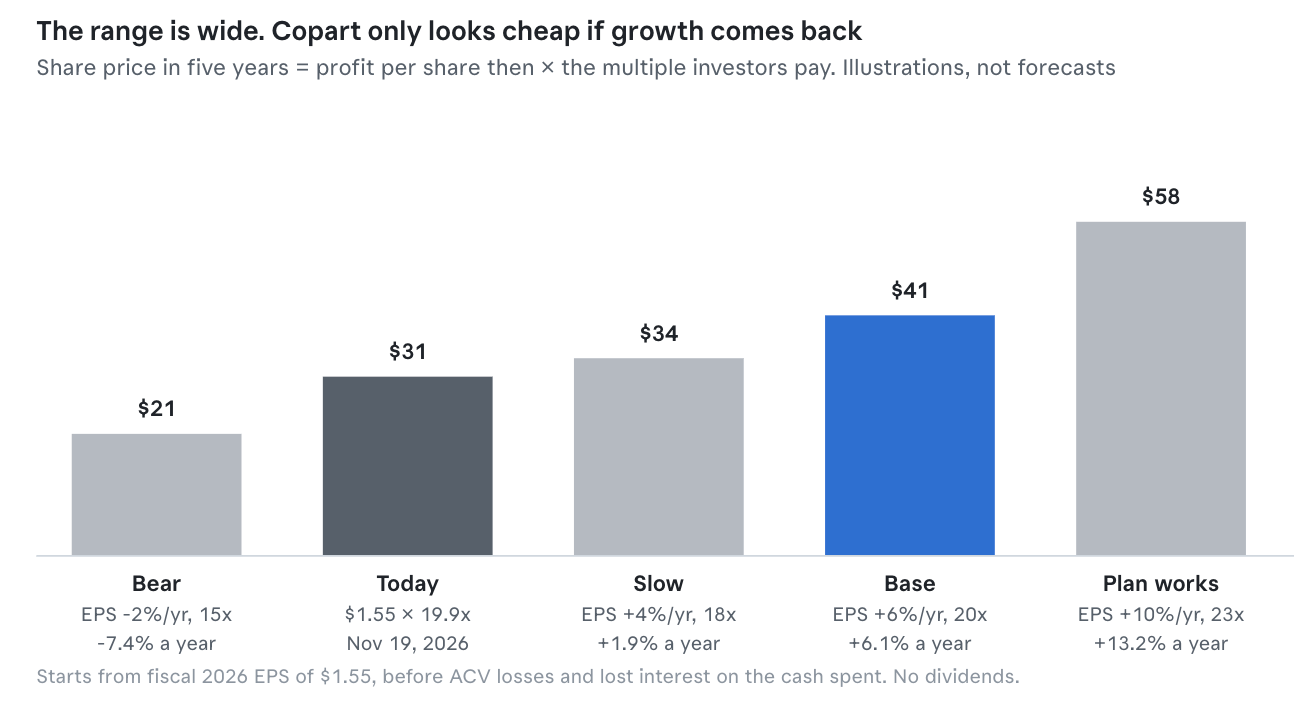
The important thing it shows is that 13% needs two things at once, faster growth and investors willing to pay more again. Better operations alone don't get you there.
I'm more confident that Copart stays a great business than that its stock will outperform. What would change my mind is evidence that it can grow US insurer volume again, raise the net recovery per car and turn ACV into a genuinely more profitable marketplace.
What I'd be watching
- US insurance volume. If it grows again in 2027, the lost insurer was a one-off. Don't expect storms to help, since 2026 was forecast to be a quiet hurricane season.
- IAA's volume and fees. If RB Global's growth slows or its fees stop falling faster than its sales, the price fight is cooling. If another top-15 insurer moves, it isn't.
- Total loss frequency. CCC publishes it. Above 23% keeps the long-run supply story intact.
- Cost per car. The December 1 report will show whether the 12.7% increase is turning.
- ACV. Whether dealers keep using it, and whether Copart's overseas buyers start bidding on ACV cars.
- The next deal. A third big acquisition after CCC and ACV would tell us Copart is becoming a different company.
My answer is that Copart should defend salvage by changing how it gets paid, starting with contracts priced on what insurers keep and running the whole claim, before putting much more into used cars. Salvage is where its moat is strongest, and ACV only pays off if the core is healthy enough to feed it.
I can see the other side, though. If insured wrecks are shrinking for good, the bigger prize is every used car, wrecked or not. Which would you prioritize?
Sources
- Copart fiscal 2026 Form 10-K
- Copart Q4 fiscal 2026 results press release
- Copart Q4 fiscal 2026 earnings call transcript (Benzinga)
- Copart announces CEO transition
- Copart to acquire ACV (CBT News)
- Copart among suitors for CCC (Claims Journal)
- GTCR and Elliott to acquire CCC for $6.1B (Coverager)
- CCC Crash Course 2026 report
- CCC mid-year 2026 update (Insurance Journal)
- RB Global Q3 2026 results
- Copart vs IAA, former GEICO executive interview (In Practise)
- Copart history
- Salvato expands into the Midwest (Coverager)
- Copart stock data (Motley Fool)