What's left for humans once AI writes the code
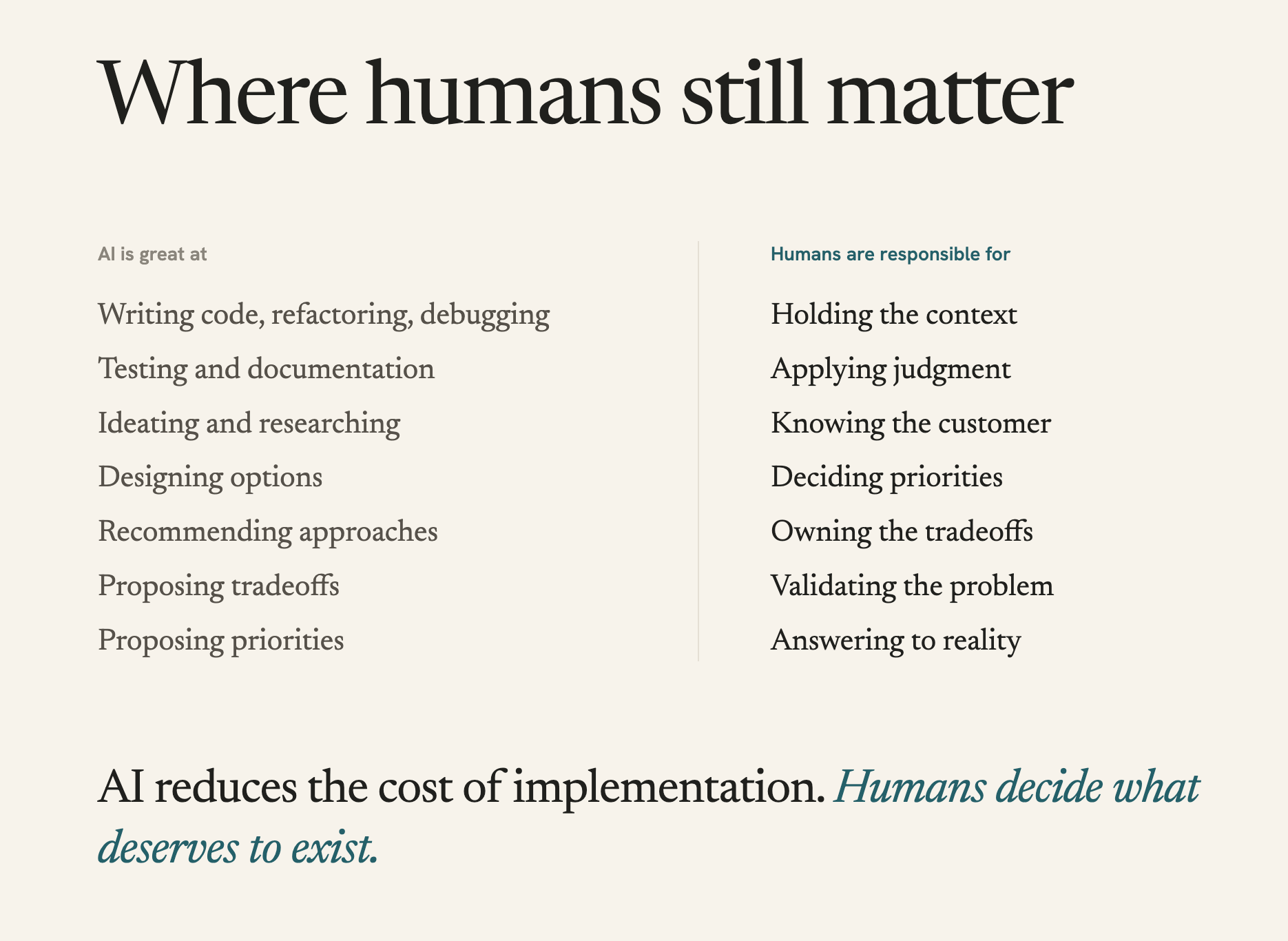
AI writes production code. It debugs. It refactors. It explains codebases it's never seen. It writes tests. It solves implementation problems, fast.
But AI can be confidently wrong.
Humans validating and steering products aren't overhead. They're the part of the system that catches what AI can't see about itself.
The tools make the work fast, consistent, and on-brand; the humans make it right.
Human work hasn't disappeared. It's just gotten more concentrated.
Humans preserve context
The biggest misconception is that Claude remembers your project. It doesn't. Every session starts fresh. No memory of why a decision got made last week, no sense of the tradeoffs, no recollection of the conversation where you argued about it.
The continuity comes from the system, not the model. Every session starts by reading project notes, architectural decisions, and active plans. Every session ends by updating them.
The notebook isn't documentation anymore. It's working memory. Skip it and every session slowly drifts. Keep it up and projects move fast, even though the model forgets everything the second you close the tab.
Humans decide what deserves to exist
This has been the biggest lesson so far.
AI is remarkably good at solving the problem you give it. It will never tell you the problem isn't worth solving. That's still on you.
Humans decide what is true
I've learned not to confuse documentation with reality. At one point, Claude made a call based on docs describing how the system worked. The docs were outdated. The system had changed. Everything Claude suggested was internally consistent. It just wasn't true anymore.
Now, whenever something actually matters, we check it against the real thing instead of trusting notes written weeks ago.
Humans recognize when something is beautifully wrong
The hardest AI mistakes aren't syntax errors. They're plausible ideas: elegant architecture, clean implementations, confident explanations, all of it wrong.
I've gotten a lot more skeptical of work that looks polished. Not because AI is unreliable, but because confidence has never been evidence. Verification is. That means running the tests, building the thing, clicking through the workflow yourself.
Humans stay close to customers
The farther a decision gets from a real customer, the more comfortable AI gets making it. The closer it gets to actual customer behavior, the more a human needs to be in the loop.
Customers don't care if the architecture is elegant. They care if it solves their problem. Watching someone struggle with a workflow tells you more than a hundred prompts ever could, and that's what actually changes the roadmap.
AI executes. Customers influence what's next.
The work is shifting
Which parts of building software get more valuable as AI gets better? From where I sit:
- preserving context
- apply judgment
- understanding customers
- deciding priorities
- owning the tradeoffs
- validating the problem(s)
- answering to reality